Introduction
Ground vibrations from blasting, pile driving, and heavy excavation travel silently through the earth — often reaching neighboring foundations, utility lines, and occupied buildings before anyone on the job site notices. By the time a neighbor files a complaint or a regulator shows up, the project team may have no documentation to defend their position.
This is the core problem that wireless and remote vibration monitoring solves. Instead of relying on periodic manual readings or site visits, modern systems capture real-time ground motion data and transmit it instantly to the cloud — creating a continuous, timestamped compliance record without requiring anyone physically on-site around the clock.
A 2020 peer-reviewed survey of 218 residents near active construction found that 73.8% worried about property damage from vibration — even when actual damage thresholds weren't exceeded. That perception gap is exactly where undocumented projects lose disputes they should win.
This guide covers how wireless vibration monitoring systems work, why they matter for construction and infrastructure projects, what to look for when selecting a system, and how to decide between renting and buying.
Key Takeaways:
- PPV is the regulatory standard for compliance under OSMRE, FTA, and most local permit frameworks
- Cellular-based systems transmit field data to the cloud, with local memory backup when connectivity drops
- Threshold alerts notify project teams the moment PPV or sound levels approach compliance limits
- Rental makes economic sense for project-based work; purchase favors high-utilization, recurring deployments
- A single unit can capture vibration and sound simultaneously, covering two compliance obligations at once
What Is Wireless Remote Vibration Monitoring?
The Core Concept
Wireless remote vibration monitoring — in the construction and infrastructure context — is the deployment of electronic seismographs and vibration sensors at or around a job site to measure ground motion, structural response, and sound levels, with data transmitted wirelessly to a cloud platform for real-time access.
The primary metric is Peak Particle Velocity (PPV), reported in inches per second. PPV measures the maximum instantaneous speed of ground-particle movement during a vibration event. Regulators, engineers, and insurers use it because it correlates most directly with structural response — seismographs are built to record it, and every major compliance standard references it.
Relevant regulatory frameworks include:
| Authority | Application |
|---|---|
| OSMRE (30 CFR 816.67) | Surface coal blast limits by distance to protected structures |
| FTA Report 0123 (2018) | Construction damage screening and transit vibration criteria |
| ISEE (2020 Guidelines) | Field practice and instrument quality standards |
How This Differs From Manual Monitoring
Traditional wired or manual monitoring required technicians to visit the site, retrieve data, and review records — often hours or days after an event. That gap creates exactly the kind of documentation void that complicates regulatory audits and neighbor disputes.
Remote systems close that gap entirely — every event is recorded, timestamped, and uploaded automatically, with no technician visit required.
Not Machine Vibration Monitoring
One important distinction: construction PPV monitoring is not the same as industrial predictive maintenance. The two disciplines differ across every dimension that matters:
- ISO 20816-3 evaluates vibration in rotating machinery above 15 kW — machine-condition analysis for maintenance decisions
- Construction PPV monitoring measures ground and structural response to external vibration sources for compliance and legal protection
- Instruments and standards are entirely separate; a seismograph is not a machine health sensor
Sound Monitoring on the Same Unit
Seismograph-based systems can capture both ground vibration (PPV) and air-overpressure or decibel levels from a single deployed unit. For projects subject to both vibration limits and noise ordinances — which includes most urban construction and blasting operations — this means a single monitoring station covers both compliance obligations simultaneously.
How Wireless Remote Vibration Monitoring Systems Work
The Sensor Layer
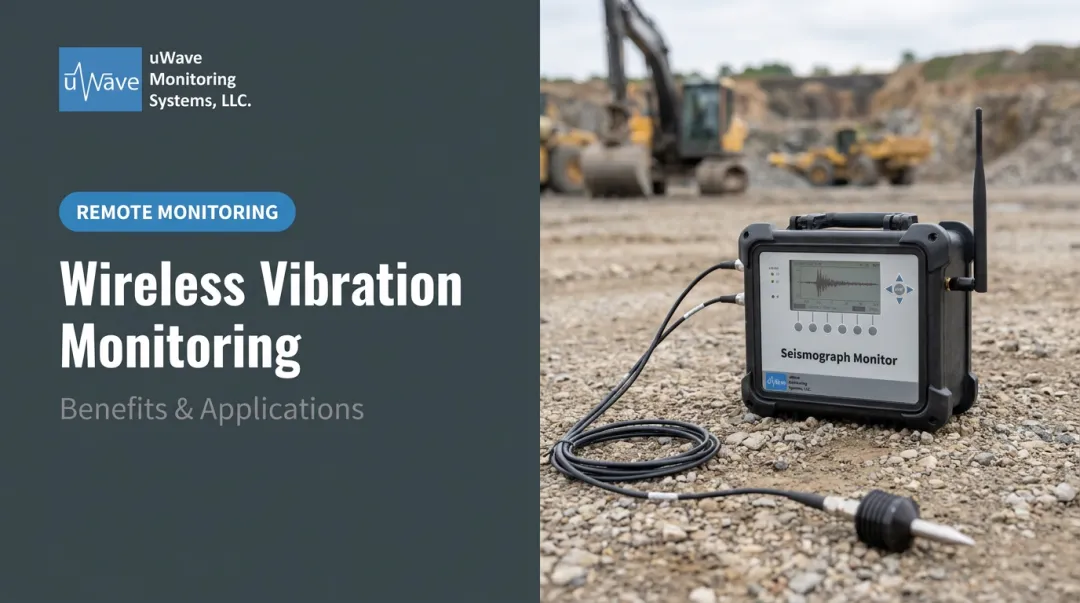
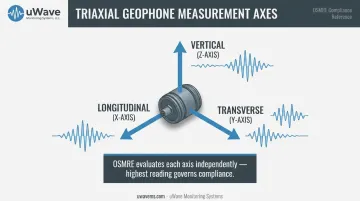
Field-deployed seismographs (Instantel's Micromate, Micromate Plus, Minimate Pro, or Blastmate III) form the measurement foundation. Each unit includes a triaxial geophone that captures vibration velocity simultaneously on three perpendicular axes: longitudinal, transverse, and vertical.
This matters because OSMRE applies its PPV limits to each axis independently, not to an average. The largest reading on any single axis governs compliance. A seismograph that only captures one direction can miss the governing event entirely.
ISEE's 2020 Field Practice Guidelines recommend a minimum of 1,000 samples per second, annual calibration, and a starting ground trigger of 0.05 in/sec. Meeting these requirements is the baseline for producing compliance records that hold up under regulatory review.
The Communications Layer
Data leaves the seismograph through a cellular modem. For construction, mining, and infrastructure sites — which rarely have reliable Wi-Fi — cellular transmission is the practical default. uWave Monitoring Systems uses Sierra Wireless AirLink gateways (RV50, RV50X, and RV55) supporting LTE-A Pro connectivity across Verizon, AT&T/FirstNet, US Cellular, and Sprint networks.
When connectivity drops, the seismograph continues logging locally. Standard internal memory holds up to 1,000 events (15 MB), with an upgrade option for 4,000+ events (60 MB). The Auto Call Home feature triggers an automatic upload when the connection is restored — so no event records are lost during outages.
The Cloud Platform Layer
Transmitted data lands in the uWave Project Manager — a cloud-hosted web portal that organizes vibration event records, waveforms, and sound data by project and monitoring unit. The platform provides:
- 24/7 remote access from any browser or mobile device
- Secure data backup for long-term project documentation
- Map view of all active monitoring locations
- Dashboard with alert summaries and equipment status
Automated Alerts
Project teams configure site-specific PPV and sound thresholds in the system. When a monitored event exceeds a set limit, the platform immediately sends email and text alerts to designated contacts. Three alert categories are supported:
- Vibration alerts — triggered when ground vibration exceeds configured PPV thresholds
- Sound alerts — triggered when air-overpressure or decibel levels breach noise limits
- Maintenance alerts — triggered for equipment issues such as connectivity problems or battery status
Field Enclosures for Harsh Environments
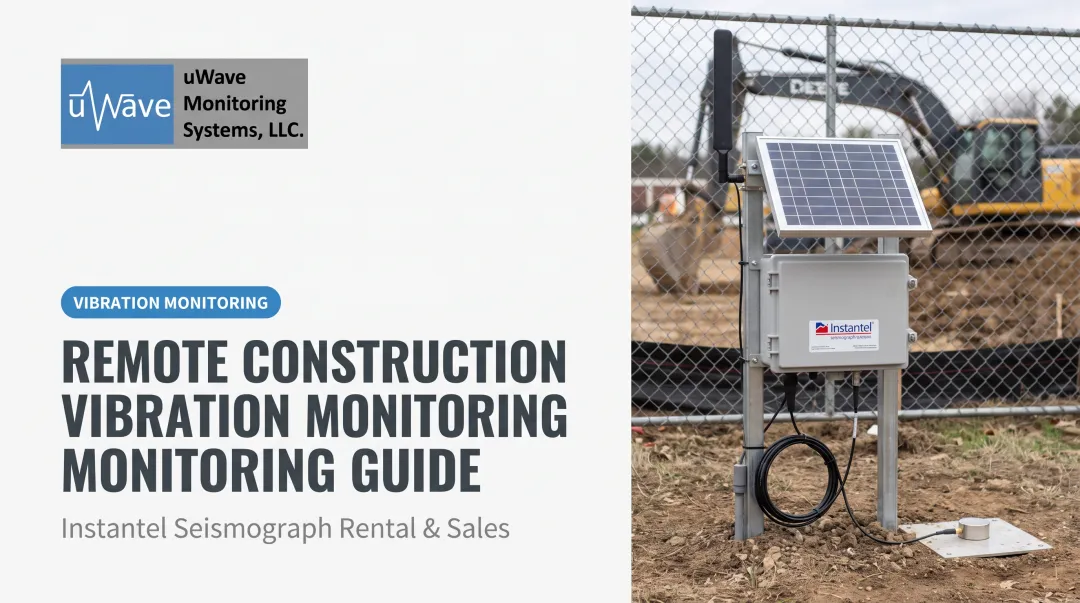
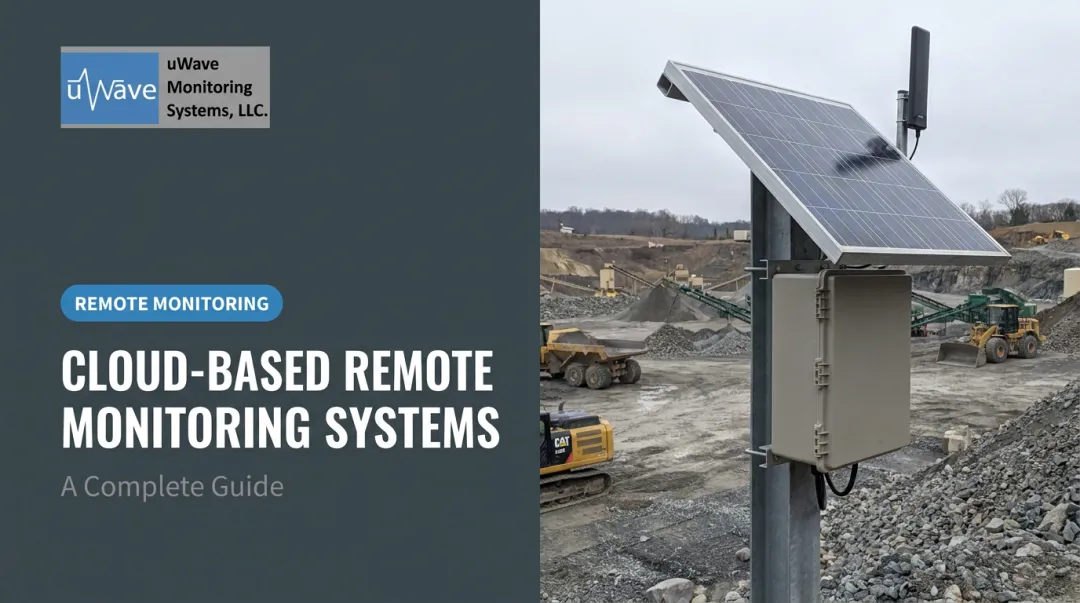
A seismograph in a carry case isn't enough for long-duration, unattended deployment on active construction or mining sites. uWave offers two semi-permanent monitoring station enclosures for long-duration unattended deployment:
- V5 Medium Duty Station — 22" × 24" × 24", 60 lbs, lockable gray enclosure with solar module, 12V battery support, cellular/GNSS antenna, and programmable timer
- V3 Heavy Duty Station — More robust build with 30W solar module, dual battery capacity, Sierra Wireless modem included, four anchor points, and an internal circuit breaker
Both stations support solar, battery, and AC power configurations — making them viable for remote sites without grid power access.
Why Construction and Infrastructure Projects Need Remote Vibration Monitoring
Regulatory Compliance and Legal Documentation
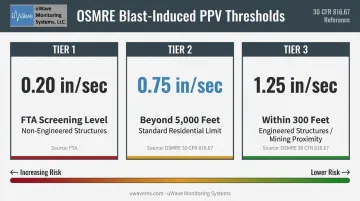
Federal OSMRE limits under 30 CFR 816.67 set the following blast-induced PPV thresholds:
- 1.25 in/sec — within 300 feet of protected structures
- 0.75 in/sec — beyond 5,000 feet
- 0.20 in/sec — FTA screening value for non-engineered timber and masonry, a threshold pile driving or demolition work can approach in dense urban settings
Remote systems create an automatic, timestamped, and tamper-evident record of every vibration event. When a regulator requests documentation or a neighbor files a damage claim, that record determines the outcome. A dashboard screenshot is not a defensible record; calibrated waveforms with axis peaks, timestamps, and instrument metadata are.
Protecting Neighboring Structures
Uncontrolled construction vibration can crack foundation walls, disturb plaster, and stress utility infrastructure — sometimes before anyone on the job site notices. Remote monitoring gives engineers early warning when cumulative or peak PPV approaches damage-risk thresholds, allowing blast charge weights, equipment routes, or construction methods to be adjusted before structural damage occurs.
Managing Community Relations
Construction vibration complaints are among the most common sources of project disputes and work stoppages. The 2020 survey cited earlier found 40% of nearby residents felt annoyed by vibration — independent of whether any structural damage occurred.
Proactive remote monitoring shifts the dynamic. When a project team can share timestamped vibration data showing compliance, unfounded claims become much harder to sustain. That same documentation also gives project managers a basis to adjust operations early, before a complaint reaches a regulator or attorney.
Urban and Long-Duration Projects
Dense urban environments and transit corridor projects face the tightest vibration limits and the highest concentration of vibration-sensitive neighbors. Manual oversight cannot match the demands of continuous construction across multiple active work fronts.
Linear infrastructure projects add another layer of complexity. Water main replacement programs, pipeline upgrades, and similar work often run for months or years across extended corridors. Milwaukee Water Works, for example, replaces approximately 14 miles of water main annually, a continuous program that makes semi-permanent remote monitoring setups far more practical than repeated manual deployments.
Key Features to Look for in a Remote Vibration Monitoring System
Choosing the wrong monitoring system can leave you with data that won't hold up under regulatory scrutiny — or no data at all when a dispute arises. Three areas separate capable systems from compliant ones:
Measurement Accuracy and Standards Compliance
The seismograph must meet ISEE and, where applicable, DIN 45669-1 standards for your project type. Key requirements:
- Triaxial measurement — three-axis geophone capture is required under most state and federal blast monitoring regulations
- Minimum 1,000 samples/second — the ISEE baseline for defensible blast records
- Full waveform recording, not just peak values — peak-only data rarely survives post-event forensic review or dispute resolution
- Annual manufacturer calibration — uWave sells and rents only units with recent manufacturer-approved calibration on file
Connectivity Reliability and Data Redundancy
For remote or rural sites, cellular transmission with on-device memory backup is the standard. The system must:
- Continue logging locally when cellular signal drops
- Upload stored records automatically when connectivity is restored
- Retain full waveform data, not just summary statistics, during outages
Configurable Alerting and Reporting
The system should allow project-specific PPV and sound threshold configuration — not fixed defaults applied across every job. Platforms that generate formatted compliance reports directly from collected data save hours of manual reformatting per reporting cycle.
uWave's Project Manager supports customized reports with ISEE and DIN 45669-1 compliance profiles pre-loaded in the THOR software platform used alongside the hardware.
Industries and Applications That Benefit Most
Heavy Construction and Urban Development
Pile driving, deep excavation, demolition, and compaction in populated areas generate significant ground motion that permit authorities increasingly require to be monitored. Urban projects adjacent to occupied buildings, historic structures, or sensitive utilities often carry monitoring as an explicit permit condition.
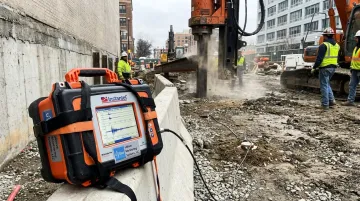
The Minimate Pro4 is particularly well-suited here, with sample rates up to 65,536 samples per second and compatibility with accelerometers, hydrophones, and high-frequency geophones for complex multi-parameter monitoring environments.
Mining and Quarrying
Blast monitoring is the most established seismograph application. Under OSMRE's distance-based framework, mining and quarrying operations must document that blast-induced PPV at protected structures stays within regulatory limits. Remote systems let operations teams review measured data after each blast and adjust charge weights or timing before the next event.
The Blastmate III — purpose-built for blast monitoring with a rugged lockable casing — is the go-to unit for these deployments.
Transit, Water Infrastructure, and Land Development
Transit construction (tunnels, rail corridors, road upgrades) and water main replacement projects share a common characteristic: extended project timelines across geographically dispersed work fronts. Covering multiple active work fronts without constant equipment mobilization is a core challenge in both sectors.
Semi-permanent remote monitoring stations address this directly. Common configurations include:
- uWave V3 or V5 enclosures with integrated solar panels and cellular modems
- Micromate Plus or Minimate Pro units for continuous, unattended data capture
- Cloud-based alerts via the uWave Project Manager platform for real-time compliance tracking
Land development and housing projects face the same pressure — grading, compaction, and foundation work near existing residential structures all require documented compliance, often across months-long build schedules.
Renting vs. Buying a Remote Vibration Monitoring System
Why Project-Based Work Favors Rental
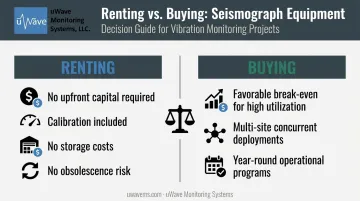
Most construction, mining, and infrastructure projects have defined start and end dates. When the project ends, the monitoring requirement ends too. Renting eliminates:
- Upfront capital cost for equipment
- Annual calibration expenses between projects
- Storage and maintenance costs during idle periods
- Technology obsolescence risk as seismograph models evolve
uWave offers complete remote monitoring system rentals built around Instantel seismographs — including the seismograph, enclosure, solar power system, cellular modem, and uWave Project Manager cloud access — with discounts available for bulk monitoring packages.
When Purchasing Makes Sense
Organizations with continuous or high-frequency monitoring needs can reach a favorable break-even point through ownership. Strong candidates for purchase include:
- Quarry and mining operators running blast programs year-round
- Infrastructure owners with ongoing maintenance monitoring programs
- Environmental firms running multi-site concurrent deployments
uWave offers new Instantel equipment as an authorized dealer and factory-certified used equipment with a one-year warranty and recent manufacturer calibration — with extended discounts available for multiple-unit purchases.
How to Calculate Your Total Cost Per Site-Day
Ownership and rental costs look very different once you move beyond the instrument invoice. For an accurate comparison, account for all site-day expenses:
- Calibration fees ($300–$500/year per unit)
- Cellular data plan costs
- Storage and transport between deployments
- Risk of deploying outdated or uncalibrated equipment
For intermittent project use, rental consistently delivers a lower total cost once these factors are included.
Frequently Asked Questions
What types of construction activities require vibration monitoring?
Common trigger activities include blasting, pile driving, heavy compaction, demolition, and deep excavation. Federal OSMRE rules apply specifically to regulated surface-coal blasting; for other activities, monitoring requirements are driven by permit conditions, proximity to sensitive structures, and local ordinances. Check the specific project permit and applicable regulatory framework before deployment.
What is Peak Particle Velocity (PPV) and why is it used as the monitoring standard?
PPV measures the maximum instantaneous speed of ground-particle motion during a vibration event, reported in inches per second. It's the standard metric in regulatory frameworks and damage thresholds because it correlates directly with structural response. Seismographs record PPV on three axes; compliance is evaluated against the highest reading on any single axis.
How far can a wireless remote vibration monitoring system transmit data?
Cellular-based systems have effectively unlimited range as long as network coverage exists at the deployment site. For locations with poor signal, options include directional antennas, signal boosters, or scheduling data uploads during periods of better connectivity. The seismograph logs all data locally regardless of signal strength, with automatic upload when connectivity is restored.
Can a remote monitoring system capture both vibration and sound levels simultaneously?
Yes. Modern seismograph-based systems record ground vibration (PPV) and air-overpressure or decibel levels from a single deployed unit. This is particularly valuable for blasting operations and urban construction projects subject to both vibration limits and noise ordinance requirements — a single unit handles both compliance obligations simultaneously.
Is it better to rent or buy monitoring equipment for a construction project?
Rental is typically more cost-effective for single or time-limited projects, since it includes equipment, calibration, and cloud data services without capital investment. Purchase makes more sense for organizations with recurring, long-duration, or multi-site monitoring needs where high utilization justifies the upfront cost.
What happens if the cellular connection is lost at a remote monitoring site?
Professional-grade units continue logging vibration and sound data locally on non-volatile internal memory when connectivity is interrupted. The Auto Call Home feature then uploads all stored records once the connection is restored — no event data is lost. Ensure the daily scheduler includes both a start and stop time so memory clears and logs upload reliably.