Introduction
Construction noise is one of the most consistent sources of community complaints in US municipalities — and one of the most manageable project risks when handled proactively. In New York City alone, construction noise complaints climbed from 14,259 in 2010 to 38,657 in 2016, with roughly 10,000 violations and $10 million in collected fines issued over that same period.
For project managers, site supervisors, and health and safety teams working in heavy construction, urban development, and transit, noise monitoring sits at the intersection of regulatory compliance, community relations, and project risk management. Skip it, and you face stop-work orders, permit suspensions, and liability for noise you may not have caused.
This article walks through the key noise metrics that matter, a four-step monitoring program, equipment selection, and the most common mistakes teams make.
Key Takeaways:
- Noise monitoring is both a legal requirement and a direct tool for protecting project schedules
- Baseline surveys before construction starts are non-negotiable for defensible compliance data
- Continuous automated monitoring captures what periodic spot checks routinely miss
- Core metrics are LAeq, LAFmax, and dBA — each serving a distinct compliance purpose
- Permitted noise limits vary by time of day, receptor type, and local jurisdiction, not federal OSHA thresholds
What Is Construction Noise Monitoring?
Construction noise monitoring is the systematic process of measuring, recording, and managing sound levels generated by construction activities to protect workers, nearby communities, and project timelines.
In practice, it involves deploying calibrated sound level meters or automated monitoring stations to measure noise emitted from equipment and site activities — measured at the site boundary or near sensitive receptors such as residences, schools, and hospitals.
Three Core Functions
Boundary noise monitoring addresses three distinct project needs:
- Demonstrate compliance — show that boundary noise stays within permitted thresholds
- Generate defensible data — produce time-stamped records for regulatory submissions and dispute resolution
- Enable rapid response — trigger corrective action before a brief exceedance becomes a formal violation
How It Differs from Related Disciplines
Construction noise monitoring is distinct from two practices that project teams sometimes conflate with it:
- Occupational noise dosimetry — personal noise exposure monitoring worn by workers, governed by OSHA to protect hearing
- General environmental noise surveys — broad community noise assessments conducted for planning purposes
Boundary noise monitoring specifically tracks community-facing sound levels during active construction operations. Meeting OSHA's worker exposure limits says nothing about whether your site is breaching community noise thresholds — the two standards operate independently.
Why Construction Noise Monitoring Matters on US Construction Sites
The Regulatory Landscape
The US regulatory framework for construction noise operates on two parallel tracks.
Worker exposure is governed by OSHA under 29 CFR 1926.52, which sets a permissible exposure limit of 90 dBA as an 8-hour time-weighted average for construction workers. A hearing conservation program is required when exposures exceed that 90 dBA-TWA threshold.
Community-facing noise at site boundaries is a separate matter entirely. Since the EPA phased out its Office of Noise Abatement and Control funding in 1982, primary responsibility for controlling community noise has rested with state and local governments. What that means on the ground:
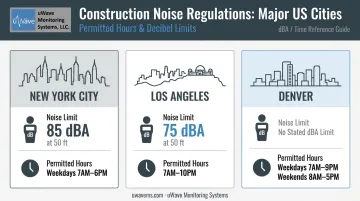
- New York City: Construction devices creating noise above 85 dB(A) measured 50 feet or more from the source is defined as unreasonable. Work is generally limited to 7:00 AM–6:00 PM on weekdays, with after-hours authorization required beyond those windows.
- Los Angeles: Powered construction equipment may not exceed 75 dBA at 50 feet in or near residential zones, with work restricted to 7:00 AM–10:00 PM.
- Denver: Construction is permitted 7:00 AM–9:00 PM on weekdays and 8:00 AM–5:00 PM on weekends, with plainly audible construction noise prohibited outside those hours.
The Project Risk Angle
Beyond fines, unmanaged noise exceedances create real schedule risk. Stop-work orders, permit suspensions, and community escalations are all documented enforcement tools. Portland, for example, allows courts to issue stop-work orders with fines up to $5,000 per violation.
Proactive monitoring also shields contractors from liability for noise they didn't generate. If a complaint arises from an adjacent site or a heavy traffic corridor, time-stamped boundary data is the only reliable way to demonstrate the exceedance originated elsewhere.
On federally funded transit and infrastructure projects, the Federal Transit Administration and Federal Highway Administration provide construction noise assessment guidance under NEPA. Agencies commonly embed monitoring plan requirements in project environmental commitments and permit conditions — treating verified noise data as a contractual deliverable, not an afterthought.
Key Noise Metrics for Construction Site Monitoring
Construction noise monitoring relies on a handful of specific metrics — each measuring something different, each used in different compliance contexts. Here's what they mean and when they matter.
dBA: The Standard Measurement Unit
dBA (A-weighted decibels) filters sound frequencies to approximate human hearing sensitivity. It's the standard unit for all environmental and occupational noise assessments — raw dB measurements without A-weighting don't correlate well with how people actually perceive sound.
For reference, FTA guidance provides the following typical equipment levels at 50 feet:
| Equipment | Typical Level at 50 ft |
|---|---|
| Generator | 82 dBA |
| Excavator | 85 dBA |
| Concrete Mixer | 85 dBA |
| Bulldozer | 85 dBA |
| Jackhammer | 88 dBA |
| Impact Pile Driver | 101 dBA |
These are planning-level reference values. Actual site readings will vary based on equipment condition, usage cycles, distance, and shielding.
LAeq: The Primary Compliance Metric
LAeq (equivalent continuous sound level) represents averaged sound energy over a defined measurement period — typically daytime work hours or a 1-hour window. Regulators and permit conditions rely on LAeq because it smooths out fluctuations between loud bursts and quieter intervals, giving a representative picture of overall noise exposure.
LN Percentile Metrics
- L90 — the level exceeded 90% of the time; represents background/ambient noise and is the foundation of any baseline survey
- L10 — the level exceeded 10% of the time; indicates peak noise events during the measurement period
- LAFmax — the single loudest moment within a measurement interval; particularly relevant for nighttime monitoring and sleep disturbance assessment, where even brief high-level events matter
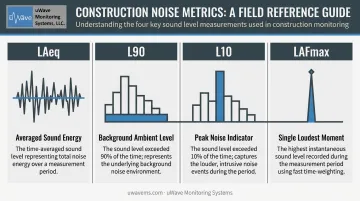
Establishing your L90 baseline before construction begins determines which noise limits apply. Some jurisdictions set limits relative to existing ambient levels — meaning baseline data directly affects what you're permitted to do on site.
Key Steps in a Construction Noise Monitoring Program
Effective construction noise monitoring is a structured four-step program that begins before the first piece of equipment arrives and continues through project closeout.
Step 1: Understand Regulatory Requirements and Noise Limits
Before designing a monitoring program, identify every applicable noise limit. These may come from:
- Local municipal ordinances (the most commonly enforced)
- State environmental regulations
- Project permit conditions or noise variance agreements
- Federal agency requirements (FTA, FHWA) embedded in NEPA commitments
Two variables must be clarified early:
- What acoustic indicator applies — LAeq, L10, or LAmax. Some require post-processing beyond simple meter readings, so the measurement approach must match the compliance metric.
- What the measurement period is — LAeq over 30 minutes gives you significantly less flexibility than LAeq over 12 hours when managing peaks before they trigger a violation.
Step 2: Conduct a Pre-Construction Baseline Noise Survey
A baseline survey measures existing ambient noise levels before any construction begins. This step is critical because many regulations set limits relative to existing ambient conditions rather than fixed absolute thresholds.
For example: if an ambient L90 reading comes in at 65 dBA, and the applicable limit is ambient + 5 dBA, the permitted construction noise level is 70 dBA (not the 60 dBA fixed limit you may have assumed in the bid). That 10 dBA difference can mean significantly more equipment running simultaneously.
A thorough baseline survey captures:
- L90 background levels across day, evening, and nighttime windows
- Dominant existing noise sources (traffic, rail, industrial activity)
- Locations and classifications of sensitive receptors within a defined radius
Without baseline data, teams lose the ability to defend against exceedance claims caused by external sources. That gap typically surfaces as a crisis mid-project — after the window to establish pre-construction conditions has closed.
Step 3: Develop a Noise Management and Monitoring Plan
A noise management plan documents the strategy for keeping noise within permitted levels throughout the project. It typically includes:
- Monitoring station positions with justification for each location
- Equipment specifications (instrument accuracy class)
- Measurement parameters and alert thresholds
- Reporting frequency (daily, weekly) and designated alert contacts
- Corrective action procedures for exceedances
- Documentation of mitigation measures already in place — noise barriers, equipment scheduling, low-noise method substitutions
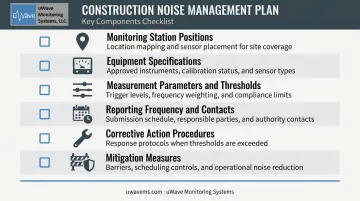
The monitoring plan is often a submission requirement for construction permits or noise variance applications. Submitting it before work begins demonstrates to regulators that the team is applying best practicable means to manage noise, which matters both for permit approval and for defensibility if complaints arise later.
Step 4: Deploy Continuous Monitoring During Active Construction
Noise levels on construction sites fluctuate dramatically — a quiet phase during a consultant's 15-minute visit can mask hours of non-compliant activity that occurred before or after. Choosing the right monitoring approach from the start determines what your compliance record actually shows.
Continuous vs. Spot-Check Monitoring
| Approach | Method | Limitation |
|---|---|---|
| Spot/manual | Consultant visits for 15–30-minute readings | Misses events outside visit windows |
| Continuous automated | 24/7 fixed stations at site boundary | Full time-series record of all activity |
How Modern Automated Systems Work
Automated monitoring stations measure LAeq, LAFmax, and LN percentiles continuously, then transmit data to a cloud platform. When thresholds are approached or exceeded, the system triggers real-time alerts (email or text) so teams can respond before a brief exceedance becomes a documented violation.
Some systems include audio recording capabilities, enabling contractors to determine whether a noise event originated from their site or from an adjacent source such as traffic or a neighboring project. When a neighbor files a complaint, that audio record lets you point to the actual source — and document it.
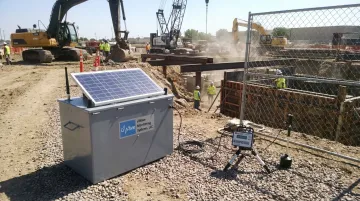
For teams managing multiple sites or extended project timelines, uWave Monitoring Systems deploys complete remote monitoring stations with solar power, cellular data transmission, and cloud-based access to noise and vibration records. Automated alerts flag threshold approaches in real time, and customized compliance reports are generated without requiring on-site personnel for every check.
Selecting the Right Construction Noise Monitoring Equipment
Equipment Categories
Handheld sound level meters are appropriate for:
- Pre-construction baseline surveys
- Spot-check investigations
- Targeted source identification
Continuous automated monitoring stations are required for:
- Ongoing boundary monitoring
- Regulatory compliance reporting
- After-hours and weekend coverage
NYC's 2026 construction noise monitoring rule — which mandates continuous monitoring for new buildings of 200,000 sq ft or more within 50 feet of residential receptors — reflects a clear regulatory direction toward permanent boundary monitoring on high-impact projects.
Key Selection Criteria
Beyond accuracy class, prioritize these factors when selecting equipment:
- Solar-powered systems with deep-cycle batteries handle site boundaries where grid power isn't available
- 4G LTE cellular transmission delivers real-time data without Wi-Fi dependency
- Internal memory keeps records intact during connectivity gaps
- Single-station multi-parameter capability covers noise, vibration, and air overpressure when permits require all three
uWave's V3 and V5 remote monitoring stations are one example of how these criteria translate into a deployable system. Each unit pairs a solar panel and cellular modem with compatible Instantel instruments — including the Micromate and Minimate Pro4 — for simultaneous sound, vibration, and air overpressure monitoring from a single location. The uWave Project Manager cloud platform provides real-time alerts, customized reporting, and 24/7 remote access.
Rental vs. Purchase
Once you've identified the right equipment spec, the next decision is procurement. For project-specific or short-duration monitoring, renting calibrated equipment eliminates upfront equipment costs and ensures instruments are current and maintained. uWave offers complete remote monitoring system rentals — including cloud-hosted data services — along with factory-certified used equipment with recent annual calibration and a one-year warranty for teams that prefer ownership.
Common Misconceptions and Pitfalls
Misconception 1: OSHA Compliance Covers Community Noise
It does not. OSHA's 90 dBA TWA standard governs worker hearing protection thresholds. A site can be fully OSHA-compliant while generating boundary noise that violates local ordinances or triggers community complaints. These are separate regulatory frameworks with separate measurement methods and limits.
Misconception 2: Spot Checks Give You the Full Picture
Periodic manual readings produce a small, non-representative sample of actual site noise. Construction noise varies — and the spikes that matter most are easy to miss:
- Heavy equipment startup and shutdown cycles
- Unexpected material deliveries
- Concrete pours running into evening hours
- Nighttime or weekend work
A morning spot check captures none of that. Continuous monitoring is the only method that produces a defensible, time-stamped record of what actually occurred across a full workday or night.
Misconception 3: Baseline Surveys Are Optional
Skipping pre-construction ambient monitoring creates three compounding problems:
- You can't accurately determine what limits actually apply to your project
- You can't defend against exceedance claims caused by traffic, adjacent sites, or pre-existing industrial noise
- You can't demonstrate that elevated readings reflect pre-existing conditions rather than your operations
By the time a neighbor files a complaint or a regulator requests documentation, that baseline window is gone — and you're left arguing against readings you can't contextualize.
Frequently Asked Questions
What is the OSHA standard for construction noise?
OSHA's permissible exposure limit under 29 CFR 1926.52 is 90 dBA as an 8-hour time-weighted average for construction workers, with a hearing conservation program required when exposures exceed that level. OSHA limits govern worker exposure only — community-facing noise at site boundaries is regulated separately by local ordinances and permit conditions.
What are the different types of noise monitoring?
Three main types:
- Personal noise dosimetry — worn by workers to measure individual occupational exposure
- Handheld/spot-check monitoring — manual readings at specific times and locations
- Continuous automated boundary monitoring — fixed stations recording 24/7 at site perimeter positions for regulatory compliance
What noise level is acceptable near a construction site?
Limits vary by jurisdiction, time of day, and receptor type. Los Angeles caps powered equipment at 75 dBA at 50 feet in residential zones; NYC sets 85 dB(A) at 50 feet for construction devices. Project-specific limits are defined in local ordinances, permits, or noise variance agreements.
When should construction noise monitoring begin on a project?
Monitoring should begin before construction starts — with a baseline ambient survey conducted several weeks prior to mobilization. Early monitoring establishes the pre-construction noise environment, informs permit applications, and provides defensible data if disputes arise later.
What equipment is used for construction noise monitoring?
Class 1 or Class 2 sound level meters are used for spot checks and surveys. Automated continuous monitoring stations are deployed at site boundaries for ongoing compliance. Modern stations transmit data to cloud platforms in real time, generating automated alerts and compliance reports.
How should you respond when a noise limit is exceeded?
First, confirm whether the exceedance came from site activity or an external source — time-stamped audio data is critical for this. Then act: pause the operation, adjust scheduling, add barriers, or switch to a lower-noise method. Log the full response for regulatory reporting.