Without accurate measurement, construction, mining, and infrastructure teams take on real risk:
- Structural damage claims from nearby property owners
- Missed compliance thresholds tied to permits or municipal codes
- Costly delays when regulators halt work over unverified vibration levels
This guide breaks down the instruments, methods, and interpretation practices you need to measure vibration correctly, plus the mistakes that quietly undermine even well-intentioned monitoring programs.
Key Takeaways
- Match the instrument to the job: seismographs for ground vibration, accelerometers for machinery, handheld meters for quick checks
- Peak Particle Velocity (PPV) and frequency together, not PPV alone, determine whether vibration poses a real risk
- Compare every reading to a standard such as USBM RI 8507 or 30 CFR 816.67—raw numbers alone are not enough
- Poor sensor coupling and ignored frequency data are the most common sources of bad readings
- Cloud-connected monitoring shrinks the lag between an exceedance and the moment someone acts on it
What You Need to Measure Vibration
Getting good data starts before you ever press record. The right sensor in the wrong location, or a sensor that isn't properly coupled to its surface, produces numbers that look precise but mean nothing.
Instruments and Sensors Required
Three categories of equipment cover almost every vibration monitoring scenario:
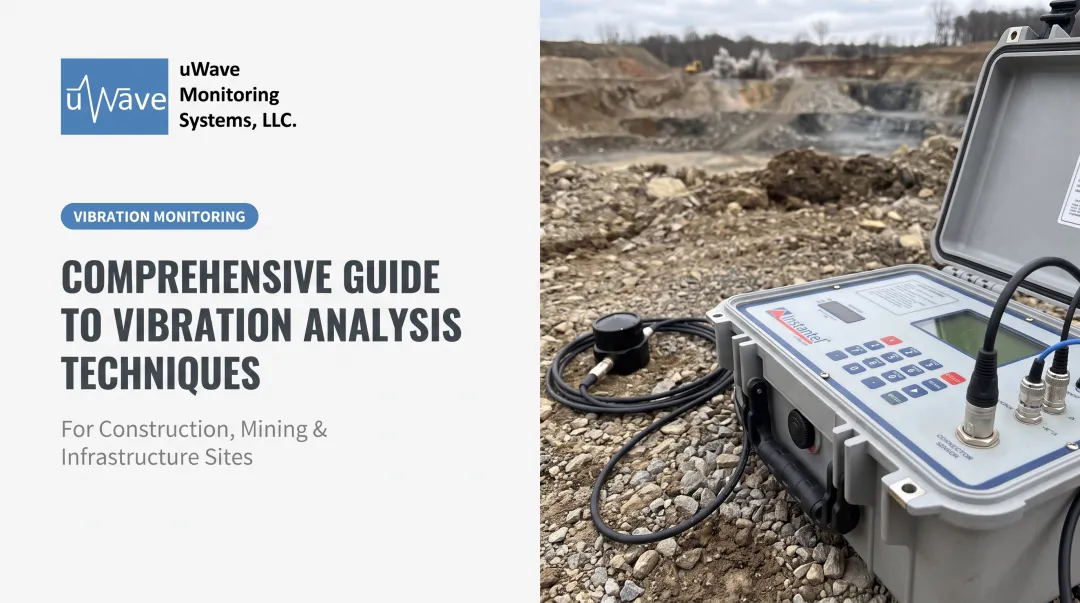
- Triaxial seismographs and geophones — for ground vibration from blasting, pile driving, or heavy construction. These capture motion along three axes (longitudinal, transverse, and vertical) simultaneously, which matters because ground waves rarely move in a single direction.
- Piezoelectric or MEMS accelerometers — for machinery and structural vibration analysis, mounted directly to equipment or structural members.
- Handheld vibration meters — for quick field checks when you don't need a permanent record.
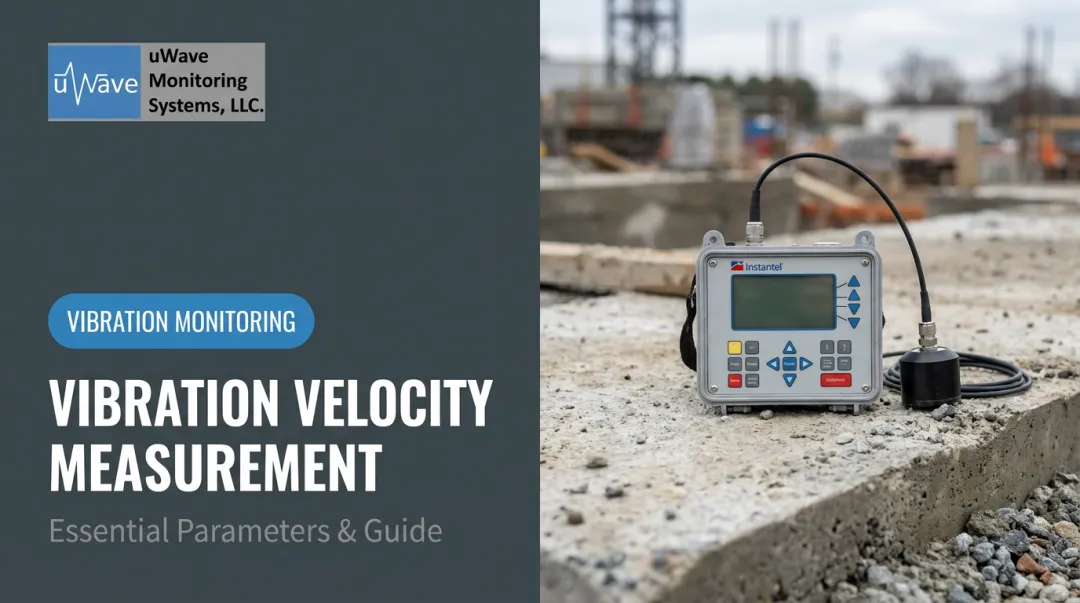
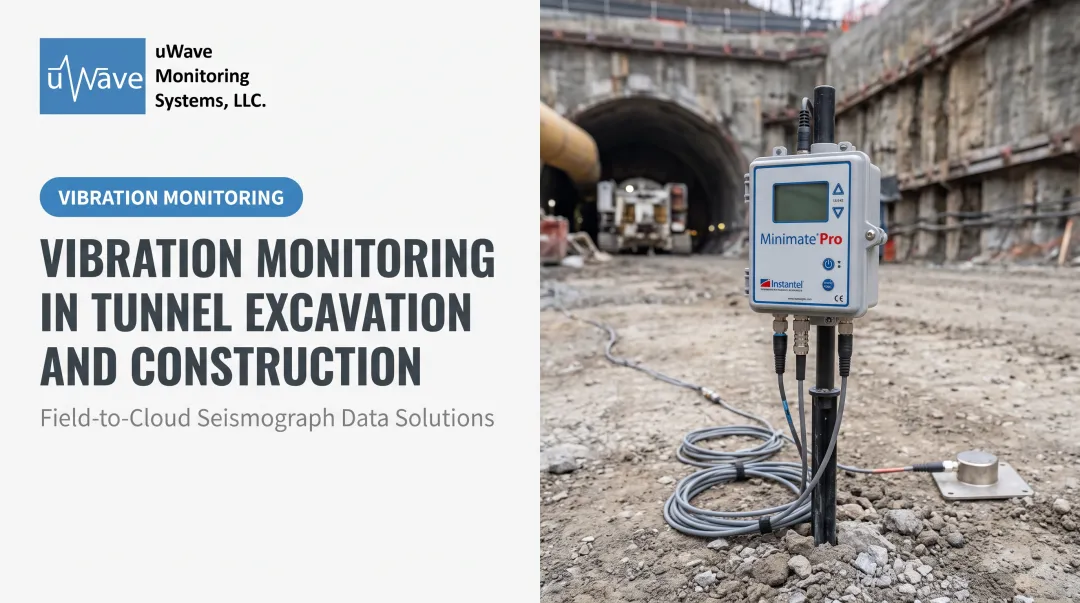
uWave Monitoring Systems supplies Instantel's Micromate, Minimate Pro, and Blastmate III seismograph lines for this work. The Micromate pairs a triaxial geophone (rated 2–250 Hz) with an optional air-overpressure or sound-level microphone on its fourth channel.
Minimate Pro4 and Pro6 platforms add support for accelerometers, high-frequency geophones, and hydrophones for underwater or dam-adjacent sites.
Preconditions and Setup
Instrument quality doesn't matter if setup is sloppy. A few preconditions make or break the data:
- Secure coupling first. Ground sensors need firm spike contact with compacted soil, embedded burial, or a mounting plate on hard surfaces. Loose coupling attenuates or distorts the signal before it ever reaches the recorder.
- Verify calibration before deployment. Instantel recommends annual calibration for seismographs, geophones, and microphones, and specifically notes that a built-in sensor check is not a substitute — it doesn't compare readings against an external reference.
- Account for environmental drift. Temperature swings, moisture intrusion, and poorly routed cables all introduce noise into an otherwise clean signal.
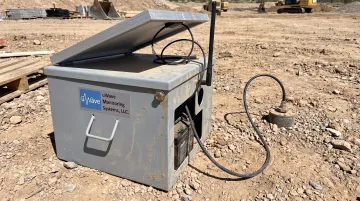
- Plan power and connectivity. Instantel's Micromate and Minimate Pro units run 10 to 15 days on internal battery alone.
For longer remote deployments, uWave's solar-powered enclosures pair a 30-watt panel with 12-volt batteries (18 Ah for short jobs, 30 Ah or more for extended or low-sunlight sites) and a cellular gateway such as the Sierra Wireless RV55 for cloud data transmission.
Methods to Measure Vibration
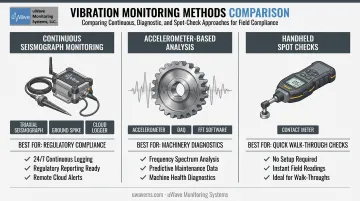
Which method makes sense depends entirely on the goal. Regulatory compliance, machine diagnostics, and a fast go/no-go check each call for a different setup.
Method 1: Continuous Seismograph Monitoring (PPV-Based)
This is the standard approach for blast monitoring and construction compliance. The seismograph runs continuously, logging Peak Particle Velocity and frequency, and triggers an alert whenever a set threshold is exceeded.
Tools needed: triaxial seismograph, ground spike or mounting plate, cloud-connected data logger.
- Select the monitoring location based on regulatory guidance and proximity to the nearest sensitive structure.
- Couple the sensor securely to the ground or structure so it transfers motion accurately.
- Set trigger thresholds against applicable compliance limits, then enable remote data transmission.
This method is ideal for 24/7 compliance monitoring. uWave's rental fleet includes Instantel seismographs paired with the uWave Project Manager platform, which pushes email and text alerts the moment an event crosses a configured threshold. That matters when a blast happens at 6 a.m. and nobody is on site to check a screen.
It is a poor fit for high-frequency machinery diagnostics, where a different tool does the job better.
Method 2: Accelerometer-Based Vibration Analysis
Accelerometers measure acceleration on machinery or structural elements and convert it into a frequency spectrum. That spectrum is how you diagnose bearing wear, imbalance, or resonance issues rather than only confirming a threshold was crossed.
Tools needed: piezoelectric or MEMS accelerometer, data acquisition system, FFT/spectrum analysis software.
- Mount the accelerometer securely at the specific point of interest.
- Acquire the time-domain signal across a representative operating period.
- Convert the signal to a frequency spectrum and compare it against a baseline reading.
This method offers far higher resolution and frequency range than a seismograph, typically covering roughly 1 Hz to several kHz. The tradeoff is clear: it takes more technical expertise to interpret, and it is not practical as a standalone tool for outdoor ground-vibration compliance work.
Method 3: Handheld Vibration Meters (Spot Checks)
Sometimes you just need a number, fast. Handheld meters deliver RMS or peak vibration readings on demand for routine inspections.
Tools needed: handheld contact vibration meter.
- Press the meter firmly against the surface being tested.
- Record the displayed RMS or peak value.
- Log the reading manually for trend tracking.
These are cheap and quick, a real advantage for daily walk-through checks. They offer limited storage and no continuous trend history, so they are unsuitable as the backbone of formal compliance documentation. Treat them as a screening tool, not a replacement for continuous monitoring.
How to Interpret the Results
A number on a screen isn't useful until you know what it means. Misreading vibration data leads to one of three bad outcomes: unnecessary work stoppages, missed early warnings of structural stress, or an unrecognized regulatory violation that surfaces later as a claim.
| Result Category | What It Looks Like | Recommended Action |
|---|---|---|
| Normal | PPV and frequency within standard limits (for example, USBM RI 8507 residential criteria) | Continue routine monitoring |
| Minor Issue | Readings approaching, but not exceeding, threshold | Increase monitoring frequency; review current methods |
| Out-of-Spec | PPV or frequency limit exceeded | Halt the triggering activity, notify stakeholders, investigate, and document |
Regulatory limits vary by jurisdiction and structure type. Under 30 CFR 816.67, surface coal blasting PPV limits scale with distance: roughly 1.25 in/s within 300 feet, dropping to 0.75 in/s beyond 5,000 feet. USBM residential guidance sets safe criteria at 0.50 to 0.75 in/s below 40 Hz.
Why Frequency Changes Everything
Two blasts can register the same PPV and pose entirely different risks. USBM research found structural response is strongly frequency dependent between 4 and 25 Hz, with buildings responding more severely in the 7–30 Hz range.
That same research sets a safe criterion of 0.50–0.75 in/s at low frequency, rising to 2.0 in/s above 40 Hz.
In practical terms: a low-frequency vibration at a given PPV is more damaging than a high-frequency vibration at that same PPV. Any interpretation that ignores frequency and looks at PPV alone is working with half the picture.
Common Errors and Best Practices in Measuring Vibration
Most bad vibration data traces back to one of three mistakes:
- Poor sensor coupling. A geophone that isn't firmly seated in the ground, or an accelerometer that's loosely bolted rather than rigidly mounted, attenuates or exaggerates the true signal.
- Ignoring frequency content. Focusing on amplitude alone skews damage-risk assessment, as shown above: a compliant-looking PPV can still represent a real risk at low frequency.
- Skipping calibration checks. Instrument drift accumulates over time. Without annual calibration, readings gradually lose accuracy even when the equipment appears to function normally.
Best practices:
- Use secure, weatherproof mounting positioned away from traffic and unrelated vibration sources
- Maintain redundant data backup so a single equipment failure doesn't erase a compliance record
- Enable cloud-hosted alert systems for real-time visibility rather than discovering an exceedance days later
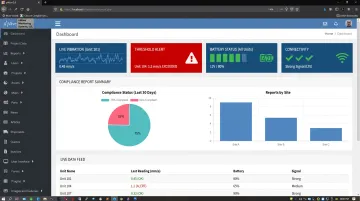
uWave's Project Manager platform builds in several of these safeguards directly, including maintenance alerts for low battery or lost connectivity, secure data backup, and customized compliance reports. Together, those features turn each sensor reading into a documented compliance record you can defend if a claim arises.
Conclusion
Accurate vibration measurement protects structures, keeps projects compliant, and builds trust with the communities working next to a job site. None of that happens by accident. It depends on choosing the right instrument for the job, placing and coupling the sensor correctly, and keeping calibration current.
Interpreted results should drive immediate action — whether that's continuing routine monitoring or halting work to investigate a source. Treat the data as a decision tool, not just a compliance box to check.
Frequently Asked Questions
What are the safe vibration levels for humans?
Humans can perceive vibration as low as 0.035 in/s PPV, far below levels that threaten structures. Complaints often start well before any real risk to a building exists.
What is Peak Particle Velocity (PPV) and why does it matter?
PPV is the greatest magnitude of particle velocity recorded during a vibration event. It's the standard metric for assessing potential structural damage because it captures the maximum local ground or structural speed during that event.
What vibration levels can damage buildings or structures?
Damage thresholds vary by construction type. USBM RI 8507 sets 0.50 in/s for older plaster-and-lath homes and 0.75 in/s for modern drywall homes below 40 Hz. Above that frequency, the limit rises to 2.0 in/s.
How often should vibration monitoring equipment be calibrated?
Manufacturers like Instantel recommend annual calibration for seismographs, geophones, and microphones. Drift accumulates gradually, so skipped checks can degrade reading accuracy.
Can vibration monitoring be done remotely in real time?
Yes. Cloud-connected seismographs paired with platforms like uWave's Project Manager enable 24/7 remote monitoring, with automated email and text alerts the moment a threshold is exceeded.
What standards regulate construction and blasting vibration limits?
Common references include USBM RI 8507 for residential damage criteria and 30 CFR 816.67 for federal surface-coal blasting. Local municipal ordinances often set additional project-specific limits based on nearby structures.