
Introduction
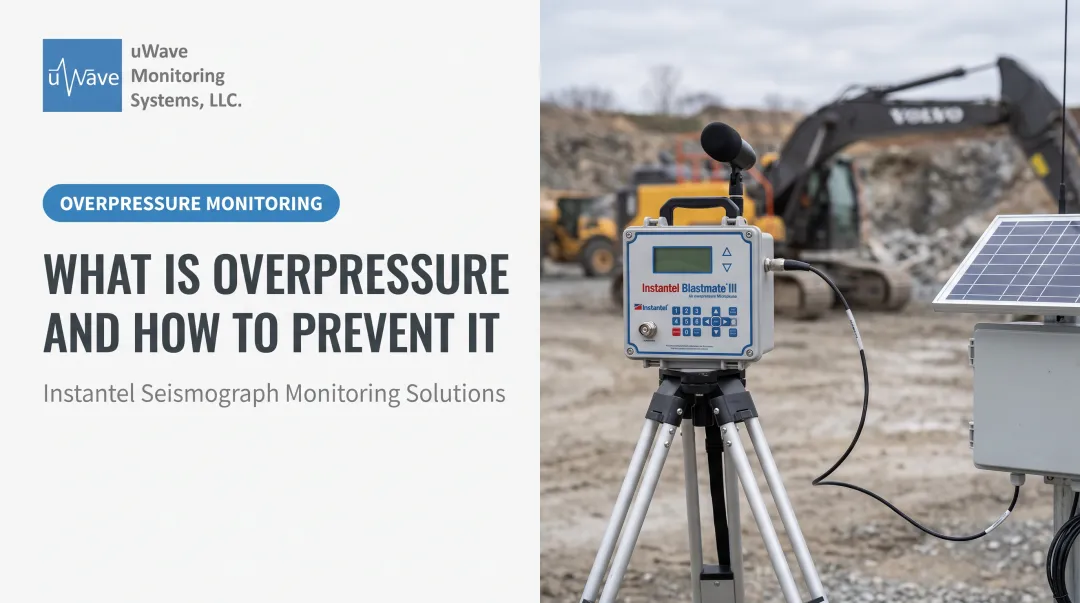
When a blast fires, it doesn't just break rock. It also sends a pressure wave through the air that can rattle windows, crack plaster, and trigger regulatory violations miles from the blast face. That pressure wave is air overpressure — and managing it is one of the most critical responsibilities in mining, quarrying, and construction blasting.
Uncontrolled air overpressure exposes operations to three converging risks:
- Structural damage to nearby buildings
- Regulatory citations and permit jeopardy
- Community relations damage that can shut down a project entirely
What makes it particularly difficult is that the same blast design can produce materially different overpressure readings depending on weather, geology, and timing. A blast that passed compliance checks last week might fail today.
This guide covers the four root causes of excessive air overpressure, the consequences of ignoring it, practical prevention strategies, and how continuous monitoring keeps operations ahead of each of those risks before they escalate.
Key Takeaways
- Air overpressure is the peak positive pressure above atmospheric produced by a blast shockwave, measured in pascals (Pa) or decibels (dB)
- Four primary causes drive overpressure events: poor stemming, inadequate burden, adverse weather, and improper delay timing
- The USBM RI 8485 standard sets 133 dB (2 Hz flat response) as the federal compliance benchmark — state limits may be stricter
- Weather alone can increase overpressure readings by up to 20 dB without any change to the blast design
- Repeated exceedances are best prevented through real-time monitoring with automated alerts
Common Causes of Air Overpressure
Air overpressure, technically defined, is the peak positive pressure produced by the airblast wave from a detonation — typically measured in Pa or dB using a linear (flat) frequency weighting. USBM RI 8485 identifies four distinct generation mechanisms:
- Air Pressure Pulse (APP) — from rock displacement during detonation
- Rock Pressure Pulse (RPP) — from ground vibration coupling into the air
- Gas Release Pulse (GRP) — from explosive gases escaping through fractured rock or the bench face
- Stemming Release Pulse (SRP) — from premature blowout of the blasthole collar
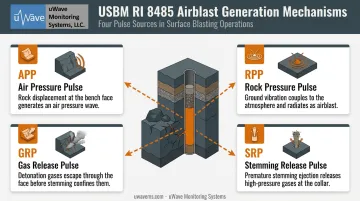
Most overpressure incidents don't have a single cause. They result from two or more of these mechanisms interacting with blast design errors or environmental conditions.
Insufficient or Poor Stemming
When stemming height is too short or stemming material is inadequate, explosive gases escape through the blasthole collar before energy is fully transferred to the rock, generating a Stemming Release Pulse. Research published in Applied Sciences found that proper stemming reduced airblast from 140 dB to 134 dB, a 6 dB reduction from this change alone.
Common failure scenarios include:
- Using drill cuttings instead of coarse angular crushed aggregate
- Stemming height below the recommended 0.8× burden ratio (Dyno Nobel's industry guide specifies 0.7–1.2× burden)
- Exposed detonating cord at the collar — USBM RI 9026 specifies at least 3 inches of aggregate cover over detonating cord to prevent this pathway
Inadequate Burden and Overloaded Holes
Burden — the rock mass between the blasthole and the free face — must be sufficient to contain explosive energy. When it isn't, gases escape through voids, fissures, or directly through the bench face, generating a Gas Release Pulse. Dyno Nobel's blasting reference guide specifies a burden range of 25–40× blasthole diameter as the accepted industry standard.
Conditions that trigger GRP events:
- Irregular or fractured bench faces with existing void pathways
- Mud seams or geological voids behind the blast face
- Holes loaded too high without accounting for local geology
- Burdens outside the 25–40× diameter range
Adverse Weather Conditions
Weather is the cause most operators underestimate, because it can increase overpressure significantly without any change to the blast itself. Research on meteorological effects on airblast shows meteorology can commonly increase airblast by up to 20 dB(L) due to inversions and wind. A separate study found inversion effects may exceed 10 dB at distances of 800 m (~2,600 ft) or greater.
Temperature inversions trap cooler surface air beneath a warmer layer above, bending airblast wave paths back downward instead of allowing them to dissipate upward. Downwind conditions produce a similar effect on wavefronts. The Defra-funded quarry blasting research report advises avoiding blasts before mid-morning and after sunset, the windows when surface inversions are most likely to form.
Improper Blast Timing and Delay Sequencing
Sound travels through air far more slowly than ground vibration travels through rock. This means that even when electronic delays are used, air pressure pulses from adjacent holes can arrive at a monitoring point nearly simultaneously and combine into a reinforced wavefront.
USBM RI 9026 documented this directly: a 17 ms delay design produced supersonic trace velocity along the blast face and generated airblast levels 6 to 7 dB higher than a 42 ms design that kept trace velocity subsonic. The key takeaway: delay intervals should exceed 1 ms per foot of hole spacing to prevent wavefront reinforcement.
What Happens If Air Overpressure Is Ignored
Structural Damage Risk
USBM RI 8485 establishes that below 140 dB, structural damage to standard construction should not occur. However, that threshold doesn't mean blasts operating near it are without consequence. RI 8485 data shows window sash rattling begins around 141–145 dB, with poorly mounted glass showing strain at 151 dB. Even at sub-damage levels, residents experience picture movement, door rattling, and the kind of perceived impact that generates formal complaints.
The practical implication: compliance with regulatory limits doesn't automatically prevent community conflict. Operators need to treat perception and damage risk as separate, parallel concerns.
Regulatory and Legal Exposure
That gap between perception and formal damage thresholds is exactly where regulatory exposure begins. Federal surface coal regulations under 30 CFR 816.67 use the same frequency-dependent table as USBM RI 8485, with 133 dB (2 Hz flat response) as the primary benchmark. State limits vary considerably:
| State | Air Overpressure Limit |
|---|---|
| Minnesota | 130 dB linear peak (non-permit lands) |
| Pennsylvania | 133 dB(L) maximum |
| Kentucky | 129 dB (listed condition) |
| Virginia | Federal frequency-response table |
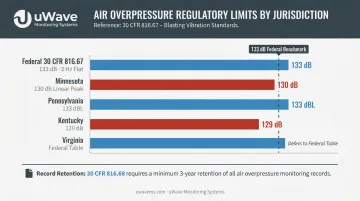
Under 30 CFR 816.68, blast records — including airblast levels and weather conditions — must be retained for at least 3 years. Failure to monitor and document doesn't just create a compliance gap; it eliminates the evidence needed to defend against complaints and creates compounding liability.
Community and Operational Costs
Persistent overpressure complaints, even when formal damage thresholds aren't crossed, carry real operational consequences:
- Stricter permit conditions imposed by regulators responding to complaint volumes
- Enforced schedule restrictions limiting when blasts can be conducted
- Mandatory blast design reviews that pause production
- Reputational damage in permit renewal proceedings
These costs compound over time. Operations that treat airblast control as reactive — responding to complaints after they occur — consistently face higher long-term costs than those that build proactive monitoring into every blast event.
Warning Signs of Elevated Air Overpressure Risk
Several observable indicators can flag elevated risk before a formal exceedance occurs:
- Visible stemming column ejection or heavy dust plumes rising from blasthole collars during a blast — a direct sign of premature gas escape
- Monitoring readings trending toward trigger thresholds (for example, approaching 130 dB) even when blast parameters haven't changed — a sign that an environmental or geological factor may be amplifying results
- Community reports of rattling or vibration following recent blasts, indicating airblast is reaching occupied structures even if formal damage thresholds haven't been crossed
How to Prevent Air Overpressure
Prevention combines blast design discipline, scheduling decisions, and real-time measurement. Each measure targets one or more of the root causes identified above.
Optimize Stemming Practices
Use coarse angular crushed aggregate — not drill cuttings — and maintain stemming height at a minimum of 0.8× burden (the full recommended range is 0.7–1.2×). Cover all detonating cord with at least 3 inches of aggregate. Where surface-level energy release is a concern, Nonel initiation systems reduce the risk further.
Apply these controls at the blast loading stage for every blast. Stemming quality must be verified before firing.
Control Charge Weight Per Delay and Blast Design
- Limit maximum explosive weight per delay interval
- Keep burden within the 25–40× blasthole diameter range
- Adjust designs for fractured faces, geological voids, and irregular bench geometry
- Orient bench faces away from line-of-sight with sensitive structures where practical
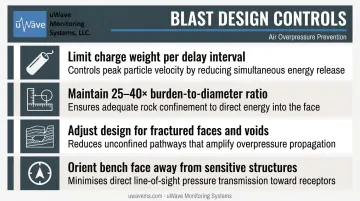
Re-evaluate the design whenever geology or bench geometry changes. A layout that worked last month may not suit a new face condition.
Schedule Blasts Around Weather Conditions
- Blast during midday hours, when normal atmospheric lapse rate promotes upward refraction of airblast waves
- Avoid early morning and evening blasts during potential inversion windows
- Check wind direction before every production blast; postpone if strong winds are directed toward populated areas
Meteorological review should be a pre-blast checklist item. Defra-funded quarry research is explicit on this: avoid blasting before mid-morning, after sunset, or during mid-day surface temperature drops.
Deploy Continuous Air Overpressure Monitoring
Real-time monitoring is the only way to confirm whether each blast remains within regulatory limits. It also catches deteriorating performance before it becomes a compliance issue.
A complete monitoring setup requires:
- Calibrated overpressure microphones with linear (flat) frequency weighting, 2–250 Hz range, positioned adjacent to the nearest sensitive structures on non-permit lands
- Seismographs that capture both ground vibration and airblast simultaneously from a single unit
- Complete blaster's logs covering date, time, explosive type, charge per delay, weather conditions, and monitoring results — retained for at least 3 years per 30 CFR 816.68
uWave Monitoring Systems' Instantel seismograph lineup (Micromate, Micromate Plus, Minimate Pro, and Blastmate III) records both ground vibration and air overpressure simultaneously from a single unit. The standard linear microphone covers 88–148 dB(L) across 2–250 Hz; a high-pressure microphone rated up to 184 dB(L) is available for elevated-intensity scenarios.
For unattended, continuous deployment, uWave's V3 and V5 remote monitoring stations pair the seismograph with a 30-watt solar module, AGM battery, and Sierra Wireless cellular modem. The integrated uWave Project Manager cloud platform delivers automated email and text alerts when pre-set thresholds are exceeded, with data accessible 24/7 from any location.
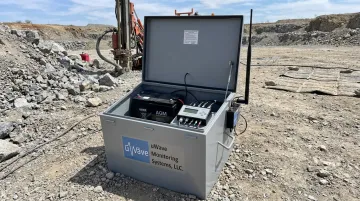
Trigger thresholds should be set below regulatory limits — not at them — so there's room for corrective action before an exceedance occurs.
Tips for Long-Term Prevention and Control
Building overpressure control into operations culture requires habits that extend beyond individual blast events:
- Conduct post-blast reviews after every event — compare air overpressure readings against blast design parameters. Recurring high readings on specific bench areas or under certain weather conditions signal needed design adjustments, not just one-off anomalies
- Train all blasters on the four airblast generation mechanisms — this includes recognizing warning signs (stemming ejection, trending readings, community reports) and knowing the site-specific regulatory thresholds that govern the operation
- Maintain systematic blaster's logs — include meteorological conditions, monitoring results, and any anomalies observed. These records support compliance audits, community engagement, and continuous improvement
- Use cloud-based monitoring for real-time visibility — automated alert systems eliminate the lag between a blast event and operator awareness, so exceedances at multi-site or remote projects get flagged immediately rather than surfacing in a days-later data review. Platforms like uWave Project Manager provide this field-to-cloud visibility with automated email and text alerts built in
Conclusion
Air overpressure from blasting has identifiable, controllable causes. Poor stemming, inadequate burden, adverse weather, and improper delay sequencing each have well-documented solutions — and applying those solutions systematically reduces both the frequency and severity of overpressure events.
The operators who manage airblast most effectively treat monitoring and documentation as operational tools, not just compliance checkboxes. Real-time data confirms what each blast actually produces, gives early warning when conditions deteriorate, and provides the documented record needed to defend against structural claims and community complaints. Seismographs with air overpressure sensors — paired with cloud-based alert systems — give crews that feedback automatically, at every blast, without relying on manual data pulls after the fact. Proactive design combined with continuous measurement is how operations stay ahead of airblast rather than reacting to it after complaints arrive.
Frequently Asked Questions
What does air overpressure mean?
Air overpressure is the peak positive pressure above normal atmospheric pressure produced by the shockwave from an explosive detonation. It is measured in pascals (Pa) or decibels (dB) using linear frequency weighting, and is technically a specific metric within the broader airblast event rather than synonymous with it.
What are the effects of air overpressure?
At sub-130 dB levels, effects are primarily perceptual: rattling objects, window vibration, and community annoyance. Above 140 dB, the risk of structural effects — including glass breakage and plaster cracking — increases. Even sub-damage levels routinely generate complaints and regulatory attention.
Can you survive 5 psi air overpressure?
Yes, 5 psi is survivable in most cases. NIOSH/CDC blast data indicates roughly 1% probability of eardrum rupture at 5 psi. Lung damage thresholds begin around 15 psi, and fatality risk increases significantly at 35–45 psi and above.
How is air overpressure measured?
It is measured using calibrated overpressure microphones with linear (flat) frequency weighting, typically 2–250 Hz, connected to a seismograph. Results are recorded in dB on a linear peak scale and can be converted to pressure units using a standard logarithmic formula referenced in USBM RI 8485.
What are the regulatory limits for air overpressure from blasting?
The USBM RI 8485 benchmark most commonly cited in compliance contexts is 133 dB using a 2 Hz flat-response measurement system. Federal 30 CFR 816.67 uses the same frequency-dependent table. State limits vary — Minnesota sets 130 dB linear peak, Pennsylvania sets 133 dBL, and Kentucky sets 129 dB under its listed conditions.
What is the difference between airblast and air overpressure?
Airblast refers to the full transient compressional pressure wave traveling through air from a detonation. Air overpressure specifically refers to the peak positive pressure produced by that wave. The terms are often used interchangeably in practice, but airblast describes the phenomenon while air overpressure is the measured parameter used for compliance.