Introduction
Ground vibration from blasting, pile driving, compaction, and demolition doesn't stay on your site. It travels — into adjacent foundations, buried utilities, and the basements of neighbors who will notice long before you do.
The stakes are real. Iowa DOT's 2024 Special Specification SP-236020 now requires equipment that continuously records vibration events and delivers immediate warnings. Caltrans defines continuous monitoring as PPV checks at one-minute intervals or less. These aren't voluntary best practices — they're contract requirements.
Older periodic-check seismographs can't meet that bar. The field has moved to cellular-connected, cloud-hosted systems that trigger automated alerts the moment a threshold is crossed — well before a complaint or claim follows.
This guide evaluates the four most reliable real-time vibration monitoring systems deployed on US construction, mining, quarrying, and infrastructure projects in 2026. Each is assessed for measurement accuracy, connectivity, alert reliability, and compliance readiness — along with a practical framework for matching the right system to your project.
Key Takeaways
- Real-time vibration monitoring measures PPV continuously, triggering instant alerts when site activity approaches regulatory or structural damage thresholds
- OSMRE sets US blast monitoring PPV limits at 1.25 in/s (0–300 ft), 1.00 in/s (301–5,000 ft), and 0.75 in/s beyond 5,000 ft under 30 CFR 816.67
- ISEE 2022 performance specs require ≥1,000 samples/sec/channel and 2–250 Hz frequency coverage — the baseline for compliant instruments
- Instantel leads North American construction deployments; Syscom, GeoSIG, and Nomis cover specialized applications
- Field-to-Cloud rental packages — seismograph, enclosure, cellular modem, and cloud alerts bundled — eliminate the IT burden for project teams
Overview of Real-Time Vibration Monitoring in Construction
Protecting adjacent structures, utilities, and residents during blast, compaction, pile-driving, or demolition work depends on catching threshold exceedances before damage occurs — not after the fact. Real-time vibration monitoring does this by measuring ground-borne vibration (expressed as Peak Particle Velocity, or PPV, in inches/sec or mm/sec) and air overpressure at project boundaries.
Why Continuous Monitoring Is Now a Spec Requirement
Regulations now specify exact technical requirements:
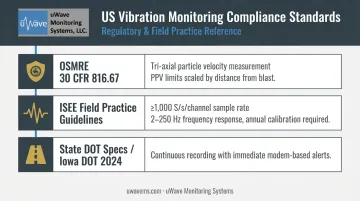
- OSMRE (30 CFR 816.67/817.67): Ground vibration must be measured as particle velocity in three mutually perpendicular directions for surface coal mining operations
- ISEE Field Practice Guidelines: Seismographs must achieve ≥1,000 samples/sec/channel, cover 2–250 Hz, and be calibrated annually — before first use and after any response-affecting repairs
- State DOT specifications: Iowa DOT's 2024 spec now mandates continuous recording with immediate phone modem warnings — not periodic spot checks
A seismograph that records data locally but requires manual retrieval to generate a report doesn't satisfy these requirements. Neither does a system that sends alerts 20 minutes after a threshold is exceeded.
What "Real-Time" Actually Means in the Field
The Ottawa LRT project sets a useful benchmark for what field-scale real-time monitoring actually looks like:
- 90 Instantel units deployed across 6 km of downtown tunneling (2016–2020)
- 60+ units reporting simultaneously during peak construction for near real-time compliance
- Cloud connectivity, automated alerts, and centralized data management required — periodic USB downloads were not an option
That deployment scale reflects what modern urban infrastructure projects demand from their monitoring systems.
Top 4 Most Reliable Real-Time Vibration Monitoring Systems for 2026
These systems were selected based on six criteria verified against real-world deployment in construction, mining, and infrastructure sectors:
- PPV measurement accuracy
- Real-time alert capability
- Field ruggedness
- Connectivity options
- Cloud data hosting
- Documented use in construction, mining, and infrastructure
Instantel Micromate / Minimate Pro (Novatek International)
Instantel has been the go-to standard for construction and blasting vibration monitoring in North America for decades. The Micromate and Minimate Pro are its flagship instruments for portable and remote-unattended deployment.
What sets it apart: Compliance with ISEE and OSMRE reporting formats, tri-axial geophone plus microphone combo measurement, event-triggered and continuous recording modes, and a broad ecosystem of enclosures and accessories for unattended remote deployment. THOR software supports BS 7385 and OSMRE workflows natively.
uWave Monitoring Systems (Golden, CO) provides complete Instantel rental packages across the full product line:
- Micromate, Micromate Plus, Minimate Pro4, Blastmate III, and Minimate Plus
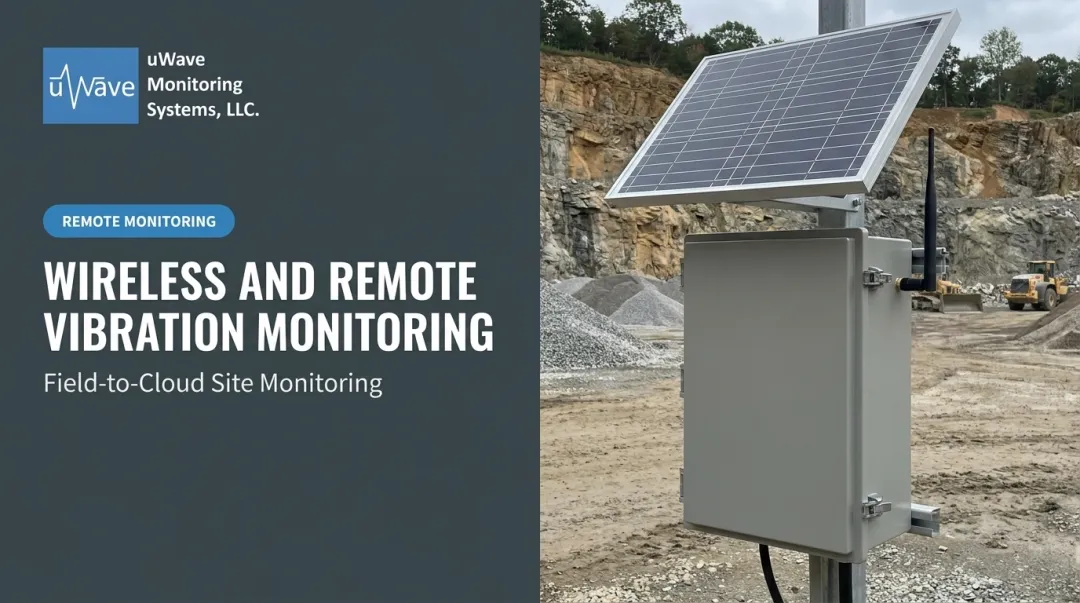
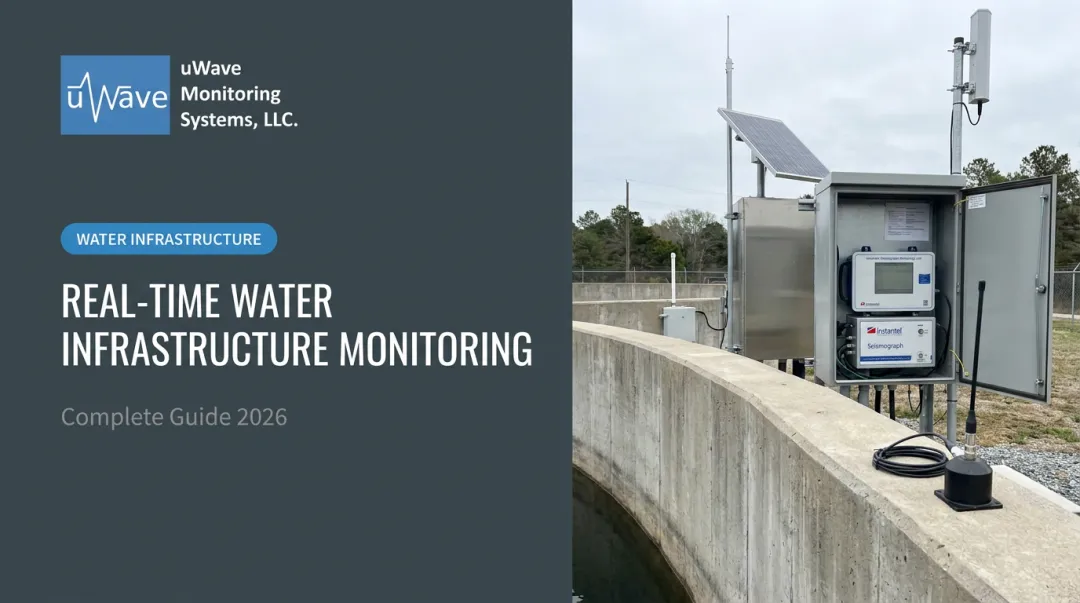
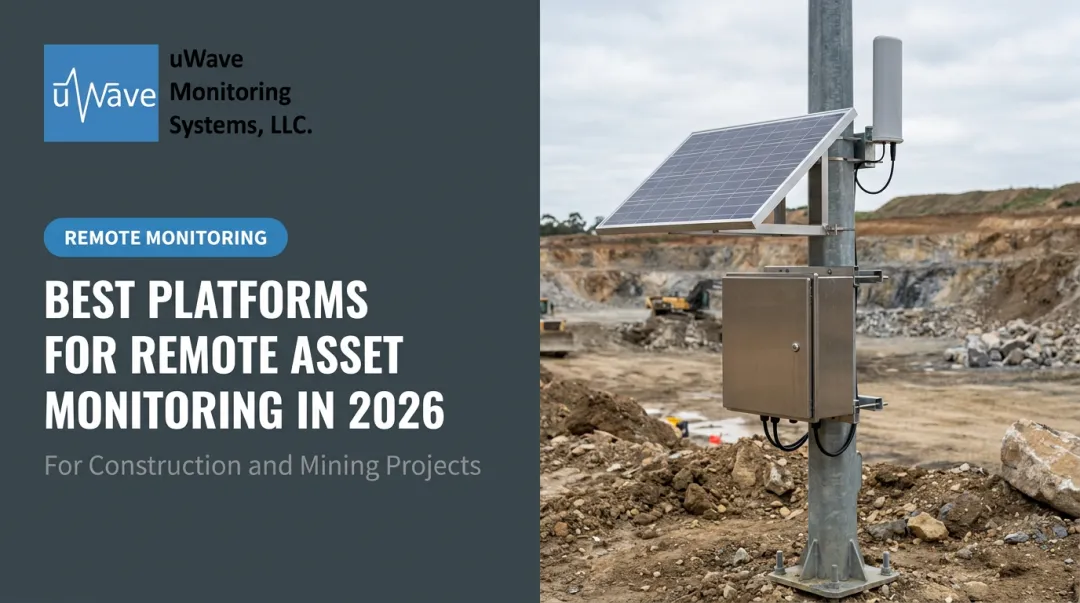
- V3 and V5 remote monitoring station rentals with solar power and Sierra Wireless LTE modems
- Cloud-hosted alert management through the uWave Project Manager platform
This turnkey Field-to-Cloud setup delivers full monitoring capability without hardware ownership.
| Specification | Micromate | Minimate Pro |
|---|---|---|
| PPV Range | Up to 254 mm/s (10 in/s) | Standard: 254 mm/s; High-freq: 2,540 mm/s (100 in/s) |
| Geophone Frequency | 2–250 Hz (ISEE), 1–315 Hz (DIN) | 2–250 Hz (ISEE), 1–315 Hz (DIN), 30–1,000 Hz (high-freq) |
| Microphone | ISEE Linear 2–250 Hz; Class 1 sound 10 Hz–20 kHz, 30–140 dB | Linear, Class 1 sound, high-pressure up to 69 kPa, hydrophone 8–500 Hz |
| Sample Rate | 1,024–4,096 S/s | 512–65,536 S/s |
| Battery Life | 10–15 days | 10 days |
| IP Rating | Water-resistant (specific IP not confirmed) | IP67 (submersible to 30 cm / 24 hrs) |
| Standards | ISEE, DIN 45669-1 | ISEE-2017, DIN 45669-1, IEC 61010-1 |
| Connectivity | USB, cellular modem, THOR, Vision II | Ethernet, RS-232, Auto Call Home, THOR, Vision II |
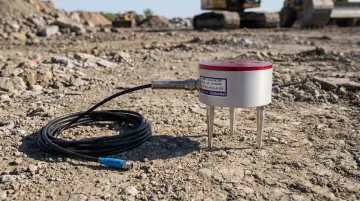
Best for: Construction, blasting, pile driving, tunnel boring, and any project requiring ISEE or OSMRE compliance documentation.
Syscom Instruments MR3003C (Orica Digital Solutions)
The Syscom MR3003C consolidates sensor, recorder, and communications into a single IP65-rated enclosure — a practical design for urban and infrastructure projects where installation footprint matters. Syscom is a Swiss manufacturer with deep roots in precision seismic measurement.
What sets it apart: Compact all-in-one design with triaxial geophone or accelerometer options, internal or external sensor configuration, and integration with Syscom Cloud Software (SCS) for near real-time monitoring, automatic reporting, and compliance-curve comparison. Built-in alarm relay capability supports immediate on-site shutdown triggers on infrastructure-sensitive projects.
| Specification | MR3003C |
|---|---|
| Sensor Options | Triaxial geophone or accelerometer; internal or external |
| IP Rating | IP65 |
| Communications | GPRS/LTE; Syscom Cloud Software (SCS) |
| Cloud Features | Near real-time monitoring, project data management, automatic reporting, compliance-curve comparison |
| Supported Standards | DIN 4150, SN 640 312a, BS 7385 |
Note: Syscom's MR3000C is the older model. Current official Orica/Syscom documentation centers on the MR3003C — buyers should request current datasheets directly from Syscom rather than relying on archived third-party PDFs.
Best for: Infrastructure protection, tunnel construction, and urban development projects in European regulatory environments or where DIN 4150 / SN 640 312a compliance is required.
GeoSIG GMSplus
GeoSIG is a Swiss seismic instrumentation company whose GMSplus is a compact, multi-channel ground motion monitoring system deployed on bridge, dam, tunnel, and urban construction projects globally.
What sets it apart: Broadband seismic sensor capability capturing both low-frequency structural motion and high-frequency construction vibration, integrated GPS timing for event correlation, and web-based remote monitoring with configurable alarm thresholds. Its 24-bit Delta-Sigma ADC per channel delivers high resolution across a DC–250 Hz (optional DC–500 Hz) frequency range.
| Specification | GMSplus |
|---|---|
| Channels | 3 or 6; up to 15 with digital sensors |
| Frequency Range | DC–250 Hz standard; DC–500 Hz optional |
| ADC Resolution | 24-bit Delta-Sigma per channel |
| GPS Timing Accuracy | <±0.5 ppm after calibration (~2 ms/hour) |
| Interfaces | Wired Ethernet; optional Wi-Fi, serial, USB |
| Alarms | Up to 4 relay outputs; optional SMS notification |
| IP Rating | IP65/NEMA 4 standard; IP67/NEMA 6 optional |
| Certifications | CE and UL approved; deployed in USGS NetQuakes network |
Best for: Projects requiring simultaneous blast monitoring and long-term structural vibration trending — bridges, dams, tunnel portals, and urban high-rise construction where OSMRE/ISEE blasting compliance is not the primary regulatory driver.
Nomis Mini-SuperGraph II (Nomis Inc.)
Nomis Inc. is a North American manufacturer of seismographs designed specifically for the blasting and construction industries. The Mini-SuperGraph II is widely used by quarry operators, mining companies, and demolition contractors across the US and Canada.
What sets it apart: ISEE-compliance-focused design ruggedized for harsh quarry and blast environments, with sample rates up to 16,384 S/s — well above the ISEE 1,000 S/s minimum. Remote connectivity supports GSM, satellite, and RF transmission with automatic data download and email delivery of PDF reports. The price point is lower than enterprise systems while fully covering ISEE compliance documentation requirements.
| Specification | Mini-SuperGraph II |
|---|---|
| PPV Range | 0–10 in/s (0–254 mm/s) |
| Geophone Frequency | 2–400 Hz standard; optional 1 Hz |
| Microphone | Linear 92–148 dB, 2–400 Hz, ±1 dB accuracy |
| Sample Rate | 1,024–16,384 S/s (higher rates optional) |
| Battery Life | Up to 7 days per charge in monitor mode |
| Data Transfer | USB, RS-232, GSM, satellite, RF; automatic email of PDF reports |
| Operating Temp | -12°C to 50°C (10°F to 120°F) |
| Standards | Current ISEE seismograph standards |
A note for buyers comparing products: The SVANTEK SV 307/SV 307A series comes up frequently in searches alongside seismographs. These are Class 1 noise monitoring stations, not ground-vibration seismographs. They pair well with the systems above for projects requiring simultaneous neighbor noise compliance, but should not be evaluated as PPV seismographs for ISEE or OSMRE purposes.
Best for: Quarry operations, mining blast monitoring, and demolition contractors who need clear, ISEE-compliant PPV and airblast logs without complex IT infrastructure.
How We Chose These Systems
These four systems were selected based on real-world deployment record in construction, mining, quarrying, and infrastructure — not catalog specifications alone.
Evaluation Criteria
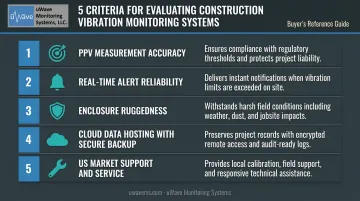
Each system was assessed across five dimensions, each tied to a direct project outcome:
- PPV measurement accuracy vs. ISEE/OSMRE standards — Non-compliant instrument specs produce data regulators will reject; this eliminates most general-purpose IoT sensors outright
- Real-time alert delivery reliability — A missed alert due to cellular dropout or alert latency can mean the difference between a proactive shutdown and a structural damage claim
- Enclosure ruggedness for unattended outdoor deployment — Systems that can't survive a quarry environment aren't real options for quarry operators
- Cloud data hosting with secure backup — Data gaps during a permit audit are treated the same as no data
- Support and service availability in the US market — Downtime on a remote monitoring station with no local service path creates compliance exposure
The Seismograph vs. Vibration Sensor Distinction
One of the most common procurement mistakes is evaluating IIoT accelerometers designed for rotating machinery — pumps, motors, compressors — when you actually need a construction-grade seismograph. The evaluation criteria above reflect this distinction directly.
These are not interchangeable:
- Construction seismographs use calibrated geophones to measure low-frequency ground motion at 2–250 Hz, with air overpressure microphones, event-triggered recording, and compliance-formatted output
- Industrial vibration sensors measure higher-frequency machinery vibration (typically 1 kHz and above) for predictive maintenance applications
ISEE 2022 performance specifications define the accepted baseline for compliant blasting seismographs. Data from an accelerometer-based machinery sensor won't satisfy OSMRE reporting requirements — and won't survive a legal proceeding involving structural damage claims.
Conclusion
The most reliable real-time vibration monitoring system for 2026 is the one that fits your project's specific risk profile, regulatory environment, and connectivity constraints — not simply the most recognized brand name. A seismograph that can't deliver automated alerts from a remote quarry site offers little advantage over a periodic spot-check.
Before finalizing a procurement or rental decision, evaluate three things beyond the hardware spec sheet:
- Ongoing data management — Who retrieves, hosts, and backs up the data? Is the reporting format compatible with your permit conditions?
- Alert response workflows — Who receives alerts, and what is the response protocol when a threshold is exceeded at 2 AM?
- System scalability — Can you add monitoring points along a project corridor without switching platforms mid-project?
Also confirm that the chosen system's data output and report templates satisfy the specific standards referenced in your permits and contracts. OSMRE, ISEE, DIN 4150-3, and BS 7385 each have different reporting expectations — and individual permit conditions often set stricter thresholds than any single standard.
uWave Monitoring Systems offers configurable rental and purchase packages for construction, mining, quarrying, water infrastructure, and transit projects across the US. Their Field-to-Cloud service includes Instantel seismograph rental, custom V3/V5 enclosure design for outdoor and remote deployments, Sierra Wireless LTE cellular modems, and cloud-hosted alert management with 24/7 remote project access.
Frequently Asked Questions
How do I choose the right vibration sensor for a construction project?
Construction and blasting projects require a seismograph with a calibrated geophone and airblast microphone to meet ISEE and OSMRE standards — not an industrial accelerometer. After confirming instrument type, evaluate connectivity and alert capability based on whether your site has cellular coverage and whether your project requires automated threshold alerts.
What is Peak Particle Velocity (PPV) and why does it matter?
PPV is the maximum speed of ground particle movement caused by vibration, measured in inches/sec or mm/sec. Regulatory agencies use PPV thresholds — OSMRE sets limits at 1.25 in/s at 0–300 ft under 30 CFR 816.67 — to determine when vibrations risk damaging adjacent structures; exceeding them without a recorded compliance log exposes project owners to damage claims and permit revocations.
What is the difference between a seismograph and a general vibration sensor?
Seismographs use calibrated geophones and airblast microphones to measure low-frequency ground motion (2–250 Hz) for construction compliance. General vibration sensors (accelerometers, MEMS) measure higher-frequency machinery vibration for predictive maintenance. Using the wrong instrument produces non-compliant data that regulators and legal proceedings will reject.
Can real-time vibration monitors operate in remote locations without Wi-Fi?
Yes. Current-generation seismographs support 4G LTE cellular modems for data transmission and alert delivery where Wi-Fi doesn't exist. Most include onboard event-triggered storage that preserves data locally if connectivity drops, with automatic upload on reconnection — uWave's V3 and V5 remote stations use Sierra Wireless LTE modems supporting Verizon, AT&T/FirstNet, US Cellular, and other carriers.
What vibration standards govern construction and blasting monitoring in the US?
Primary applicable standards include:
- ISEE Field Practice Guidelines — blasting seismographs
- OSMRE (30 CFR Part 816/817) — surface coal mining
- DIN 4150-3 / BS 7385 — where specified by contract or local ordinance
Individual permit conditions frequently set thresholds stricter than any single standard, so always review permit language directly.
How long should vibration monitoring data be retained after a construction project?
30 CFR 816.68 requires blast records to be retained for at least 3 years under OSMRE regulations. Industry best practice for projects with structural damage exposure extends retention to 5 years or longer. Cloud-hosted platforms with secure backup — such as uWave's Project Manager — help meet these retention obligations without requiring on-site server management.