Nearby buildings, buried utilities, and construction crews all sit in the path of that energy. A 2024 study on shield-tunneling vibration found more than 65% of measured vibration energy concentrated in the 0-16 Hz range, with pile response still measurable beyond 12 meters from the excavation, not just at the boundary of the work zone. Vibration doesn't stop at the property line — it decays gradually, and low-frequency waves travel the farthest.
This guide covers the tools you need, the monitoring methods that fit different tunneling approaches, how to read the results correctly, and the mistakes that trip up even experienced crews.
Key Takeaways
- Vibration monitoring protects tunnel structures, adjacent buildings, and buried utilities from excavation-induced ground motion
- Seismographs, geophones, and accelerometers are the core tools — sensor placement and calibration drive data accuracy
- Method choice depends on tunneling technique: fixed-point, blast-trigger, or remote cloud-based monitoring
- Interpret readings against PPV thresholds in ISO 4866, DIN 4150, and USBM RI 8507
- Most monitoring failures come from poor sensor coupling or skipped calibration, not broken equipment
What You Need for Vibration Monitoring in Tunnel Excavation
Tunneling generates continuous, high-energy vibration from multiple sources at once: the TBM cutterhead grinding rock, blast rounds detonating on a cycle, and pile driving near shafts and portals. That combination makes sensor selection and placement far more demanding than a typical construction site.
Tools and Equipment Required
A functional monitoring setup usually includes:
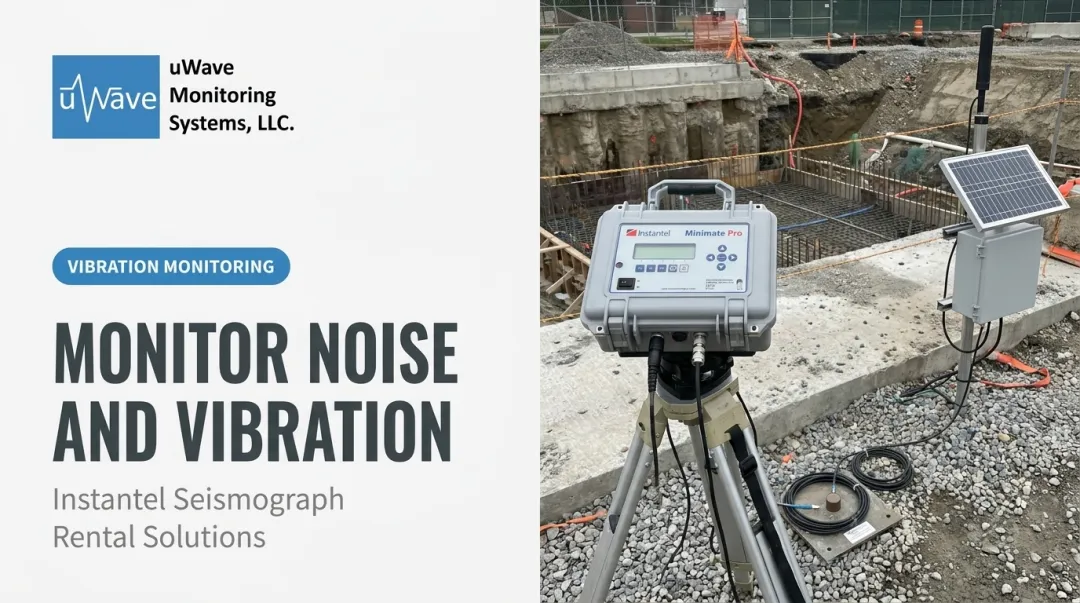
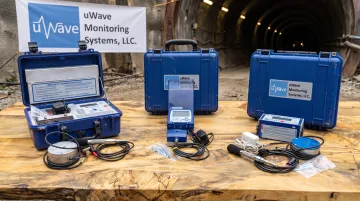
- Engineering seismographs — Instantel Micromate, Minimate Pro, and Blastmate III units; Micromate is documented for tunnel boring applications
- Triaxial geophones rated for the ISEE standard range of 2-250 Hz, or DIN-compliant units covering 1-315 Hz
- Piezoelectric-type accelerometers for capturing high-frequency events beyond geophone range
- Data loggers and cellular telemetry modems for remote sites where daily site visits aren't practical
uWave Monitoring Systems stocks all three Instantel model lines for rental or purchase, bundled with geophones, geophone spikes, carrying cases, and mounting hardware. Projects that need several points along a tunnel alignment can often get bulk rental discounts or extended pricing on multi-unit purchases.
Preconditions and Setup
Before any unit goes live, a few setup basics determine whether the data means anything:
- Couple the sensor properly. Spike it into undisturbed soil, bolt or bond it to bedrock, or mount it directly to a structure's foundation. Loose or sandbagged placements introduce frequency-dependent errors that can swing readings well outside the expected range.
- Plan power and connectivity. Underground and remote sites need battery life, solar backup, and cellular gateways that keep transmitting without daily intervention. A 30-watt solar module paired with a deep-cycle battery is a common configuration for stations left unattended for weeks at a time.
- Run a baseline survey. Document existing crack patterns, settlement, and structural condition on nearby buildings before excavation starts. Without this record, it's nearly impossible to prove whether new damage came from the tunnel or existed already.
Methods to Monitor Vibration in Tunnel Excavation
Which method you use depends on the excavation technique, how sensitive the surrounding structures are, and whether you need continuous data or just peak-event readings.
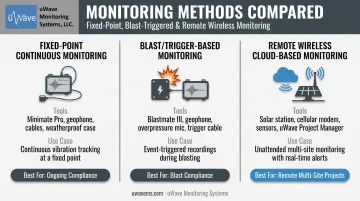
Method 1: Fixed-Point Continuous Seismographic Monitoring
Description: Continuous recording at sensitive receptors (historic buildings, gas lines, water mains) positioned near the tunnel alignment.
Tools needed: A ground-coupled seismograph with a triaxial geophone, set to log continuously or at defined intervals.
Setup steps:
- Identify and rank sensitive receptors along the full tunnel route
- Mount the seismograph at foundation level with secure coupling
- Set PPV alarm thresholds per the applicable standard and let it run continuously
Best for: Long-duration TBM drives passing under or near sensitive structures.
Not ideal for: Isolated blast events, where you only need one short spike per detonation.
Method 2: Blast/Trigger-Based Monitoring
Description: Event-triggered recording built for drill-and-blast tunneling, capturing peak vibration from each individual blast.
Tools needed: A trigger-level seismograph set below the regulatory PPV limit, positioned at the nearest structure or property line.
Setup steps:
- Set the trigger threshold slightly below the applicable PPV limit. ISEE field guidance cites 1.3 mm/s (0.05 in/s) as a common starting point, though every site differs
- Position units at multiple monitoring points around the blast zone
- Retrieve peak event data after each blast for compliance reporting
Best for: Blast compliance documentation. It's not built to capture the steady-state vibration from continuous machinery.
Method 3: Remote Wireless Cloud-Based Monitoring
Description: Continuous, unattended monitoring with real-time data transmission and automated alerts. This approach suits 24/7 projects with limited underground access.
Tools needed: A field-deployed seismograph paired with a cloud-hosted platform and automated alert system.
Setup steps:
- Deploy sensors at critical points with cellular or telemetry connectivity
- Configure automated thresholds for vibration, sound, and equipment maintenance alerts
- Check live dashboards remotely and respond the moment a threshold gets breached
Platforms like uWave's Project Manager give field teams 24/7 access to monitoring data without repeated site visits. Vibration, sound, and maintenance alerts route by email or text as soon as a threshold is crossed, which helps when several units run along a long alignment.
How to Interpret Vibration Monitoring Results
Misreading vibration data cuts both ways. Miss an early warning sign and you risk structural damage; misinterpret a normal reading as a problem and you halt work unnecessarily. Both outcomes cost money.
Use these result categories to decide the next step:
| Result Category | What It Looks Like | Recommended Action |
|---|---|---|
| Normal/Acceptable | PPV and frequency within approved limits | Continue work as planned |
| Minor Issues | Readings approaching threshold, intermittent spikes | Increase monitoring frequency, review nearby excavation activity |
| Out-of-Spec | Readings exceed regulatory PPV limit | Halt operations immediately, inspect affected structures |
A common trap: assuming a low PPV number always means "safe." It doesn't. Tunnel-blast research consistently notes that frequency and duration matter as much as velocity. A low-frequency, high-amplitude event can be more damaging to a structure than a higher-PPV reading at a higher frequency.
Key Regulatory Standards for Tunnel Vibration
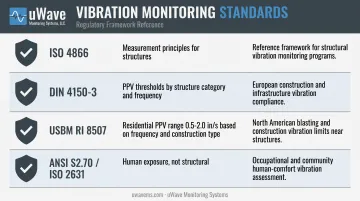
ISO 4866 is the primary international reference for evaluating vibration effects on fixed structures. It establishes principles for measurement and data processing when assessing structural effects, rather than defining a single universal PPV number.
Beyond ISO 4866, three other frameworks come up constantly:
- DIN 4150-3: Sets PPV thresholds by structure category (commercial, residential, historic) and frequency band. Historic and sensitive structures get the lowest allowable limits.
- USBM RI 8507: Based on studies of 76 homes and over 200 production blasts, this framework ties residential safe levels to frequency and construction type, roughly in the 0.5-2.0 in/s PPV range depending on those variables.
- ANSI S2.70 and ISO 2631: These apply to human exposure (hand-transmitted and whole-body vibration), not structural limits. Don't confuse a comfort standard with a structural damage threshold; they answer completely different questions.
Common Errors and Safety Best Practices in Vibration Monitoring
Most bad vibration data comes from how the equipment gets used, not from defective instruments.
The most frequent mistakes:
- Poor sensor coupling — Loose placement, tape, or sandbags can attenuate or amplify readings unpredictably. Lab tests found mount-to-rock transmissibility from 0.16 to 1.25 depending on method; anchoring or plaster bonding is far more reliable.
- Sensor placement too far from the structure of concern — A reading taken 100 feet (30 meters) from the building you're actually worried about tells you very little about what that building is experiencing.
- Skipped calibration — Deploying a unit without a current calibration certificate means you're trusting numbers you can't actually verify.
- Ignoring frequency alongside PPV — As covered above, a low PPV reading at a damaging frequency can still cause harm.
Best practices worth building into every project:
- Require calibration certificates before any unit goes into the field
- Use secure, weatherproof housing for sensors left in place for weeks or months
- Build in redundant power and connectivity — a dead battery mid-blast-cycle means a data gap you can't recover from
- Set up maintenance alerts to flag sensor drift, low battery, or lost connectivity before it becomes a compliance problem
Cloud platforms make that last point easier to manage. Operators can check calibration date, battery percentage, and modem signal strength remotely, and catch a failing unit before a data gap happens.
Conclusion
Accurate, continuously monitored vibration data is what separates a well-run tunnel excavation from one that risks structural damage claims or costly work stoppages. Getting there means combining the right sensor placement, a monitoring method suited to your tunneling technique, and correct interpretation against a recognized standard.
None of that matters, though, if the results don't translate into action. A normal reading means keep working. A borderline spike means watch closer. An exceedance means stop and inspect — immediately, and with a documented record of what happened next.
Frequently Asked Questions
What does vibration monitoring do in tunneling projects?
It tracks ground-borne vibration from TBM operation, blasting, or drilling to protect nearby structures, utilities, and worker safety. Monitoring flags rising vibration levels before they reach damaging thresholds, giving crews time to adjust.
What are the different methods for vibration monitoring in tunneling?
The three primary approaches are fixed-point continuous monitoring, blast/trigger-based monitoring, and remote wireless cloud-based monitoring. The right choice depends on whether the tunneling method produces continuous vibration (TBM) or discrete events (blasting).
What is a vibration monitoring unit for tunneling?
A vibration monitoring unit is a field device, typically a seismograph paired with a geophone or accelerometer, that measures ground motion parameters such as PPV and frequency. Most units also connect to data loggers or cloud telemetry for remote access.
What is the ISO standard for vibration monitoring in tunneling?
ISO 4866 governs the evaluation of vibration effects on fixed structures and is the primary international reference for this application. ISO 2631 covers human exposure to vibration separately and doesn't apply to structural limits.
How often should vibration monitors be calibrated during a tunneling project?
Manufacturer guidance and ISEE performance specifications both call for calibration before initial use, annually thereafter, and after any repair affecting sensor response. Keep calibration certificates on hand for compliance documentation.
What PPV limit is considered safe for structures near tunnel excavation?
Safe limits vary by structure type, frequency, and the standard applied. DIN 4150 and USBM RI 8507 set different thresholds for residential, commercial, and historic structures. Always confirm project-specific limits with a geotechnical engineer before excavation begins.