Introduction
Mining consistently ranks among the noisiest industries in the U.S. — and the numbers back that up. According to NIOSH, 76% of mine workers are exposed to hazardous noise, with one in four already having a hearing problem and four out of five developing impairment by retirement age. Those numbers carry real regulatory weight.
MSHA actively enforces noise regulations under 30 CFR Part 62, and unmonitored blasting vibration can trigger structural damage claims and permit disputes with neighboring communities. Left unaddressed, both hazards create compounding legal and operational risk.
This guide covers what you need to know: the scale of the noise and vibration problem in mining, what U.S. regulations actually require, and how monitoring methods work. It also explains how a continuous field-to-cloud strategy supports both compliance and long-term operational efficiency.
Key Takeaways:
- 76% of U.S. mine workers face hazardous noise exposure — the highest rate of any industry
- MSHA's 90 dBA PEL and 85 dBA Action Level trigger distinct, mandatory compliance obligations
- Blast vibration (PPV) is separately regulated under state codes and mine permits — often overlooked
- Continuous remote monitoring creates the audit-ready compliance record that spot-checks can't
- Primary tools: personal dosimeters for noise, triaxial geophone seismographs for blast vibration
Why Noise and Vibration Are Critical Hazards in Mining
Equipment Noise Levels That Regularly Exceed Safe Limits
Common mining equipment generates noise well above the 85 dBA threshold where hearing damage begins. NIOSH case studies on stone and aggregate mines documented the following ranges:
| Equipment Type | Typical dBA Range |
|---|---|
| Rotary drills | 91–102 dBA |
| Face/percussion drills | 86–109 dBA |
| Primary jaw crushers | 83–105 dBA |
| Secondary/cone crushers | 90–107 dBA |
| Ventilation fans | 86–109 dBA |
| Conveyors and belt drives | 85–101 dBA |
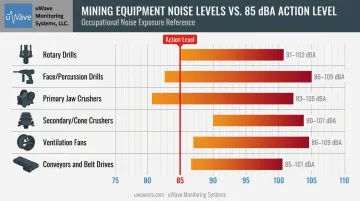
Haul truck cab noise varies significantly by cab age — old-style cabs average 86.3 dBA, while retrofitted cabs average 85.1 dBA. Both sit right at or above the Action Level. Outside the cab, haul truck noise doses in surface granite operations reached as high as 396% of the permissible daily dose.
When crushing, hauling, and drilling happen simultaneously — which is standard — cumulative noise doses can push workers past permissible limits well before a shift ends.
Two Distinct Vibration Hazards
Mining generates two separate categories of vibration risk:
- Whole-body vibration (WBV): Equipment operators absorb continuous vibration from heavy machinery and uneven haul roads. NIOSH found that 5 of 7 haul-truck drivers exceeded ISO/ANSI Exposure Action Values by 9–53% — worst on wet or slippery downhill grades.
- Ground-borne vibration: Blasting and heavy equipment transmit vibration outward through the ground, potentially damaging nearby structures, utilities, and residential properties — and generating community complaints and permit violations.
Beyond Hearing Loss
Chronic noise exposure in mining doesn't stop at hearing impairment. CDC/NIOSH research links repeated exposure at or above 85 dBA to elevated blood pressure and cardiovascular disease — estimating that 14% of high blood pressure cases and 9% of high cholesterol cases among workers could be tied to occupational noise.
Fatigue, impaired concentration, and communication breakdown follow. Workers become slower to recognize hazard signals, and site-wide safety degrades well beyond the individual exposed to the noise.
U.S. Regulatory Standards: What MSHA Requires for Noise Control
MSHA's 30 CFR Part 62 is the mining-specific noise standard — separate from OSHA's general industry rules and written to address the continuous, high-intensity noise exposure common in surface and underground mining. It applies to all mine operators and carries clear obligations around exposure monitoring, engineering controls, and hearing conservation programs.
Permissible Exposure Limit and Action Level
Two thresholds drive compliance obligations under Part 62:
- Action Level: 85 dBA TWA (50% dose) — triggers mandatory hearing conservation program requirements, including noise monitoring, audiometric testing, and worker training
- PEL: 90 dBA TWA (100% dose) — the maximum permissible 8-hour exposure; exceeding this requires immediate engineering and administrative control efforts
Both thresholds integrate sound across 80–140 dBA using A-weighting and slow response settings — the same measurement parameters required for compliant noise dosimetry.
The Rule of 5 Exchange Rate
MSHA uses a 5 dB exchange rate — for every 5 dB increase in noise level above the 90 dBA criterion, allowable exposure time is halved:
| Noise Level | Maximum Exposure Time |
|---|---|
| 90 dBA | 8 hours |
| 95 dBA | 4 hours |
| 100 dBA | 2 hours |
| 105 dBA | 1 hour |
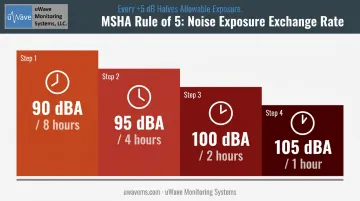
This is notably less protective than the 3 dB equal-energy rule used by NIOSH and adopted in many other countries, where each 3 dB increase halves allowable time.
These exposure limits determine when operators must act — and what actions MSHA requires them to take.
Control Hierarchy and Dual Hearing Protection
MSHA's explicit priority order under 30 CFR 62.130:
- Engineering controls — enclosures, isolation mounts, quieter components, cab retrofits
- Administrative controls — worker rotation, scheduling noisy operations away from high-density shifts, repositioning rest areas
- PPE — only after feasible controls are documented and implemented
Operators must document that all feasible controls have been tried before relying on PPE. For exposures exceeding 105 dBA TWA (800% dose), MSHA mandates dual hearing protection — both earplugs and earmuffs worn simultaneously. An absolute ceiling of 115 dBA applies at all times, with no adjustment for hearing protectors. Accurate noise monitoring is what makes this documentation defensible — without it, operators cannot prove controls were evaluated or that exposure thresholds were met.
Vibration in Mining: The Compliance Risk Operations Overlook
PPV Regulations and What They Cover
While Part 62 gets most of the attention, blast vibration is separately regulated — typically under state blasting codes and individual mine operating permits. The key metric is Peak Particle Velocity (PPV), measured in inches per second at a given distance from the blast.
For surface coal mining operations, 30 CFR 816.67 establishes federal PPV thresholds at protected structures (dwellings, public buildings, community buildings):
| Distance from Blast | Maximum PPV |
|---|---|
| 0–300 ft | 1.25 in/s |
| 301–5,000 ft | 1.00 in/s |
| 5,001 ft or more | 0.75 in/s |
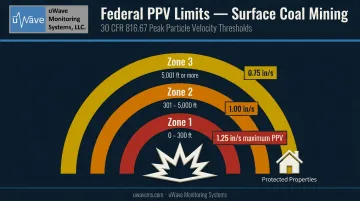
PPV must be recorded in three mutually perpendicular directions (vertical, longitudinal, transverse), and the maximum of the three components determines compliance. State programs for non-coal operations set their own thresholds. Pennsylvania, Wyoming, and Colorado each administer distinct blasting programs, so operators must confirm the specific requirements for their jurisdiction and permit.
Why Unmonitored Vibration Is a Liability
Meeting those requirements on paper is only half the challenge — without recorded PPV data from every blast, operators face compounding risks that are difficult to recover from:
- Cannot demonstrate compliance with permit conditions during inspections
- Cannot respond credibly to community structural damage claims
- Cannot defend against liability if a neighboring property owner alleges blast damage
- Cannot avoid financial exposure when OSMRE investigates damage claims — homeowners may receive compensation or repairs billed directly to the operator
A Pennsylvania quarry study monitoring 106 blasts recorded 206 ground vibration events at nearby homes. Without instrumented monitoring in place, that data simply wouldn't exist — leaving operators with no record to produce and no basis to challenge a claim.
Methods Used for Mining Noise and Vibration Monitoring
Occupational Noise Monitoring Methods
Personal noise dosimeters are the primary tool for measuring individual worker noise dose throughout a shift. MSHA's compliance guide confirms that compliance determinations are primarily based on full-shift dosimeter samples — the instrument must be configured with a 90 dB criterion level, 5 dB exchange rate, A-weighting, and slow response.
Part 62 does not mandate a specific ANSI-certified dosimeter model — it specifies the performance settings the instrument must use. Workers wear the dosimeter at ear level throughout the shift, capturing actual exposure as tasks and locations change.
Fixed-location sound level meters and environmental monitoring stations complement personal dosimetry by:
- Identifying high-noise zones within the site
- Monitoring noise at site boundaries for community impact assessment
- Supporting area surveys that inform engineering control placement
Used together, personal dosimetry and area monitoring give the complete picture regulators expect — and that effective engineering controls require.
Vibration Monitoring Methods
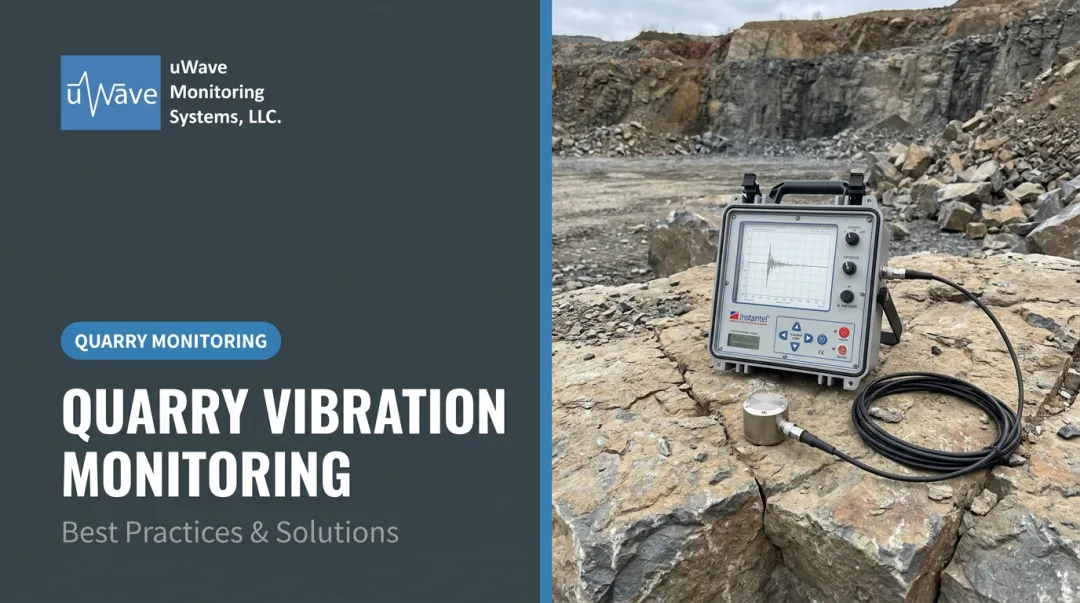
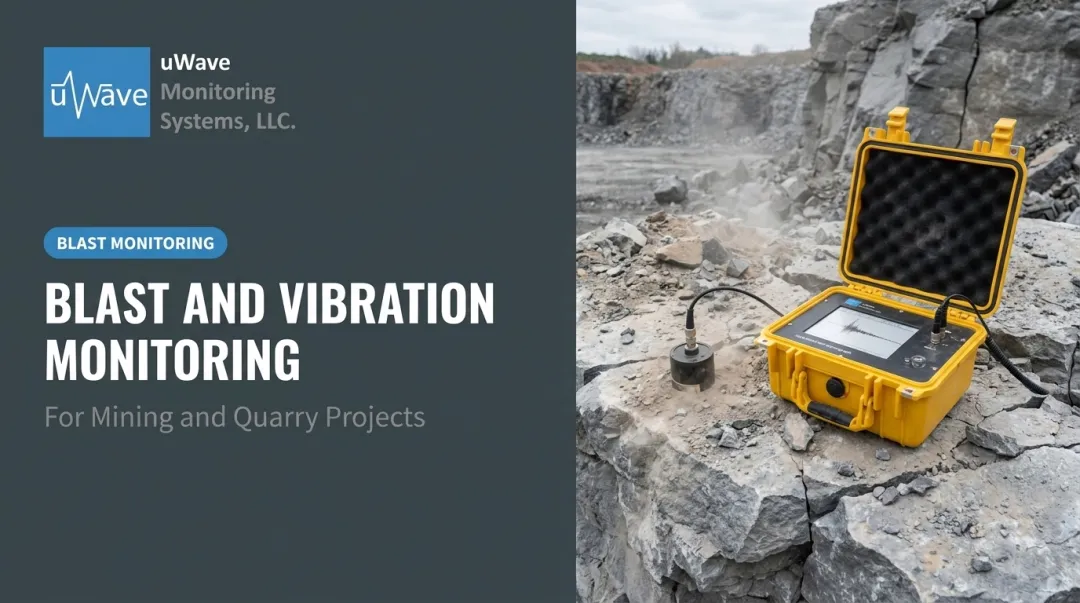
Seismographs with triaxial geophones are the primary instrument for blast PPV monitoring. They capture waveforms in three axes simultaneously, record time-stamped event data, and produce the documentation required for regulatory submissions and permit compliance. The ISEE Field Practice Guidelines for Blasting Seismographs recommend a minimum sampling rate of 1,000 samples per second, trigger levels near 0.05 in/s, annual calibration, and placement within 10 feet of the structure being protected where practical.
Most operations choose between two deployment approaches:
- Single-event manual deployment: A seismograph is placed for a specific planned blast and retrieved afterward. Adequate for infrequent operations but creates gaps when blasts occur outside the planned window.
- Continuous/remote monitoring: Semi-permanently installed stations capture every blast and equipment vibration event automatically. This approach produces an unbroken compliance record and eliminates the risk of missing an event.
Continuous Remote Monitoring: Turning Data Into Compliance Confidence
Manual spot-checks create gaps. A blast that occurs outside the scheduled monitoring window leaves no record — and "no data" is not a defensible compliance position.
Cloud-hosted, continuous monitoring closes that gap. Every blast event, every noise exceedance, and every maintenance anomaly is captured, time-stamped, and stored automatically, creating a compliance record that's accessible remotely at any time.
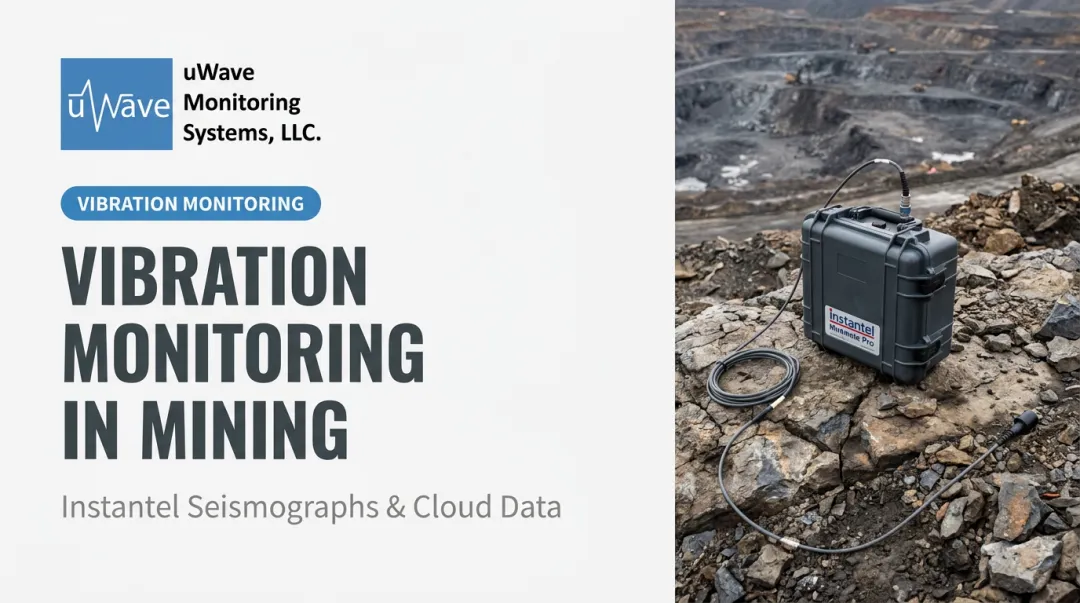
uWave Monitoring Systems deploys this approach using Instantel seismographs housed in V3 and V5 semi-permanent monitoring stations: weatherproof, solar-powered enclosures built for continuous field operation. Each station includes 30-watt solar panels, 12V AGM battery backup, and Sierra Wireless cellular modems for real-time data transmission.
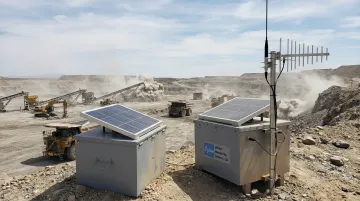
Stations can be secured with soil or concrete anchors and operate reliably from -40°C to 55°C — covering the full temperature range of active mining environments.
Data flows directly to the uWave Project Manager cloud platform, which provides:
- Access live and historical monitoring data from any device, 24/7
- Receive automated email and text alerts the moment vibration or sound thresholds are exceeded — no one needs to be on site to detect a problem
- Track battery voltage, cellular connectivity, and calibration schedules to prevent silent monitoring failures at remote sites
- Generate structured reports from raw sensor data for regulatory submissions and community communication
- Retain secure data backup so no event record is lost, even during temporary connectivity interruptions
For mining operators managing multiple blast monitoring stations across a large site, bulk monitoring package discounts are available — pricing is provided on request at info@uwavems.com.
Building Your Noise and Vibration Control Strategy
A defensible control strategy starts with measurement. Engineering controls, administrative schedules, and PPE requirements all depend on actual noise levels and vibration data — gathered from the specific tasks and locations generating exposure, not estimated from reference tables.
uWave offers complete remote monitoring station rentals — seismograph, enclosure, solar panel, cellular modem, and cloud platform access included — as a straightforward way to establish that baseline without committing to a major equipment purchase upfront.
The Practical Control Hierarchy for Mining
Once baseline data is in hand, work through controls in order:
- Engineering controls first — equipment enclosures, vibration isolation mounts, quieter replacement components, cab retrofits for haul trucks
- Administrative controls second — worker rotation schedules, relocating rest areas away from high-noise zones, scheduling the loudest operations during lower-occupancy periods
- PPE for residual exposure — after feasible controls are documented and in place, assign appropriate hearing protection based on actual measured attenuation needs
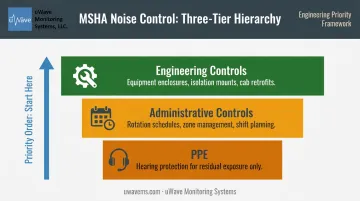
Each tier should be informed by monitoring data, not estimates. Controls applied without measurement leave compliance exposure that no paperwork can fix.
Compliance Doesn't End at Initial Certification
Continuous monitoring must persist as equipment ages, operations expand, and permit conditions evolve. A compliant hearing conservation program requires more than a one-time baseline:
- Ongoing audiometric testing for exposed workers
- Monitoring updates whenever tasks, equipment, or work areas change
- Documented evidence of sustained, good-faith compliance over time
An unbroken monitoring record — automatically generated by a cloud-connected system — gives MSHA inspectors and state regulators a timestamped, gap-free account of your compliance history.
Frequently Asked Questions
Does MSHA require noise dosimeters for mining noise monitoring?
30 CFR Part 62 requires full-shift noise monitoring set to a 90 dB criterion level, 5 dB exchange rate, A-weighting, and slow response. MSHA compliance determinations rely on personal dosimeter samples, though the regulation specifies performance settings rather than a particular instrument model.
What is the "rule of 5" in noise monitoring?
MSHA's 5 dB exchange rate means that for every 5 dB increase in noise level above the 90 dBA criterion, allowable exposure time is halved — so at 100 dBA, a worker may only be exposed for 2 hours. This is less protective than the 3 dB equal-energy rule recommended by NIOSH and used internationally.
What are typical noise levels in mining?
Drills commonly reach 91–109 dBA, primary crushers 83–105 dBA, ventilation fans 86–109 dBA, and conveyors 85–101 dBA. Most of these sources routinely exceed the 85 dBA Action Level, and several can approach or surpass 100 dBA during normal operations — well above the 90 dBA PEL.
What methods are used for mining noise monitoring?
Personal noise dosimeters measure each worker's full-shift TWA dose and are the primary basis for MSHA compliance determinations. Area conditions are assessed with fixed sound level meters and boundary stations, while blast vibration is recorded using seismographs with triaxial geophones for permit compliance.
Why is vibration monitoring important in mining operations?
Blast and heavy equipment vibration can structurally damage nearby properties and violate permit conditions. Seismograph-recorded PPV data is required to demonstrate compliance during inspections and to respond to community damage claims — and many mine permits explicitly mandate instrumented records for every blast.
What is PPV and why does it matter in mining compliance?
Peak Particle Velocity (PPV), measured in inches per second, is the standard metric for blast-generated ground vibration. Federal thresholds under 30 CFR 816.67 set limits of 0.75–1.25 in/s for surface coal mining to protect neighboring structures, and seismograph records documenting PPV per blast are the primary compliance evidence operators must produce.