But bigger blasts bring bigger problems. Fragmentation control gets harder. Safety margins shrink if planning slips. Regulatory scrutiny increases. And the neighbors down the road start calling when their windows rattle.
Many quarry operators struggle with the same tension: push production targets higher while keeping vibration, airblast, and flyrock within limits that protect people and property. This article walks through how large quarry blasting actually works, the methods operators rely on, what it costs, and why vibration monitoring has become non-negotiable for any operation running multiple active blast zones.
Key Takeaways
- Large quarry blasts use bigger hole diameters and taller benches to move more rock per shot than construction blasting.
- Fragmentation quality directly affects crusher throughput, with well-engineered blasts improving output by 10% to 25%.
- Federal rules require a post-blast hazard check before anyone re-enters the site.
- Vibration and airblast limits are set at the state level, not nationally, so compliance is site-specific.
- Real-time seismograph monitoring reduces liability and supports community trust near sensitive areas.
What Is Large Quarry Blasting?
Quarry blasting is the controlled use of explosives to fragment rock at or near the surface for extraction. What makes a blast "large" isn't a fixed federal number. No regulatory agency publishes an official tonnage or diameter cutoff for the term.
Instead, scale shows up in the physical design:
- Larger hole diameters: often well beyond what a small construction crew would drill
- Taller benches: sometimes 15 to 21 meters high, based on published quarry case studies
- Higher tonnage per shot: case documentation from a 2013 MSHA investigation recorded a single blast producing roughly 8,900 tons of broken rock from 18 holes
How It Differs From Mining and Construction Blasting
Large quarry blasting sits between two other categories:
- Underground mining blasting targets ore or mineral deposits deep below surface, with different ventilation, confinement, and access constraints
- Small-scale construction blasting handles site prep or utility trenching with far smaller charge volumes
- Regulatory oversight also differs, with agencies like MSHA applying separate surface quarry standards compared to underground mine rules or local construction permits
Large surface quarries also frequently run multiple benches or blast zones at once. That adds real complexity to design coordination, timing sequences, and vibration monitoring across the site.
Why Blasting Matters for Large-Scale Quarry Operations
Blasting breaks rock faster than mechanical methods like ripping or hydraulic hammering, and it sets the foundation for the entire production chain that follows.
Efficiency and cost. A single engineered shot fragments rock volumes that ripping or hydraulic hammering can't touch at comparable speed. When fragmentation is dialed in correctly, secondary breakage drops and crushers spend less energy chewing through oversize material.
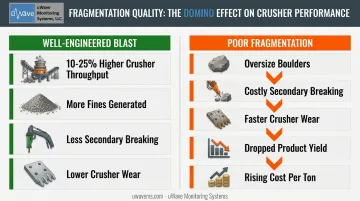
Fragmentation quality drives throughput. This is where blast design pays off downstream. According to Pit & Quarry's Drilling & Blasting handbook, properly engineered blasts can raise crusher throughput by 10% to 25% by generating more fines ahead of the primary crusher and eliminating oversize rock. That's not a guaranteed number for every site, but it shows how much is riding on getting burden, spacing, and timing right.
Poor fragmentation, on the other hand, creates a domino effect:
- Oversize boulders require costly secondary breaking
- Crushers work harder and wear faster
- Product yield drops
- Overall cost per ton climbs
Safety benefits. Controlled, engineered blasts reduce the risk of uncontrolled rockfalls compared to manual or unplanned rock removal. Every hole, delay, and charge weight is calculated in advance rather than improvised.
Amplified stakes at scale. Larger blasts release more energy. That means greater potential for ground vibration, air overpressure, and flyrock to reach surrounding communities and infrastructure. As blast size grows, so does the responsibility to manage what happens beyond the pit boundary.
The Large Quarry Blasting Process Step-by-Step
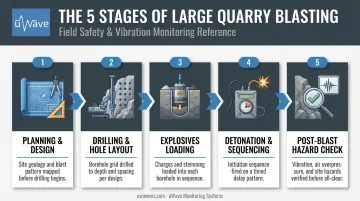
Large blasts follow a structured sequence. Skipping steps or rushing design work is where problems start.
Planning and Design
Every blast begins with a site survey and geological assessment. Engineers then calculate:
- Burden: distance from the hole to the free face
- Spacing: distance between holes
- Hole diameter: sized to bench height and rock hardness
- Bench height: tied directly to production targets
Manufacturer design guidance suggests hole diameter shouldn't exceed roughly 15 times the bench height in meters, with burden typically set at 25 to 40 times the hole diameter. These are starting-point rules, not universal answers.
Getting burden wrong in either direction causes trouble: too little increases airblast and flyrock risk, too much causes poor fragmentation and excessive ground vibration.
Drilling and Hole Layout
Drill rig selection depends on required tonnage, rock hardness, and bench height. Large operations lean toward larger-diameter holes because they move more rock per hole drilled, which improves overall drilling efficiency at scale.
Hole layout accuracy matters just as much: deviated holes throw off the burden and spacing calculations made during design, undermining fragmentation and vibration control downstream.
Explosives Loading
Large quarries typically load with:
- ANFO: ammonium nitrate and fuel oil, common and cost-effective, but with little water resistance
- Bulk emulsions: better suited to wet holes thanks to strong water resistance
- Heavy ANFO: an emulsion/ANFO blend that balances cost with improved performance in variable ground conditions
Bulk-loading systems are preferred at high-volume sites because they load holes faster and more consistently than bagged product.
Detonation and Sequencing
Electronic detonators provide millisecond-level timing control, which helps engineers manage fragmentation and vibration across dozens of holes fired in sequence rather than all at once. This sequencing is part of why large multi-hole blasts can be designed to reduce peak vibration compared to firing everything simultaneously.
Seismographs placed near sensitive structures confirm in real time whether this sequencing keeps vibration and airblast within permitted limits.
Post-Blast Procedures
Work cannot resume until a qualified person completes a hazard examination. Under 30 CFR Part 56, faces and muckpiles must be inspected for misfires before crews return to the area. Waiting periods for suspected misfires typically run 15 to 30 minutes, depending on the detonator type used.
Blasting Methods Used in Large Quarries
Different methods serve different goals within the same operation.
Bench Blasting
Large quarries use stepped benches to systematically control blast size, fragment size, and wall stability across a large working face. Each bench is blasted, mucked out, and cleared before the next lift proceeds. This method supports both production volume and structural stability of the pit walls over time.
Controlled and Presplit Blasting
Presplitting fires a single row of small, decoupled charges along the desired excavation line before the main production blast. This technique protects the final wall rather than moving material, limiting overbreak near sensitive boundaries and property lines. Because these blasts occur near existing structures, operators often pair presplitting with vibration monitoring for compliance.
Open Pit and Surface Blasting
This is the dominant approach for large-scale surface quarries producing aggregate, dimension stone, or industrial minerals. Rather than a single blast pattern, it describes the overall operating context linking bench blasting and presplitting:
- Bench blasting controls fragmentation and wall stability across successive lifts
- Presplitting protects the final wall line near sensitive boundaries
- Open pit blasting sets the production context connecting both methods
Safety, Vibration Control & Monitoring in Large Quarry Blasting
Bigger blasts release more energy. That energy has to go somewhere, and some of it travels as ground vibration and air overpressure toward the nearest structures.
Vibration limits vary by state. There's no single national quarry vibration standard. Maine, for example, caps airblast at 129 dB and sets frequency-dependent peak particle velocity (PPV) limits under its performance standards for quarries.
Rhode Island's explosives law sets a separate PPV limit of up to 0.5 inches per second at lower frequencies near the nearest structure. Operators running sites across state lines need to know exactly which rules apply where.
Standard Safety Protocols
Meeting those limits starts long before the shot fires. Every large blast follows a set sequence of safety checks that protects crews, equipment, and nearby residents, regardless of which state's rules apply:
- Exclusion zones cleared of personnel and equipment
- Pre-blast briefings covering timing, sequencing, and evacuation routes
- Remote detonation to keep blasters at a safe distance
- Audible warnings and guarded access roads
The Role of Seismographs
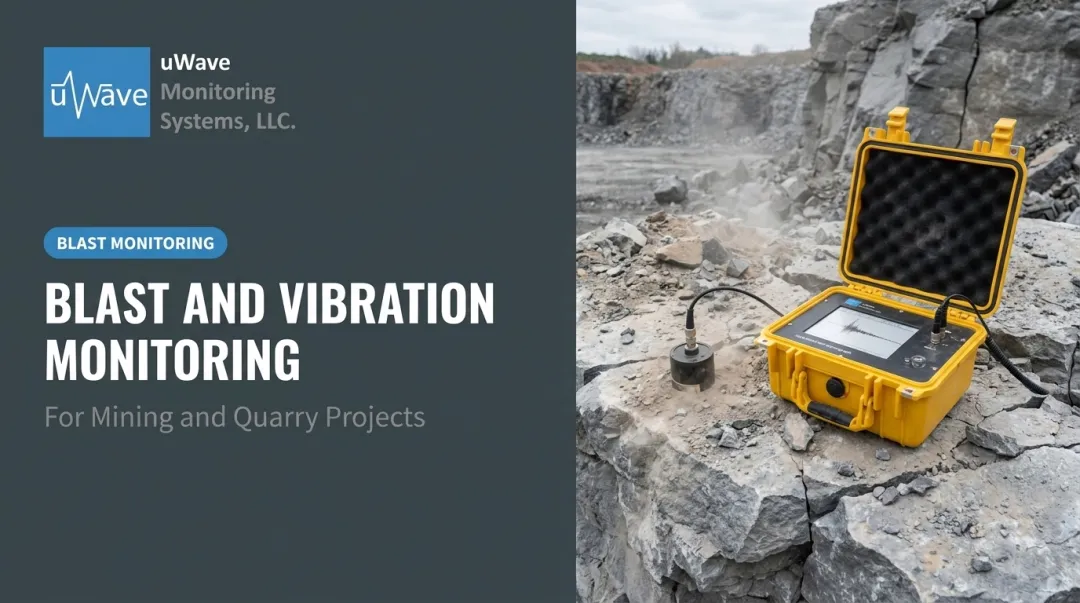
Seismographs measure peak particle velocity and air overpressure in real time, giving operators hard data to compare against permit limits. Geophones are typically buried a few inches and placed near sensitive structures to capture accurate ground motion readings.
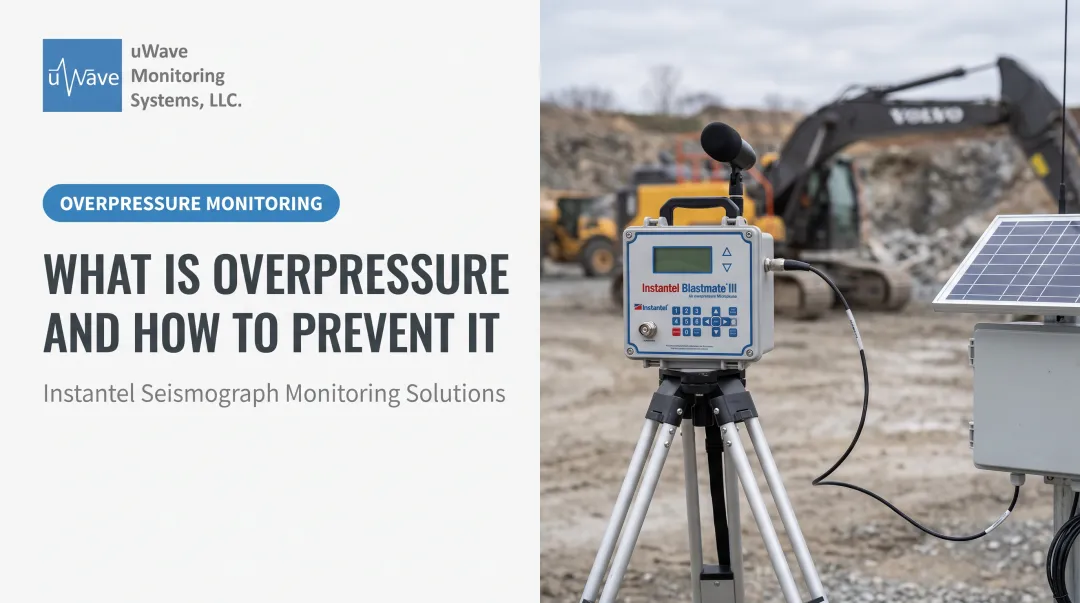
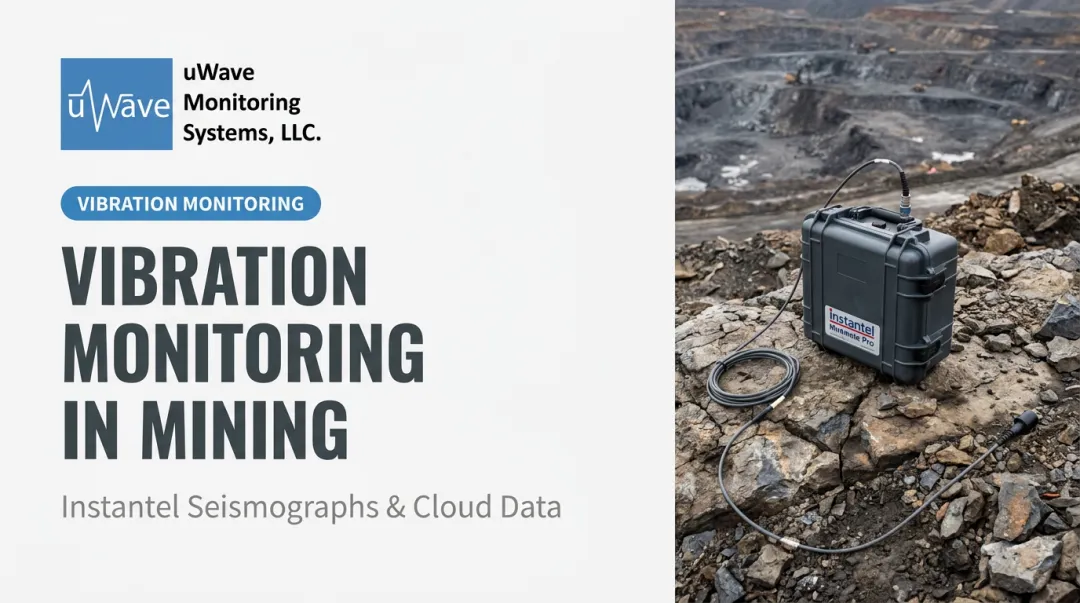
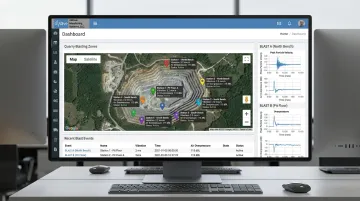
This is where monitoring equipment earns its keep on large sites. uWave Monitoring Systems supplies Instantel seismographs, including the Micromate, Minimate Pro, and Blastmate III, all built to record vibration and air overpressure data simultaneously and compatible with cloud-based reporting.
For quarries running multiple active benches at once, that connectivity matters more than the instrument alone:
- Remote monitoring stations run on solar power with cellular modems for 24/7 unattended data collection across scattered benches
- Automated alerts via email and text notify safety teams the moment a threshold is crossed, without anyone needing to watch a dashboard
- Maintenance alerts flag low battery or lost connectivity before a gap in data becomes a compliance headache
- Centralized cloud access via the uWave Project Manager platform shows every monitoring point across all blast zones from one login
Why This Matters Beyond Compliance
Proactive monitoring does more than satisfy a permit condition. When a quarry can hand a nearby resident an actual seismograph reading after a complaint, that's a very different conversation than "trust us, it was within limits." Transparent data builds credibility and reduces the odds of a complaint turning into a legal claim.
How Much Does Quarry Blasting Cost?
There's no single, defensible national price per ton or per blast for large quarry operations. Costs are driven by site-specific variables that shift from one quarry to the next.
Primary cost drivers:
- Hole diameter and depth: larger holes cost more to drill but move more rock per hole
- Explosive volume and type: ANFO, emulsion, and Heavy ANFO carry different price points based on water resistance and performance needs
- Rock hardness: harder rock requires more drilling time and often more explosive energy
- Bench depth and geometry: taller benches change burden, spacing, and stemming requirements
Major cost components include:
- Drilling (rig time, bit wear, labor)
- Explosives and blasting accessories
- Detonation systems, including electronic detonators for precise sequencing
- Compliance and monitoring services, including seismograph rentals or purchases
Skimping on blast design or monitoring rarely saves money long-term. Poor fragmentation drives up crusher costs, and missed compliance data invites fines.
A vibration complaint that turns into a lawsuit costs far more than the seismograph that could have documented compliance from day one. Investing in accurate blast design and consistent monitoring reduces re-drilling, community friction, and regulatory risk over the life of an operation.
Frequently Asked Questions
How much does quarry blasting cost?
Costs vary by hole size, explosive type, rock hardness, and bench depth, so there's no fixed national rate. Total cost is best measured as cost per ton of finished aggregate rather than a flat per-blast price.
What is the difference between quarry blasting and mining blasting?
Quarry blasting typically extracts aggregate or stone at or near the surface, while mining blasting often targets underground ore or mineral deposits. Both fall under mine safety regulations, but the extraction methods and site conditions differ significantly.
How far can quarry blasting vibrations travel?
There's no fixed compliance distance. Vibration travel depends on charge weight per delay, distance from the blast, and local geology, which is why seismograph monitoring at specific structures matters more than general estimates.
How often do large quarries conduct blasting?
Blast frequency depends on production demand and site size, ranging from a few times per week to nearly daily at high-volume operations. Some states, like Maine, cap the maximum number of blasts allowed per day.
What regulations govern large quarry blasting?
Federal rules under 30 CFR Part 56 cover blast-site safety, evacuation, and post-blast hazard checks. Vibration and airblast limits, however, are typically set by state law and vary by jurisdiction.
How is blast vibration monitored at quarry sites?
Seismographs with geophones and microphones are placed near sensitive structures to record peak particle velocity and air overpressure during each shot. Cloud-connected systems, like those offered through uWave Monitoring Systems, add real-time alerts and remote access across multiple blast zones.