Introduction
Right now, thousands of seismographs are recording the ground beneath your feet. Not just during earthquakes — continuously, every second, whether the earth is calm or shaking.
The scale is bigger than most people realize. EarthScope's Global Seismographic Network alone runs roughly 150 digital stations distributed across the planet, feeding free, real-time data into hazard research and early-warning systems.
Yet ask most people to explain the difference between a "seismograph," a "seismometer," and the "Richter scale," and you'll get a shrug. These terms get used interchangeably, but they describe different things entirely.
This guide breaks down exactly how a seismograph detects, processes, and records ground motion, step by step, from the first wave to the finished readout.
Key Takeaways
- Seismographs use an inertial mass that resists movement while the instrument frame moves with the ground
- Detection, damping, and digital recording turn ground motion into a seismogram
- Seismometer, seismograph, and seismogram mean sensor, full system, and output record
- Sensor type (short-period, broadband, strong-motion) determines what frequency and intensity range gets captured
- That inertial-detection principle also powers vibration monitoring on construction and mining sites
What Is a Seismograph?
A seismograph is the complete instrument system that detects, measures, and records ground motion. Three related terms get mixed up constantly, so here's the breakdown:
| Term | What it actually is |
|---|---|
| Seismometer | The internal sensing element: the pendulum, spring-mounted mass, or electronic sensor |
| Seismograph | The full recording system, including the seismometer and its output components |
| Seismogram | The resulting record of ground shaking |
According to USGS, these terms are sometimes used interchangeably in casual conversation, but the distinction matters when you're trying to understand what's actually happening inside the box.
From Seismoscopes to Digital Sensors
The concept isn't new. Zhang Heng built a seismoscope in China around A.D. 132 — an instrument that indicated an earthquake had occurred and roughly which direction it came from, but didn't produce a waveform record. The first true seismograph, capable of recording actual ground motion over time, came from Filippo Cecchi in 1875. Today's digital instruments still follow that same core idea: measure motion continuously and preserve the waveform.
Not the Richter Scale
A seismograph is not the Richter scale. The instrument records raw ground motion. The Richter scale is a logarithmic formula applied afterward, converting recorded amplitude into a single magnitude number. One is hardware; the other is math.
Three Types for Three Jobs
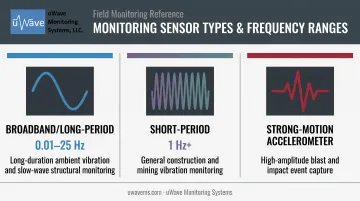
Most stations run three sensors simultaneously (one for north-south motion, one for east-west, and one vertical) to capture shaking from every direction. The sensor class varies by purpose:
- Broadband/long-period sensors: cover roughly 0.01 Hz to 25 Hz, ideal for regional and global signals
- Short-period sensors: tuned to 1 Hz and higher, better for local, high-frequency events
- Strong-motion accelerometers: built for large-amplitude shaking near major earthquakes without saturating
How Does a Seismograph Work?
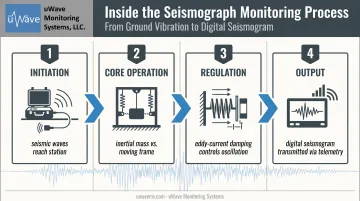
A seismograph runs through a defined sequence: continuous input, inertial detection, damping and regulation, then digital output. Each stage shapes how accurate the final seismogram turns out to be.
Initiation
Detection starts the instant seismic waves physically reach the station — no manual trigger involved. P-waves arrive first, followed by the slower, more damaging S-waves.
Modern instruments run continuously and automatically. That's a shift from older strong-motion units, which historically activated only once ground motion crossed a set threshold.
One frequent bottleneck has nothing to do with electronics: installation quality. Poor coupling between the instrument and bedrock or foundation introduces noise or weakens the signal. A seismograph bolted loosely to a shifting surface will never produce clean data, no matter how good the sensor is.
Core Operation
Here's the principle in plain terms: a suspended mass resists movement due to inertia, while the surrounding frame moves along with the shaking ground. That difference in motion — frame moving, mass lagging — is what gets measured.
In modern electronic seismometers, this relative motion happens between a magnet and a coil, generating a proportional electrical voltage. That's a direct upgrade from the old pen-and-drum mechanical method, which physically scratched a line onto rotating paper.
Sensitivity determines the instrument's range. A station on quiet bedrock can pick up ground motion barely above background noise. A strong-motion accelerometer near an active fault needs to handle far larger accelerations without clipping the signal. Site noise conditions (traffic, wind, even ocean microseisms) directly affect how small a signal any given station can reliably detect.
Regulation and Control
Without damping, that suspended mass would keep oscillating long after the initial disturbance, smearing the record. Damping mechanisms — often using eddy-current induction — bring the mass back to rest quickly enough that the recorded trace reflects real-time shaking, not residual wobble.
Gain and sensor type get selected based on expected frequency and amplitude:
- Broadband sensors for long-period, distant signals
- Short-period sensors for local, higher-frequency events
- Strong-motion accelerometers for large nearby quakes
Get this stage wrong, and the consequences are immediate. A large nearby earthquake can exceed a sensor's recording capacity, clipping the waveform. A poorly calibrated gain setting can amplify background noise until it drowns out the actual signal. Either way, the data becomes unreliable.
Output and Result
The final product is a continuous digital waveform — the seismogram — plotting displacement, velocity, or acceleration against time.
That data doesn't stay local. It's transmitted via telemetry to central analysis networks for near real-time processing, feeding everything from academic research to early-warning alerts.
This is where the raw record becomes useful information. By comparing the P-wave and S-wave arrival time gap across multiple stations, seismologists calculate distance from each station, triangulate the epicenter, and determine magnitude. USGS explains that observations from three or more stations are what make epicenter triangulation possible: one station gives you a distance, three give you a location.
Where Seismographs Are Used
Permanent global and regional networks form the backbone of hazard research, earthquake early-warning systems, and aftershock studies. These stations work best on quiet bedrock, away from traffic and human activity.
Specialized versions also operate on volcanoes and the ocean floor. At a monitored volcano, six to eight seismometers within about 20 kilometers are typically needed for basic earthquake-location coverage.
The same inertial-detection principle extends well beyond earthquake science. Construction, mining, quarrying, and infrastructure projects rely on it too, aimed at a different problem: protecting nearby structures from blast and vibration damage while staying within regulatory limits.
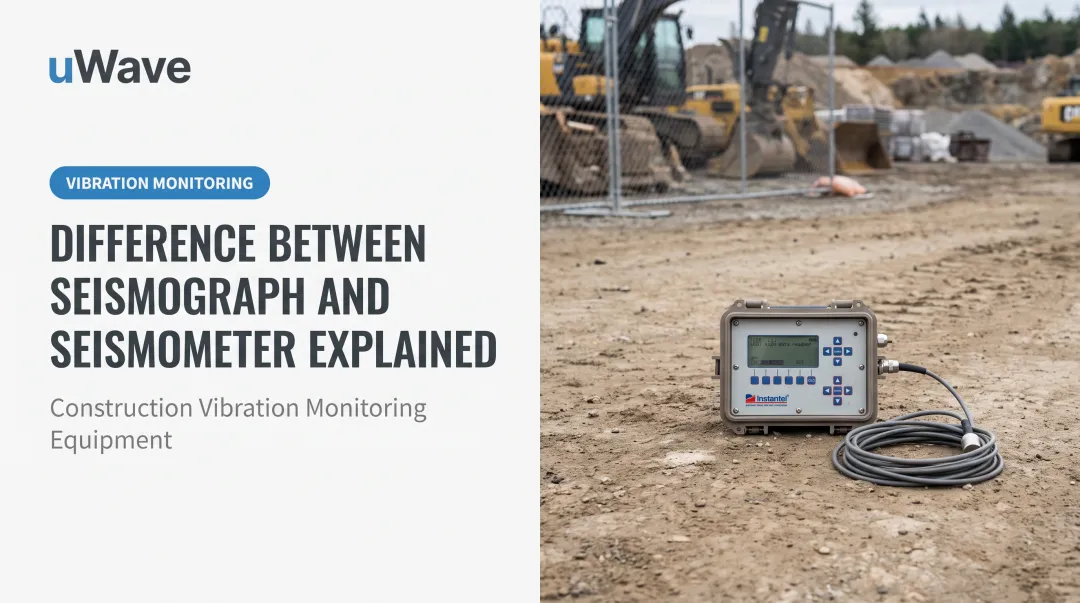
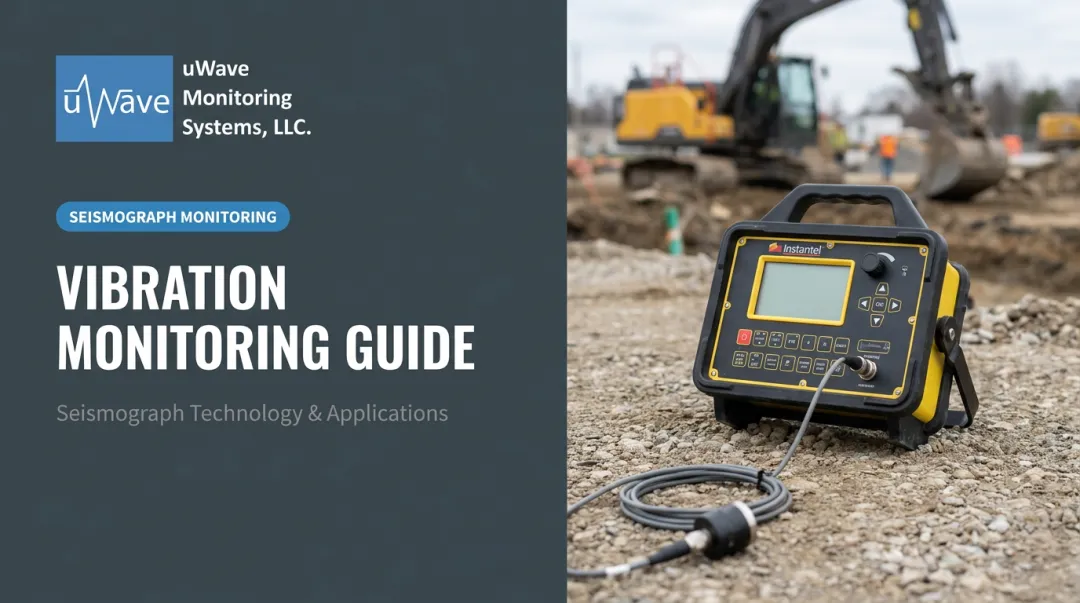
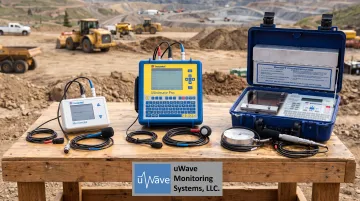
On those job sites, providers such as uWave Monitoring Systems supply Instantel seismographs built on the same mass-and-inertia sensing concept, recalibrated for construction frequencies and amplitudes rather than tectonic ones. As an Instantel authorized dealer, uWave rents and sells Micromate, Minimate Pro, and Blastmate III units for vibration, sound, and air-overpressure monitoring.
- Micromate: four channels, including a triaxial geophone for vibration plus a microphone channel for sound or air overpressure
- Minimate Pro: available in 4-channel and 6-channel configurations, supporting geophones, accelerometers, hydrophones, and sound-level microphones
- Blastmate III: measures ground vibration and air overpressure, with peak sound monitoring from 50–110 dB(A)
uWave pairs the hardware with solar-powered remote monitoring stations (enclosures with 30-watt solar modules, cellular modems, and battery systems) that send data to its cloud-based Project Manager platform. Teams use the platform for:
- 24/7 project access and secure data hosting
- Customized compliance reports
- Automated email and text alerts when vibration or sound crosses a threshold
- Maintenance alerts that flag equipment issues before data gaps appear
Whether it's excavation near a residential building, pile driving on a transit line, or tunnel boring under a water main, the goal matches earthquake seismology: turn imperceptible ground motion into a number someone can act on.
Conclusion
A seismograph does one job: it converts imperceptible ground motion into measurable data, using inertia to detect movement, damping to keep the reading clean, and digital recording to preserve it.
That logic applies whether you're reading a global earthquake report or monitoring vibration compliance on a construction site. Once you understand how the instrument actually works, it's easier to see why installation quality, calibration, and choosing the right sensor type matter. Those choices separate reliable data from noise.
Frequently Asked Questions
How do you read a seismograph?
A seismogram's horizontal axis represents time, and the vertical axis shows ground motion. A relatively flat line means low activity, while sharp wiggles mark the arrival of P-waves and, shortly after, S-waves.
How sensitive is a seismograph?
Sensitivity depends on sensor type, site noise, and installation quality. Quiet bedrock sites can detect very small ground motions, while strong-motion accelerometers capture large shaking without saturating.
What does a seismograph look like?
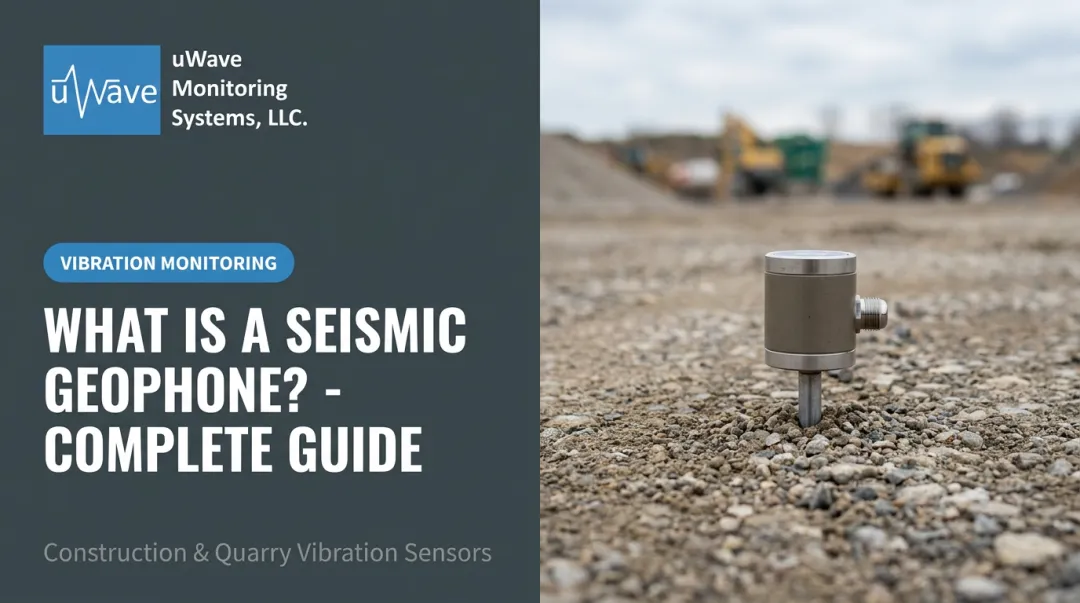
Modern seismographs are compact electronic sensor units, often cylindrical, either buried or bolted to bedrock and connected to a digital recorder. Older pen-and-drum models scratched a record directly onto paper.
What is the difference between a seismograph and the Richter scale?
A seismograph is the physical instrument that records ground motion. The Richter scale is a mathematical formula that converts the recorded amplitude data into a single magnitude number.
What is the difference between a seismograph and a seismometer?
The seismometer is the internal sensing component: the mass-and-spring or electronic sensor. The seismograph is the complete system, including the parts that produce a readable output.
How do seismographs help locate an earthquake's epicenter?
Seismologists compare P-wave and S-wave arrival time differences at three or more stations. Each gap converts to a distance from that station, and where those distances intersect marks the epicenter.