Introduction
On construction, mining, and infrastructure projects, one undetected vibration exceedance near a historic structure or active utility corridor can trigger damage claims, permit suspensions, and contractor liability that far exceed the cost of an entire monitoring program. The financial exposure is real — and it's preventable.
Yet many project teams still treat vibration monitoring as a compliance checkbox rather than a daily operational tool. In practice, wireless monitoring protects assets, keeps projects on schedule, and creates the documented proof required when disputes arise.
This article covers the practical benefits of wireless vibration monitoring — what it actually does on a job site, where it delivers the most value, and what happens when it's skipped.
Key Takeaways
- Wireless vibration sensors stream real-time data to the cloud, giving you 24/7 remote site visibility with no wired infrastructure
- Automated threshold alerts stop problems before they escalate — no one needs to be on-site to know an exceedance occurred
- Cloud-hosted records create an auditable compliance history for permits, insurance claims, and disputes
- Battery-powered stations deploy in hours and reposition easily as site conditions change
- Rental options make professional-grade monitoring accessible for projects of any duration
What Is Wireless Vibration Monitoring?
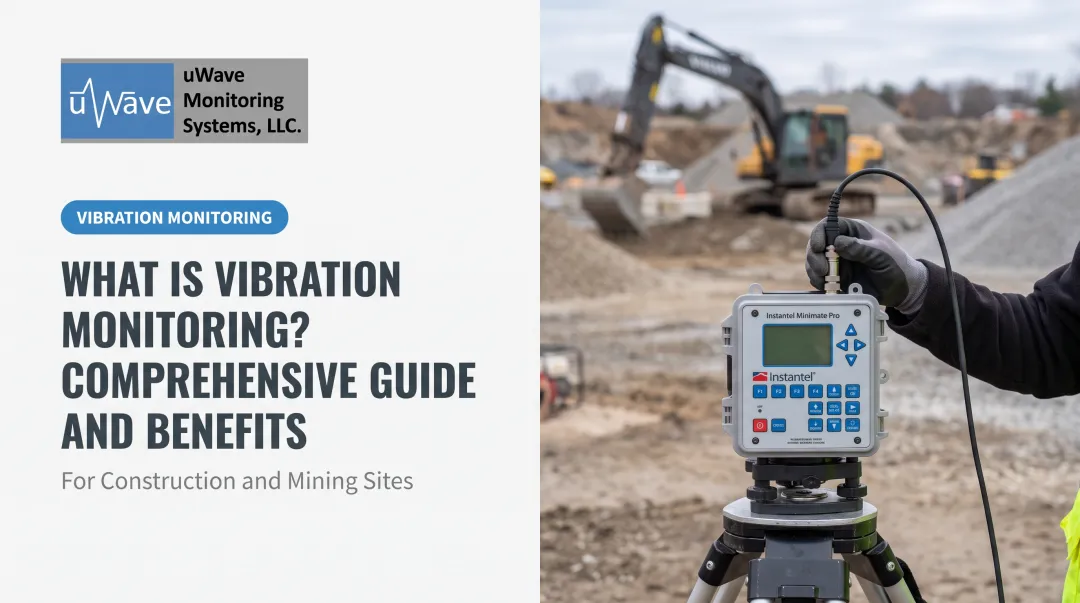
Wireless vibration monitoring uses battery-powered, network-connected sensors — primarily triaxial geophones paired with seismograph units — to continuously measure ground and structural vibration and transmit that data to a cloud platform in real time. No conduit, no cable runs, no connection to site electrical.
Typical deployment contexts include:
- Active construction adjacent to occupied structures or utilities
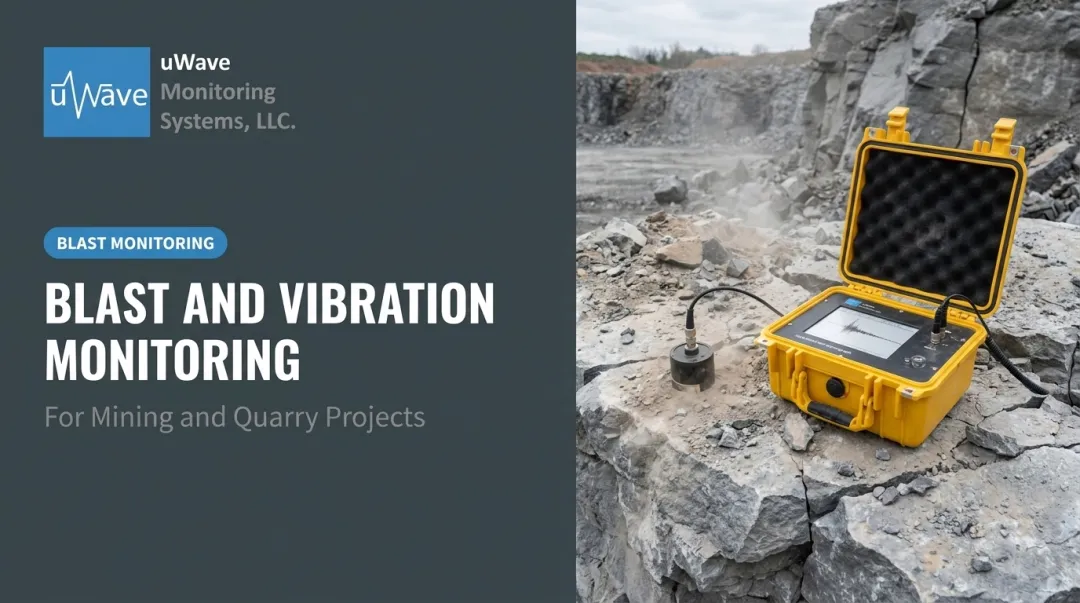
- Mining and quarrying operations subject to blast PPV limits
- Transit corridor projects near rail infrastructure or historic buildings
- Water main upgrades and urban utility work
- Multi-phase land development where site conditions evolve weekly
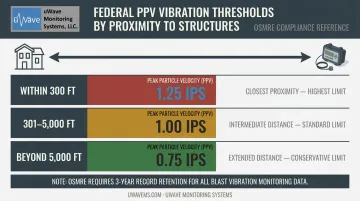
The core measurement unit is peak particle velocity (PPV), expressed in inches per second. Federal limits under OSMRE blasting guidance vary by distance from the nearest structure, with blast records required for a minimum of three years:
The core measurement unit is peak particle velocity (PPV), expressed in inches per second. Federal limits under OSMRE blasting guidance vary by distance from the nearest structure, with blast records required for a minimum of three years:
| Distance from Structure | Federal PPV Limit |
|---|---|
| Within 300 ft | 1.25 ips |
| 301 – 5,000 ft | 1.00 ips |
| Beyond 5,000 ft | 0.75 ips |
For transportation and construction projects, Caltrans' vibration guidance identifies architectural damage risk for continuous vibration at just 0.2 in/sec PPV, a threshold that periodic spot-checks routinely miss.
Wireless monitoring addresses both sides of that risk: contractors get real-time alerts before a limit is breached, and project owners get a defensible compliance record when it's over.
Key Advantages of Wireless Vibration Monitoring
Real-Time Alerts That Stop Problems Before They Escalate
The most operationally significant advantage of wireless monitoring is immediate notification — automated email and text alerts the moment a reading crosses a pre-set threshold. The project team is notified within seconds of a threshold trigger — not after a log review the next morning.
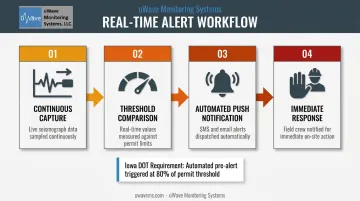
Here's how it works in practice:
- Continuous capture — sensors record vibration data throughout all active operations
- Threshold comparison — readings are checked against pre-set limits tied to regulatory standards or permit conditions
- Automated push notification — when a limit is approached or exceeded, designated team members receive alerts via email and SMS
- Immediate response — crews can halt pile driving, suspend blasting, or reduce equipment loads before a secondary damage event occurs
This model is now reflected directly in agency specifications. Iowa DOT's Special Provision SP-236020 (effective August 2024) requires continuous electronic logging, alarms triggered at 80% of the 0.2 ips PPV limit, automatic phone notification to the engineer and contractor, and immediate cessation of all site activity upon exceedance.
The liability case is just as direct. Travelers' construction risk guidance notes that residents can perceive vibration, allege damage, and file claims even when actual structural damage is unlikely. Real-time alerting interrupts that chain before a complaint escalates into an insurance event.
This advantage matters most on:
- Urban infill projects near occupied buildings
- Sites within influence zones of historic structures, hospitals, or water mains
- Any project where a single exceedance carries significant permit or insurance exposure
Cloud-Hosted Data for Compliance Documentation and Dispute Resolution
Every reading, alert, and threshold event recorded by a wireless monitoring system gets archived automatically to a cloud platform — timestamped, backed up, and retrievable on demand. That continuous record is what separates a defensible compliance position from an exposed one.
Manual spot checks don't produce that record. A technician visiting twice a week creates documentation gaps — leaving contractors unable to prove what happened during the hours no one was on site.
Cloud-hosted records support:
- Permit compliance reviews — many agencies now require complete vibration logs as a permit condition. Projects near New York City water infrastructure, for instance, have required independent monitoring, pre-construction crack surveys, and prompt blast-data submission to DEP engineers
- Insurance claims — a time-synchronized, gap-free vibration history carries far more weight than a manual log when a neighbor alleges damage
- Third-party disputes — cloud records provide an unambiguous, timestamped account of what levels were recorded and when, leaving no room for contested interpretations
OSMRE requires contractors to retain blast records for at least three years. Continuous cloud-archived data satisfies that requirement automatically.
This advantage matters most on:
- High-density urban projects near infrastructure with low vibration tolerances
- Work subject to strict permit conditions in transit, utility, and municipal development contexts
- Any project where a third-party damage claim is a realistic outcome
Rapid Deployment and Scalability Without Wired Infrastructure
A fully operational wireless monitoring station can be installed on a job site in hours. No conduit, no electrical tie-ins, no contractor coordination for power access. Battery-powered units with cellular LTE modems can be positioned on any structure, stake, or barrier and begin transmitting live data immediately.
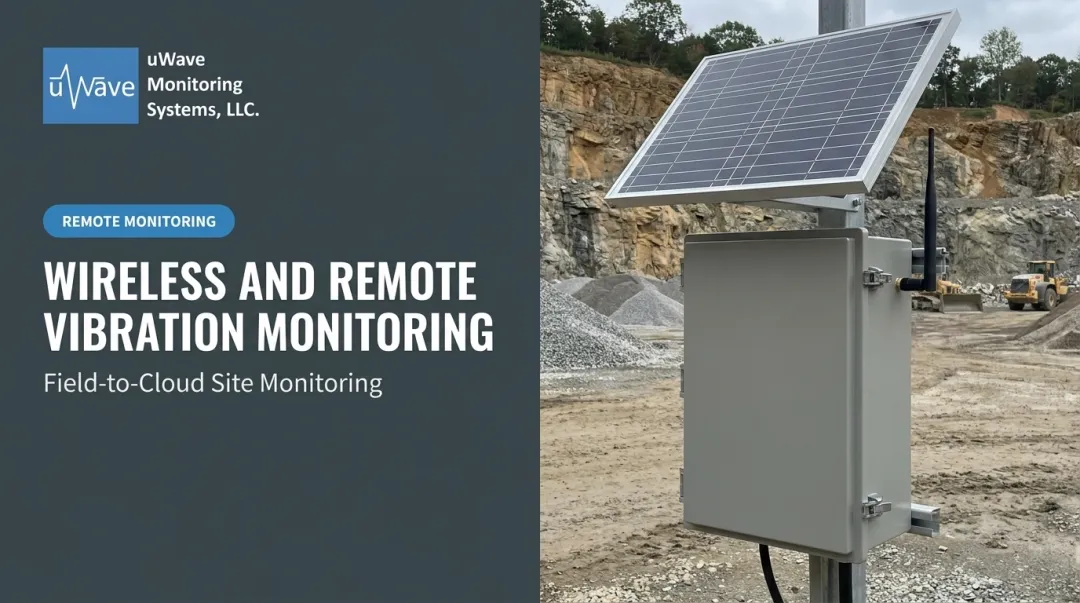
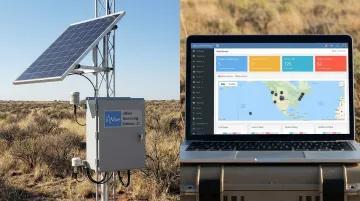
uWave Monitoring Systems' V3 (Heavy Duty) and V5 (Medium Duty) remote monitoring stations illustrate this deployment model directly. Each station includes a 30-watt solar module, onboard battery, cellular modem, and lockable enclosure — anchored to soil with rebar or to concrete with standard hardware. A two-person crew can complete installation with hand tools: a shovel, a wrench, rebar, and a padlock. Remote software configuration is handled via the modem's IP address after the team leaves the site.
Key operational advantages of this model:
- No grid power required — solar charging with battery backup supports off-grid operation in remote quarry sites, greenfield development, and underground access points
- Multi-site visibility — uWave Project Manager consolidates monitoring data from multiple field locations into a single dashboard with a US map view, aggregate alert counts, and per-project reporting
- Repositionable as the site evolves — sensors can be relocated as excavation fronts advance or high-risk phases shift to new areas
- Scalable for multi-phase programs — bulk monitoring packages with volume discounts support organizations running several simultaneous deployments
Traditional wired monitoring is impractical on active sites where conditions change weekly. A wireless setup eliminates the protected window gap during early excavation or blasting phases — when risk is often highest — because deployment can happen immediately, before work begins.
This advantage matters most on:
- Multi-phase construction programs with shifting risk zones
- Remote mining and quarrying sites with no existing electrical infrastructure
- Urban projects where site access, staging areas, and adjacent structures change throughout the project lifecycle
What Happens When Wireless Vibration Monitoring Is Skipped
Project teams that rely on periodic manual checks — or skip monitoring entirely — run into the same problems, repeatedly:
- Exceedances go undetected in real time. Damage claims from neighboring property owners, utility operators, or transit authorities become the first signal — not an alert that could have stopped work before harm occurred
- Documentation gaps create legal exposure. Logs with time gaps offer no reliable record — making it nearly impossible to prove compliance or defend against a claim, even when no actual damage took place
- Operations continue at unsafe levels. Without threshold alerts, crews have no mechanism to know when vibration is approaching a limit. Regulatory shutdown or physical failure becomes the first signal
- Unplanned stoppages cost far more. Under Iowa DOT specifications, any exceedance triggers mandatory work suspension until a post-alarm survey identifies the cause and a lower-impact method is approved — a process that is significantly more disruptive when it's not anticipated
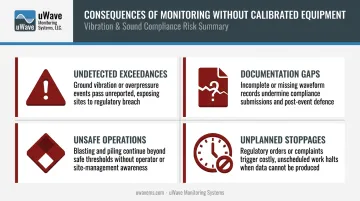
The Iowa DOT specification makes the compliance stakes explicit: monitoring equipment that fails daily testing or becomes unavailable triggers mandatory work suspension. Regulators treat the absence of monitoring as equivalent to a failed system.
How to Get the Most Value from Wireless Vibration Monitoring
Wireless monitoring delivers its full value when it's operational before work begins — not after the first complaint arrives. A few operational practices separate projects that use monitoring well from those that treat it as a box to check:
Before work starts:
- Deploy sensors and verify threshold settings against site-specific regulatory limits before any blasting, pile driving, or heavy excavation begins
- Confirm cellular signal at each monitoring location and test the alert notification chain
During the project:
- Review cloud data and alert logs regularly — not just when something triggers
- Adjust sensor placement as the site progresses and high-risk zones shift
- Use maintenance alerts to track calibration schedules and prevent equipment drift that compromises data accuracy
At key milestones:
- Generate compliance reports at phase transitions and permit review points, rather than scrambling for documentation at project closeout
- Retain cloud-archived records beyond project completion to satisfy multi-year retention requirements
These practices only work if the deployment model supports them. Rental systems with cloud hosting and automated alerts — like uWave Monitoring Systems' Field-to-Cloud platform — let project teams stand up monitoring quickly without capital equipment investment. For projects where requirements shift between phases, rental also eliminates the overhead of storing, calibrating, and managing owned equipment across the full program duration.
Conclusion
Wireless vibration monitoring delivers value in three concrete ways — each one directly affecting project outcomes:
- Real-time alerting stops damage before it compounds, keeping projects on schedule
- Complete data records prove compliance and protect against damage claims at closeout
- Rapid, flexible deployment puts coverage exactly where risk exists, from day one
None of these are theoretical. Together, they determine whether a project closes out clean.
Monitoring should be built into the site management plan from day one and treated as a project-long operational tool, not a reactive measure deployed after complaints surface. The regulatory landscape — from OSMRE blast-record retention requirements to Iowa DOT's mandatory real-time alerting specifications — is built around that assumption. Meeting those requirements is far easier when your data infrastructure is already running.
Frequently Asked Questions
Why is vibration monitoring important?
Undetected vibration exceedances can cause structural damage to nearby buildings, utilities, and infrastructure — and the first sign is often a damage claim, not an on-site alert. Continuous monitoring provides early warning to prevent damage and a documented compliance record required by regulators, permit authorities, and insurers.
What are the advantages of vibration sensors?
Vibration sensors provide real-time data without requiring manual site visits, trigger automatic alerts when thresholds are crossed, generate cloud-stored compliance records, and deploy quickly in remote or active construction environments without wired infrastructure.
What are the 5 pillars of condition monitoring?
The five pillars are vibration analysis, thermography, oil/lubricant analysis, ultrasonic testing, and visual inspection. For construction and infrastructure applications, vibration monitoring is the primary pillar — directly relevant to ground transmission, structural impact from heavy equipment, and blast activity.
What industries use wireless vibration monitoring?
Primary industries include heavy construction, mining and quarrying, transit and rail projects, water and utility infrastructure work, and urban and suburban land development — anywhere vibration-generating activity occurs near structures, utilities, or sensitive equipment.
How does wireless vibration monitoring work on a construction site?
Battery-powered seismographs mount at key positions on or near structures and transmit readings continuously via cellular connection to a cloud platform. Project managers receive automated alerts if readings approach or exceed set thresholds and can review all data remotely.
Can wireless vibration monitoring data be used as legal evidence?
Cloud-hosted, timestamped records from a properly calibrated system can support permit compliance reviews, insurance claims, and third-party damage disputes. Confirm that any provider offers data integrity protections and secure backup before deployment.