On the equipment side, the numbers are steep. Cummins notes that unplanned downtime on a mining dump truck or excavator could cost more than $1,000 per hour, an OEM benchmark that shows how expensive a single missed bearing fault can become. On the blasting side, regulators are watching closely. Community complaints about blast notifications, dust, and vibration remain an active compliance issue in mining regions, and every unmonitored blast is a potential violation waiting to happen.
This guide covers both disciplines: ground and blast vibration monitoring for compliance, and equipment condition monitoring for predictive maintenance. You'll learn how the technology works, what it delivers, and how to build a program that holds up in the field.
Key Takeaways
- Vibration monitoring covers two disciplines: blast compliance and equipment condition monitoring
- Seismographs track peak particle velocity, frequency, and duration to ensure regulatory compliance
- Continuous machinery monitoring catches bearing wear and misalignment before failures occur
- Field-to-cloud systems give mine managers 24/7 visibility with automated email and text alerts
- Strong programs need calibrated instruments, trained analysts, and documented response steps
What Is Vibration Monitoring in Mining?
Vibration monitoring in mining is the systematic measurement, recording, and analysis of vibrations produced by blasting, drilling, heavy equipment, and natural seismic activity. It spans two distinct disciplines that happen to rely on similar sensors.
Vibration sources generally fall into two categories. Transient ground vibration comes from blasting, drilling, and pile driving, tied to a specific event and measured in short bursts. Continuous mechanical vibration comes from rotating machinery like crushers, conveyors, motors, and pumps, measured around the clock.
Both categories serve overlapping purposes:
- Protecting worker health and nearby community structures from blast-induced shockwaves
- Ensuring regulatory compliance with blasting permits and environmental limits
- Enabling predictive maintenance on critical rotating assets before failures cascade into costly downtime
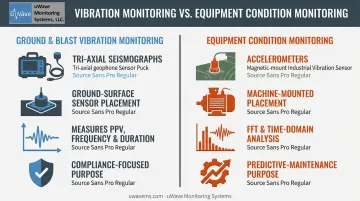
This article focuses on two primary disciplines built around those purposes. Ground and blast vibration monitoring uses tri-axial seismographs to protect structures and demonstrate compliance, while equipment condition monitoring uses accelerometers mounted directly on machinery to catch mechanical faults early.
Both rely on vibration sensors and transducers to capture motion data, but that's largely where the similarity ends. Sensor placement differs (ground surface near structures versus bolted to a machine housing), measurement units differ, and the expertise required to interpret results differs just as much.
A blasting engineer reading a seismograph waveform is asking a different question than a reliability technician reading an FFT spectrum off a gearbox.
Ground & Blast Vibration Monitoring: The Compliance and Safety Cornerstone
Blasting moves rock, but it also sends shockwaves through everything around it. Uncontrolled ground vibration can crack foundations, disturb underground workings, and draw regulatory scrutiny fast. Every blast is a legal event with a paper trail, and the seismograph is what generates that record.
How Seismographs Measure Blast Vibration
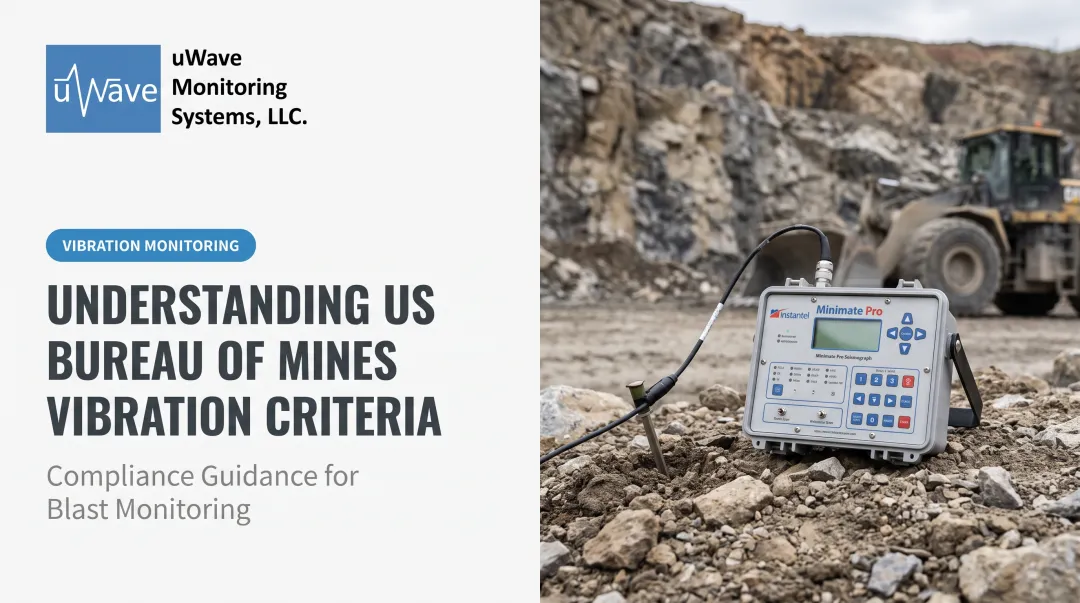
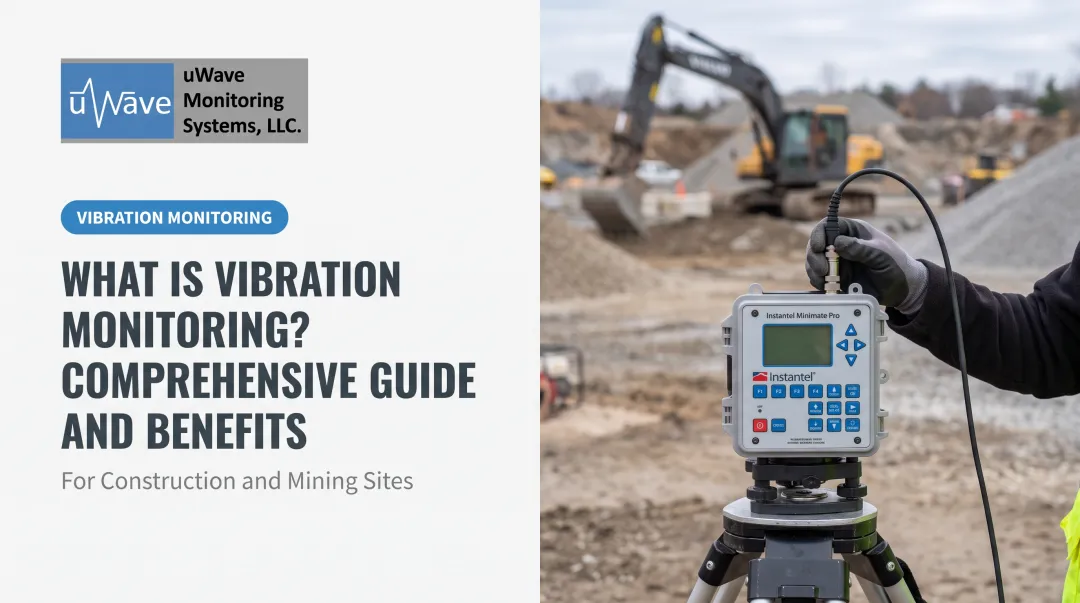
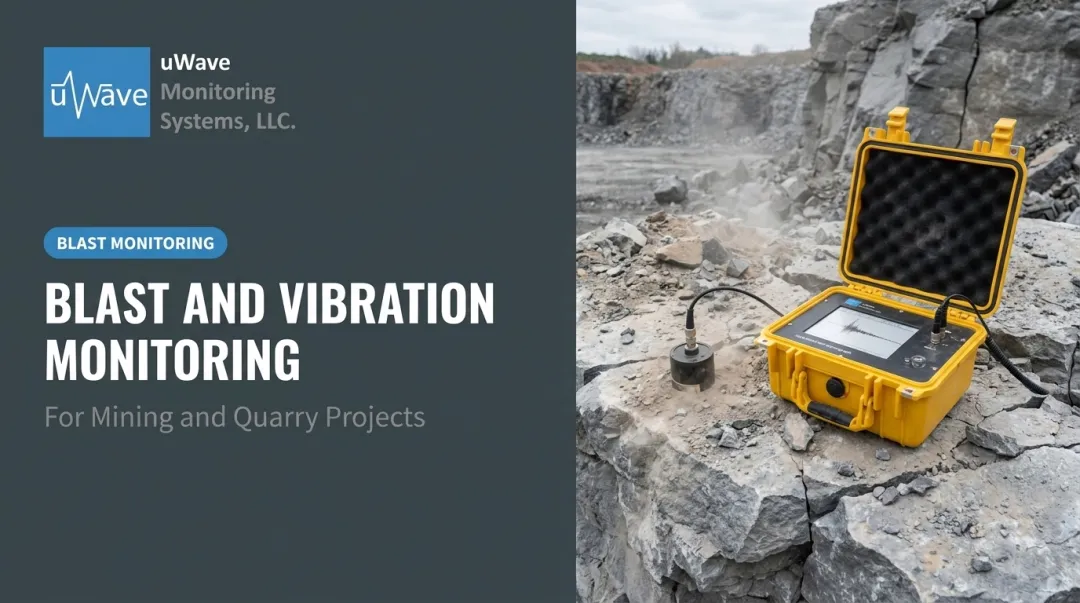
Tri-axial seismographs, such as the Instantel Micromate, Minimate Pro, and Blastmate III units, are placed at sensitive receptor locations: nearby residences, mine infrastructure, pipelines, and water supplies. Each records three things simultaneously:
- Peak Particle Velocity (PPV): the maximum speed at which ground particles move, measured in inches per second
- Frequency: how fast the vibration oscillates, measured in Hz
- Duration: how long the vibration event lasts
PPV without frequency doesn't tell the whole story. U.S. federal rules under the PPV compliance option set distance-based limits:
| Distance to Protected Structure | Maximum PPV |
|---|---|
| 0-300 ft | 1.25 in/s |
| 301-5,000 ft | 1.00 in/s |
| 5,001 ft or more | 0.75 in/s |
These are the 30 CFR 816.67 limits applied to homes, schools, and public buildings outside the permit area, and a seismographic record is required for every blast under this option. Once collected, engineers compare readings against those limits and the mine's own blast design criteria, then adjust charge weights, timing, and burden distances to keep future shots under control.
Protecting Structures, Communities & Workers
Continuous, remote ground vibration monitoring does more than satisfy a permit condition. It protects homes, roads, pipelines, and underground workings from the cumulative effects of blast damage that build up over months of repeated shots. It also gives community relations teams something concrete to reference when residents raise concerns about cracked walls or rattled windows.
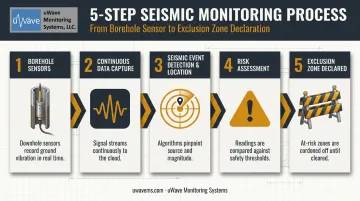
Underground, the stakes shift toward life safety. Deep hard-rock mines rely on seismic networks built from geophones and accelerometers, often positioned in boreholes, to detect and locate mining-induced seismic events such as rockbursts and fault-slip events.
NIOSH has tested more advanced approaches too, including a 14-sensor fiber-optic array mounted on longwall shields. That array picked up dozens of seismic events during an 80-hour monitoring window.
That data feeds directly into safety decisions. When elevated seismic risk shows up in a specific area, ground control teams use it as the factual basis for calling re-entry exclusion zones before someone walks into danger.
Field-to-Cloud Monitoring Simplifies Compliance
Manually retrieving data from a seismograph after every blast doesn't scale across a large site with multiple pits or a quarry running several shots a week. Field-to-cloud systems solve that by transmitting seismograph data directly to a cloud-hosted platform as soon as it's recorded.
That shift changes what compliance looks like day to day:
- 24/7 access to vibration and sound data from any device, no field trip required
- Automated email and text alerts the moment a threshold gets exceeded
- Instant reporting for regulators, insurers, or internal audits, instead of scrambling before a deadline
uWave Monitoring Systems offers this as a Field-to-Cloud rental, sales, and service model built around Instantel seismographs, giving mining, quarrying, and heavy construction operators a practical way to meet these demands.
The company's cloud platform, uWave Project Manager, bundles customized reporting, secure data backup, and maintenance alerts alongside vibration and sound threshold notifications. A manager overseeing several sites can check status from one dashboard instead of chasing spreadsheets from each location.
Equipment Condition Monitoring: Predictive Maintenance for Mining Machinery
Blasting isn't the only vibration mining operations need to watch. Rotating machinery—crushers, conveyors, pumps, motors, gearboxes—generates continuous mechanical vibration that changes character long before a component fails outright. Accelerometers mounted on that equipment track those changes and flag early signs of misalignment, imbalance, or bearing wear.
Three Ways Analysts Read Vibration Data
Reading that data takes more than a single number. Analysts typically lean on three methods:
- Time-domain analysis: plots amplitude against time, useful for spotting impacts and diagnosing gear or bearing issues from the waveform itself
- Frequency-domain analysis: uses an FFT to separate vibration into individual frequencies, exposing fault frequencies, harmonics, and severity trends a raw waveform hides
- Envelope analysis: filters out low-frequency noise to isolate the repetitive high-frequency impacts that signal early-stage bearing or gear defects
None of these are self-explanatory. Interpreting them accurately takes specialized training and dedicated analysis software, which is why serious condition monitoring programs staff or contract a reliability analyst rather than leaving it to whoever checks the dashboard.
A Real-World Catch: Caterpillar's Swing System Fault
The payoff shows up in real fault detection. Caterpillar's drivetrain analysts caught rising vibration in the swing system of a 7495 HR Electric Rope Shovel in October 2023. Inspection traced it to progressive gear-tooth damage on the swing rack, caused by an incorrectly applied lubricant film, well before it turned into a major failure.
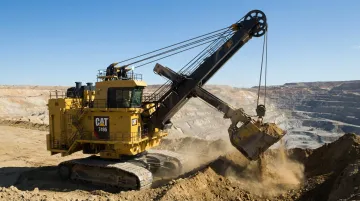
Caterpillar didn't publish a dollar figure for that catch, but the pattern is the point: a vibration signature changed weeks ahead of failure, and someone was watching closely enough to notice.
That's the core value of condition monitoring. It doesn't eliminate every failure, but it buys time to schedule a repair on your terms instead of reacting to a shovel that just went down mid-shift.
Key Benefits of Vibration Monitoring in Mining
Vibration monitoring earns its place in a mine's budget across several fronts at once:
- Safety enhancement: Real-time monitoring, whether tracking blast vibration near a pit wall or catching a bearing fault before it seizes, cuts the risk of structural collapse, catastrophic equipment failure, and worker injury. Underground seismic networks add another layer, letting ground control teams call exclusion zones before a rockburst hits.
- Cost savings: Shifting from fixed maintenance schedules to condition-based maintenance means fewer emergency repairs and less unplanned downtime. McKinsey research on digital maintenance and reliability programs found combined levers, including condition monitoring, can cut maintenance costs by 15-30% across mining and metals.
- Increased productivity: Fewer unplanned shutdowns keep material flow moving on schedule. Vibration data also lets engineers fine-tune blast charge weights and timing, meaning fewer re-blasts and steadier throughput at the crusher.
- Regulatory compliance: Continuous, documented vibration data is the clearest way a mine can demonstrate it's operating inside its permit conditions, even when regulators mandate specific monitoring locations or lower limits at their discretion.
- Community and stakeholder trust: Transparent, time-stamped vibration data reassures neighbors and regulators that blasting is managed responsibly, making tough conversations with concerned residents far easier.
- Extended equipment and asset lifespan: Early fault detection reduces cumulative stress on machinery, while controlled blast vibration protects infrastructure, pipelines, roads, and underground workings, extending time between major overhauls.
Building an Effective Vibration Monitoring Program
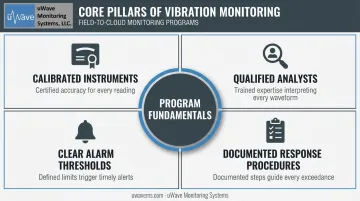
A monitoring program is only as good as the pieces holding it together. Four elements separate one that works from one that just generates data nobody trusts:
- Calibrated instruments: seismographs and accelerometers need current calibration certificates, or readings aren't defensible in a compliance dispute
- Qualified analysts: someone has to know how to read a waveform or FFT spectrum, not just glance at a pass/fail light
- Clear alarm thresholds: set before the first blast or the first bearing starts wearing, not after a near-miss
- Documented response procedures: a written plan for what happens the moment a threshold gets exceeded
With these fundamentals in place, the next decision is how to acquire the equipment. Rental vs. purchase. Short-term projects usually favor renting. A quarry running a six-month expansion doesn't need to own a seismograph it'll use twice a year.
Long-term, multi-site operations tend to come out ahead buying, especially with volume pricing. uWave Monitoring Systems offers both paths: bulk discounts on cloud data hosting, plus extended pricing on multiple-unit purchases of Micromate, Minimate Pro, and Blastmate III seismographs. Either way, a program can scale up or down without repricing from scratch.
Enclosures and connectivity built for the site. Standard equipment housings weren't designed for a haul road's dust or a pit's moisture. Custom enclosure design matters, and so does planning for cellular connectivity in areas with unreliable signal.
Remote communications consulting matches the right modem and antenna setup to a site's coverage. That keeps a monitoring station from going dark exactly when a blast happens.
Cloud platforms that do the watching for you. A cloud-hosted platform with automated threshold alerts, maintenance alerts, secure data backup, and 24/7 remote access turns raw vibration data into something a manager can actually use across multiple sites. That's the difference between a program that reacts to problems and one that catches them early.
Frequently Asked Questions
What is the difference between vibration monitoring and vibration analysis in mining?
Monitoring means measuring and recording vibration data from blasting or machinery. Analysis means interpreting that data, using waveforms, spectrums, or PPV comparisons, to diagnose a fault or confirm compliance.
How often should vibration monitoring be conducted in mining operations?
Blast vibration monitoring should run during every active blasting program, with a seismographic record for each shot under most regulatory frameworks. Equipment condition monitoring runs continuously or on a scheduled route, depending on asset criticality.
What is PPV (peak particle velocity) and why does it matter in blast monitoring?
PPV is the maximum velocity at which ground particles move during a blast, measured in inches per second. It's the primary figure regulators and engineers compare against permit limits to confirm a blast stayed within safe bounds.
Can vibration monitoring data be accessed remotely?
Yes. Field-to-cloud systems, such as the uWave Project Manager platform, transmit seismograph and sensor data straight to a web-based dashboard, giving mine managers 24/7 access along with automated email and text alerts whenever a threshold gets exceeded.
What mining equipment can be monitored for vibration?
Common targets include crushers, conveyors, pumps, motors, and gearboxes. Ground and structural monitoring near blast sites covers homes, roads, pipelines, and underground infrastructure as well.
Is vibration monitoring required by law in mining operations?
Many jurisdictions require blast vibration monitoring and reporting as a condition of operating permits, though limits and frequency vary by region. U.S. federal rules, for example, set distance-based PPV limits under 30 CFR 816.67.