Introduction
Blasting operations generate forces that don't stay at the blast site. Ground vibration travels through soil and rock at speeds up to 25,000 ft/s, while air overpressure radiates outward at roughly 1,100 ft/s — and both can reach neighboring structures long before anyone realizes there's a problem.
The consequences are real. In Franklin, Wisconsin, a quarry received nine vibration complaints from seven households in a single quarter — even though all 18 blasts complied with local limits of 0.30 in/s and 123 dB. Compliance and community acceptance aren't the same thing.
That distinction drives everything in this guide. It covers what blast and vibration monitoring is, how it works, the US regulatory framework, how to reduce vibration at the source, and what to look for when choosing a monitoring solution.
Key Takeaways:
- PPV (Peak Particle Velocity) is the primary US compliance metric under USBM RI 8507
- Federal limits (30 CFR 816/817) offer multiple compliance paths; state and local rules can be stricter
- Reducing maximum instantaneous charge (MIC) per delay is the most effective vibration control
- ISEE 2022 sets instrument standards: 2–250 Hz response, ≥1,000 samples/second, annual calibration
- Cloud-connected monitors provide real-time alerts and 24/7 remote data access
What Is Blast and Vibration Monitoring?
Blast and vibration monitoring is the measurement and recording of ground vibration (particle velocity) and air overpressure generated during blasting operations. Seismographic instruments placed near sensitive structures or along the blast perimeter capture both energy types after each shot.
The two energy types require separate measurement channels:
- Ground vibration travels through soil and rock as a mechanical wave, measured as particle velocity in in/s or mm/s. It arrives fast and poses the primary structural damage risk.
- Air overpressure propagates through the air as an acoustic shockwave, measured in decibels or Pascals. It arrives later but can rattle windows, stress facades, and generate noise complaints independently of ground motion.
Monitoring only one channel gives an incomplete picture — and regulators require both.
Where and When Is It Used?
Blast monitoring applies across any project where explosives are used near protected structures or populated areas:
- Surface mining and quarrying — ongoing operations with recurring blast events and defined permit conditions
- Underground mining — higher-magnitude events in confined rock environments
- Tunnel construction — urban or suburban bores where vibration can affect surface structures directly overhead
- Road and transit infrastructure — controlled blasting near existing roads, bridges, and rail lines
- Urban demolition — structure removal in dense areas with adjacent occupied buildings
- Water infrastructure upgrades — dam construction and pipeline projects in remote or semi-remote settings
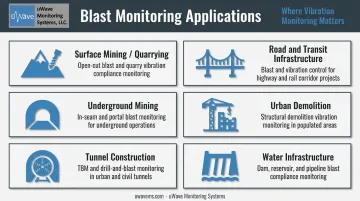
Urban demolition requires tighter PPV thresholds and more frequent monitoring locations. Remote water infrastructure projects, by contrast, demand self-powered, cellular-connected stations that can operate unattended for weeks.
Why Blast and Vibration Monitoring Matters
Structural Damage Risk
Excessive ground vibration can crack walls, foundations, and buried pipelines. The risk is highest near aging masonry, historic buildings, and residential neighborhoods built to older construction standards.
USBM RI 8507 establishes that safe PPV levels for residential structures range from 0.5 to 2.0 in/s, depending on vibration frequency and wall construction type. Lower frequencies receive lower allowable PPV because structures respond more strongly near resonant frequencies, which makes frequency measurement as important as PPV itself.
The Federal Transit Administration's construction vibration guidance sets damage-risk criteria as low as 0.12 in/s for buildings extremely susceptible to vibration — well below the federal mining thresholds that apply to most quarry operations.
Legal and Regulatory Exposure
Unmonitored blasts that cause damage create liability without defense. Monitoring creates a documented record — waveform data, calibration certificates, sensor placement notes — that can demonstrate compliance or refute exaggerated claims.
The regulatory stakes are concrete. Under 30 CFR 816.67, blast records must be retained for at least three years and made available for regulatory and public inspection. Failing to maintain those records — as occurred in the West Virginia enforcement case — compounds the violation beyond the PPV exceedance itself.
Community Trust and Operational Efficiency
Residents near blast zones often perceive vibration even when PPV levels are within limits. The Franklin, Wisconsin data illustrates this directly: the highest-cited complaint reading was 0.193 in/s PPV, well below the 0.30 in/s local limit. Proactive monitoring with transparent data reporting addresses perception as well as compliance.
Waveform data collected across multiple blast events also drives operational improvements:
- Identifies patterns in ground response across different charge configurations
- Supports fine-tuning of delay timing to reduce peak particle velocity
- Improves fragmentation results without increasing charge weight
- Reduces material costs and vibration exposure in a single adjustment
How Blast Vibration Monitoring Works: Equipment and Key Metrics
A complete blast vibration monitoring system has three core components:
- Triaxial sensor — measures ground motion on three mutually perpendicular axes (vertical, radial, transverse)
- Data logger / seismograph — digitizes and records the signal, typically with a triggered start when vibration exceeds a threshold
- Data transmission and storage — USB download, cellular modem, or cloud upload for analysis and reporting
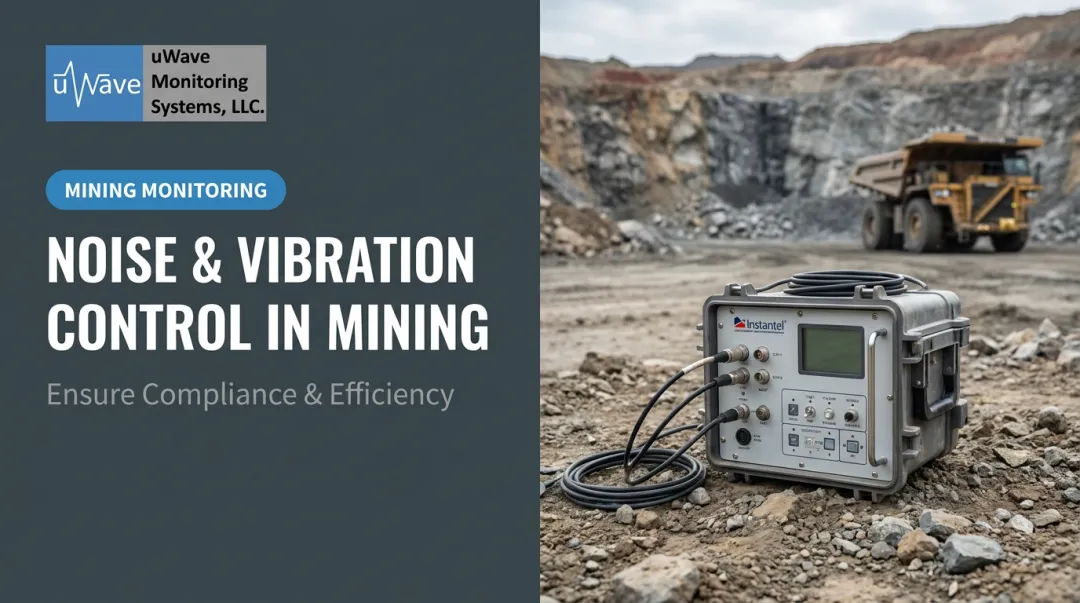
A fourth channel handles the microphone for air overpressure. Modern Instantel units like the Micromate® and Minimate Pro4™ (available for rental or purchase through uWave Monitoring Systems) capture all four channels simultaneously in a single instrument, eliminating the need for separate devices at each monitoring location.
Geophones vs. Accelerometers — Which Should You Use?
For US regulatory compliance, geophones are the standard choice. USBM RI 8507 and ISEE guidelines are written around particle velocity measurements, and triaxial geophones measure velocity directly. There is no conversion step, no additional uncertainty, and the data format matches what regulators expect.
The Instantel ISEE geophone (2–250 Hz) covers the frequency range required by ISEE 2022 and is appropriate for approximately 95% of construction and mining applications. A DIN 45669-1 Class 1 geophone (1–315 Hz) handles wider frequency response requirements or cable runs up to 3,280 feet.
Accelerometers — including MEMS sensors — are supported on the Minimate Pro4 and Pro6 platforms. They work well in two specific situations:
- Sensors must be mounted to a structure rather than coupled to the ground
- Applications require the Pro's higher sample rates (up to 65,536 samples/second)
However, no authoritative US regulatory guidance currently establishes MEMS accelerometers as an accepted substitute for velocity-based compliance monitoring on surface blasting projects.
Key Metrics Every Operator Should Know
| Metric | Definition | Compliance Role |
|---|---|---|
| PPV | Maximum particle velocity on any single axis, in in/s or mm/s | Primary US compliance metric |
| PVS | Vector resultant of all three axes simultaneously | Contextual; not the 30 CFR compliance metric |
| Air Overpressure | Pressure wave in air, reported in dB | Separate regulatory limit under 30 CFR 816.67 |
| Dominant Frequency | Frequency of the principal waveform peak | Required when using the Figure 1 frequency-dependent method |
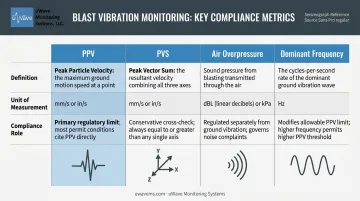
PPV is measured independently on each axis. The highest single-axis value is used for compliance comparison — not an average and not the PVS.
Regulatory Standards and Compliance in the US
The Federal Framework: 30 CFR 816/817 and USBM RI 8507
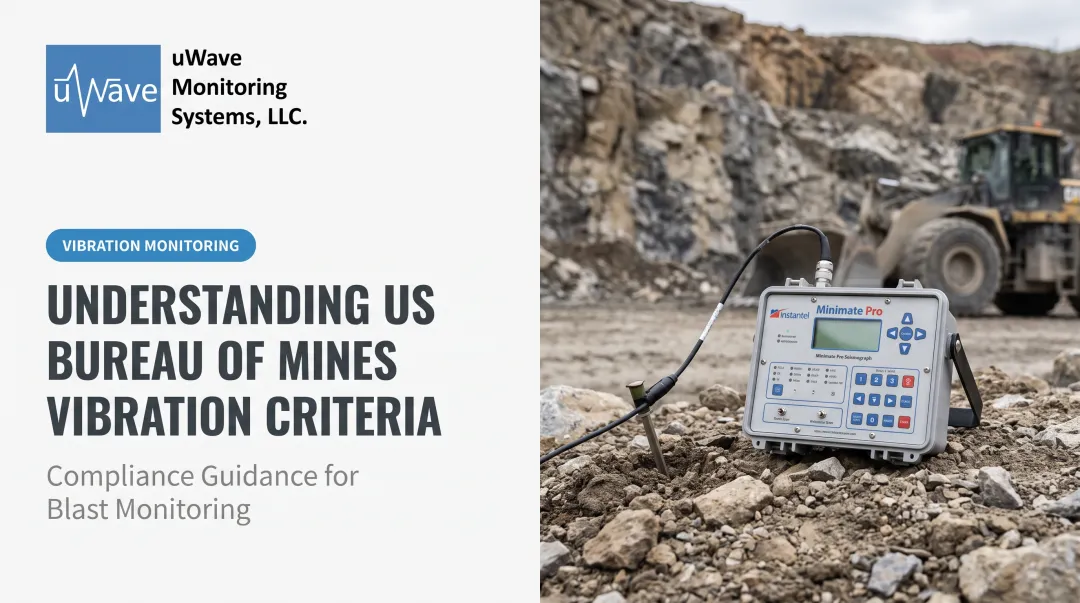
The Office of Surface Mining Reclamation and Enforcement (OSMRE) administers blast vibration standards for surface mining under 30 CFR Part 816 (surface activities) and Part 817 (underground activities). Both reference the same technical foundation: USBM RI 8507, which establishes frequency-dependent PPV limits rather than a single flat threshold.
Operators have multiple approved compliance paths:
Distance-based table (simplified):
| Distance to Protected Structure | Maximum PPV | Scaled-Distance Factor |
|---|---|---|
| 0–300 ft | 1.25 in/s | 50 |
| 301–5,000 ft | 1.00 in/s | 55 |
| 5,001 ft and beyond | 0.75 in/s | 65 |
Frequency-dependent Figure 1 / RI 8507 method: Allowable PPV varies continuously with dominant vibration frequency — roughly 0.5 in/s at lower frequencies to 2.0 in/s at higher frequencies for residential structures. This approach requires frequency-quality waveform data but allows higher charge weights at high-frequency sites.
Scaled-distance formula: SD = D / √W, where D is distance in feet and W is the maximum explosive weight detonated within any 8-millisecond window. Operators can pre-plan shots using site-specific propagation constants derived from previous monitored blasts.
Airblast limits under 30 CFR 816.67 range from 105 dBC (C-weighted, slow response) to 134 dB (0.1 Hz or lower flat response), depending on the measurement system's lower-frequency limit.
ISEE 2022 Performance Specifications
ISEE 2022 defines the minimum equipment requirements that make monitoring data legally defensible:
- Frequency response: 2–250 Hz (ground and air channels)
- Sampling rate: ≥1,000 samples/second per channel
- Calibration: Before initial use, annually, and after any repair affecting response
Calibration documentation must show each channel meets these specifications. Annual factory calibration is mandatory — it's the foundation of the chain of evidence that makes your data hold up under regulatory review.
Meeting equipment standards gets your data accepted. Meeting the right thresholds keeps your project compliant — and federal limits aren't always the ceiling.
Jurisdiction Variability
State programs, municipal permits, and transit authority requirements can all impose stricter thresholds than the federal baseline:
- Minnesota caps blast PPV at 1.0 in/s at non-permittee structures — stricter than the federal 1.25 in/s in the 0–300 ft bracket
- Franklin, Wisconsin's quarry approval uses 0.30 in/s and 123 dB — materially below federal distance-table values
- FTA guidance sets damage-risk criteria from 0.12 to 0.5 in/s for transit projects
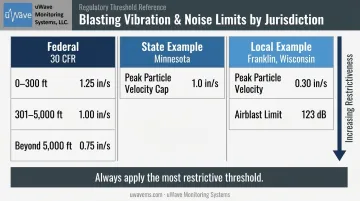
These gaps between jurisdictions can be significant. Identify every applicable standard — federal, state, local, and permit-specific — before the project begins, and always default to the most restrictive threshold.
How to Control and Reduce Blast Vibration
Monitoring verifies compliance. Blast design controls actually achieve it. The two main levers are primary design parameters — which directly set energy release — and supplementary techniques that fine-tune results without overhauling the blast plan.
Primary Design Controls
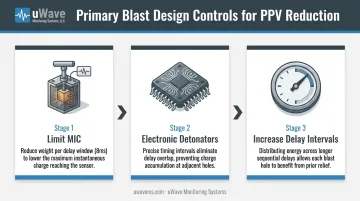
1. Limit Maximum Instantaneous Charge (MIC) US regulations define MIC as the maximum explosive weight detonated within any 8-millisecond period. Reducing that weight directly reduces PPV at a given distance. This is the single most impactful control available to blast engineers.
2. Use Electronic Detonators The 2020 Federal Register identifies microchip-controlled electronic detonators as providing more precise delays than pyrotechnic alternatives. Precise timing means energy goes into breaking rock rather than propagating as fugitive ground vibration — and eliminates the unintended charge overlap that pyrotechnic scatter can cause.
3. Increase Delay Intervals Distributing energy release across more delay intervals reduces the per-delay charge weight while maintaining fragmentation. Sequential relief lets each row break to a free face (an unconfined surface) before the next fires, preventing compounding energy buildup.
Supplementary Controls
- Decking: Split a single borehole into multiple smaller charges separated by inert stemming, each fired at different delays. This cuts weight per delay without redesigning the hole layout.
- Burden and spacing adjustments: Excessive confinement redirects energy into the ground rather than into rock breakage. Reducing burden or tightening spacing can cut wasted vibration energy.
- Pre-blast condition surveys: Document existing cracks and settlement in nearby structures before work begins. This isn't a PPV control — it establishes a defensible baseline if damage claims arise later.
Choosing the Right Blast Vibration Monitoring Solution
Portable vs. Cloud-Connected Systems
Portable standalone seismographs work for single-event or short-duration projects where an operator is present to retrieve data after each blast. The limitation is clear: no real-time notification, no remote access, and data retrieval requires someone on site.
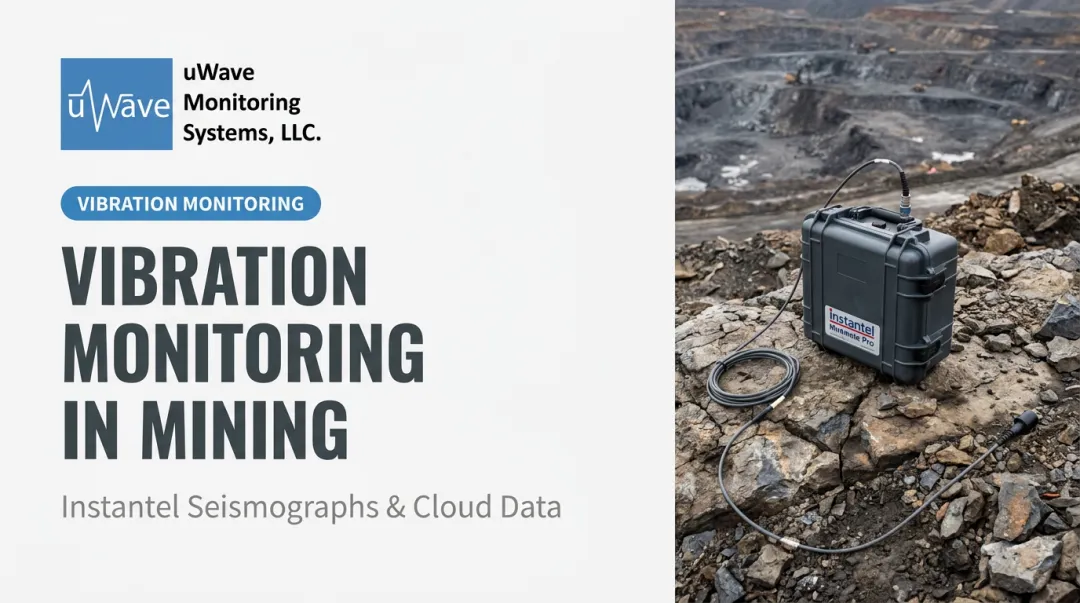
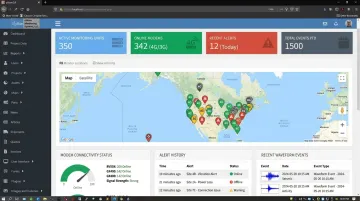
Cloud-connected remote monitoring stations work differently for ongoing or multi-site projects. uWave Monitoring Systems' Field-to-Cloud solutions combine Instantel seismographs with Sierra Wireless LTE cellular gateways, solar-powered V3 or V5 enclosures, and the uWave Project Manager platform.
After each blast event, waveform data transmits automatically to the cloud. If PPV approaches a configured threshold, the system sends email and SMS alerts to designated stakeholders — no on-site presence required.
The uWave Project Manager dashboard provides 24/7 remote access to all monitoring locations simultaneously, with real-time unit status, modem connectivity, alert history, and customized compliance reports — all backed by secure cloud data storage.
Rental vs. Purchase
Neither option is universally better. The right choice depends on project duration and blasting frequency:
- Rent when: projects are short-term or infrequent, or you need compliance coverage without capital commitment. Complete remote monitoring system rentals (enclosure + power + modem + seismograph) are available from uWave, with bulk package discounts for multi-unit deployments.
- Purchase when: operations involve continuous or high-frequency blasting, or equipment will stay in active use across multiple projects.
Factory-certified used units from uWave range from approximately $2,995 to $6,995 depending on model and configuration, and every unit includes geophones, microphones where applicable, and carrying case. Each comes with a one-year warranty and a recent annual calibration certificate.
Critical Selection Criteria
Beyond hardware specs, evaluate every potential monitoring system against these requirements:
- ISEE 2022 compliance — 2–250 Hz response, ≥1,000 sps, annual calibration documentation
- Waveform retention — full event waveforms must be exportable and stored, not just peak values
- Cloud data backup — regulatory records must survive equipment failure or site access loss
- Customizable PPV alert thresholds — thresholds should reflect the most restrictive applicable standard, not just federal defaults
- Reliable technical support — responsive vendor support ensures issues are resolved before they affect data collection or reporting deadlines
Gaps in any of these areas can compromise data integrity and the legal defensibility of compliance records.
Frequently Asked Questions
How do you control vibration in blasting?
The most effective controls are reducing the maximum instantaneous charge weight per 8-millisecond delay interval, using electronic detonators for precise timing, and applying the scaled-distance formula (SD = D / √W) to pre-plan charge weights before each blast. Real-time monitoring then verifies that actual PPV stays within permitted limits.
What equipment is used for blast vibration monitoring?
Blast vibration monitoring uses a blasting seismograph consisting of a triaxial geophone sensor, a digital data logger, and typically a microphone for air overpressure. Modern systems like the Instantel Micromate or Minimate Pro4 capture all channels in a single unit and transmit data wirelessly to a cloud platform for remote review.
What is Peak Particle Velocity (PPV) and why does it matter?
PPV is the maximum ground motion velocity recorded on any single axis during a blast event, expressed in in/s or mm/s. It is the primary metric used in US compliance standards (USBM RI 8507 and 30 CFR 816/817) to determine whether a blast poses a structural damage risk to nearby buildings.
What are the US regulatory standards for blast vibration monitoring?
OSMRE regulates federal surface mining blasts under 30 CFR 816/817, using USBM RI 8507 as the technical basis for frequency-scaled PPV limits; ISEE 2022 Performance Specifications set minimum equipment requirements for data quality. State programs, municipal permits, and transit authority guidelines can all impose stricter thresholds than the federal baseline.
Is it better to rent or buy blast vibration monitoring equipment?
Renting is typically the better choice for short-term or infrequent projects, since it avoids capital cost and maintenance responsibility while still providing fully calibrated, ISEE-compliant equipment. Purchasing makes more economic sense for continuous blasting operations, especially when factory-certified used units with warranty and calibration documentation offer a lower-cost ownership path.