Blasting crews in construction, mining, and quarrying deal with overpressure constantly, whether they realize it or not. It's one of the most tightly regulated aspects of blast work, and it's a leading source of community complaints, structural damage claims, and project delays.
Many operations struggle with the same recurring problem: a shot that looked fine on paper produces window-rattling booms a half-mile away. Understanding what actually causes overpressure, and how to prevent it, keeps blasting programs compliant, protects nearby structures, and helps avoid disputes that can stall a project for weeks.
Key Takeaways
- Overpressure is the airborne pressure wave from a blast, measured in psi or decibels, distinct from ground vibration
- Most overpressure issues stem from blast design errors, poor confinement, weather, or bad timing
- Unaddressed overpressure risks regulatory violations, property damage claims, and community backlash
- Prevention relies on sound design, weather checks, and continuous monitoring
- Long-term control depends on documented data, trained crews, and consistent recordkeeping
Common Causes of Overpressure
Overpressure is the pressure wave that radiates through the air after a blast, typically measured in psi or decibels (dB). It's a different phenomenon from ground-borne vibration, though seismographs at the blast site usually record both on separate channels at once.
Most overpressure problems don't come from bad luck. They trace back to one or more preventable conditions in blast design or execution.
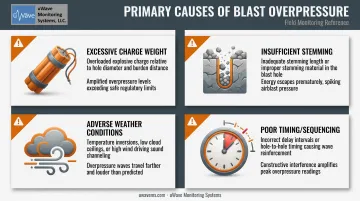
Excessive Charge Weight or Poor Blast Design
Using more explosive charge per delay than the rock actually requires pushes more energy into the air instead of the ground. This shows up most often as:
- Undersized blast patterns that don't match the rock mass
- Incorrect burden or spacing calculations
- Rushed design reviews on compressed schedules
Charge weight and distance have a direct, measurable relationship. Research from the U.S. Bureau of Mines found overpressure scales with the charge weight per delay and the distance to the receptor. Every added pound of explosive without a corresponding increase in distance raises the airblast reading at the nearest structure.
Insufficient Stemming or Confinement
Stemming holds explosive gases in the hole long enough to do their job, breaking rock instead of venting into the atmosphere. According to USBM Report of Investigations 8508, airblast levels are strongly affected by the confinement provided by burden, stemming, and surrounding geology. Common triggers include:
- Loose or wet stemming material that fails to seal the hole
- Stemming columns too short for the hole depth
- Cratered or collar-heaved holes that transmit energy skyward
Adverse Weather and Atmospheric Conditions
Temperature inversions, low cloud cover, and wind direction can trap or channel pressure waves toward populated areas, sometimes intensifying complaints miles from the site. A blast that reads well within limits at the monitor closest to the pit can still rattle windows in a neighborhood downwind.
Typical scenario: crews fire without checking inversion forecasts, and complaints roll in from residents who never noticed previous shots.
Poor Timing and Initiation Sequencing
Incorrect delay intervals between holes let pressure waves overlap and reinforce each other, spiking overpressure well above what a single hole would produce. Common culprits include:
- Firing multiple rows too close in time
- Unconfined detonating cord that vents energy into open air
What Happens If Overpressure Goes Unmonitored
Skipping airblast monitoring doesn't make the problem disappear. It just delays the moment you find out about it, usually through a complaint, a violation notice, or a lawsuit.
The Office of Surface Mining Reclamation and Enforcement notes that when blasting limits are exceeded, regulators write violations and can take action against the responsible blaster's certification under a documented enforcement process.
Beyond regulatory exposure, unmonitored overpressure can lead to:
- Structural damage claims from nearby property owners, whether or not the damage is actually blast-related
- Permit suspensions that halt production entirely
- Litigation costs that dwarf the price of proper monitoring
- Reputational harm that makes future permits harder to secure
Warning Signs You May Be Producing Excessive Overpressure
Trouble rarely arrives without warning. Watch for:
- Recurring resident complaints about "booms" or window rattling after specific shots
- Monitoring reports trending upward, with airblast readings creeping closer to regulatory limits over time
- Visible venting, dust, or gas plumes at the blast face, a clear sign of poor confinement
Any one of these is a cue to revisit blast design before the next shot, not after the next complaint.
How to Prevent Overpressure
Preventing overpressure takes engineering discipline, weather awareness, and consistent monitoring on every blast—not a one-time design pass.
Optimize Blast Design and Charge Weight
Calculate charge weight per delay based on burden, spacing, and rock characteristics, then verify the numbers before every shot, not just at the start of the project. Reducing unnecessary charge weight directly cuts the energy released as airborne pressure. Rock conditions change across a site, and a design that worked last week can overcharge a different bench.
Improve Stemming and Confinement Practices
Use properly sized, dry, angular stemming material at the recommended length for each hole. Good confinement keeps explosive energy directed into the rock instead of venting skyward. This matters most in weathered or fractured rock zones, where gas escapes more easily.
Monitor Weather Before Firing
Check temperature inversion forecasts, wind speed, and wind direction before authorizing any shot. Postponing a blast during unfavorable atmospheric conditions keeps pressure waves from carrying toward homes, schools, or other sensitive receptors. This check belongs on the pre-blast checklist both the morning of the shot and again immediately before firing.
Deploy Continuous Airblast and Vibration Monitoring
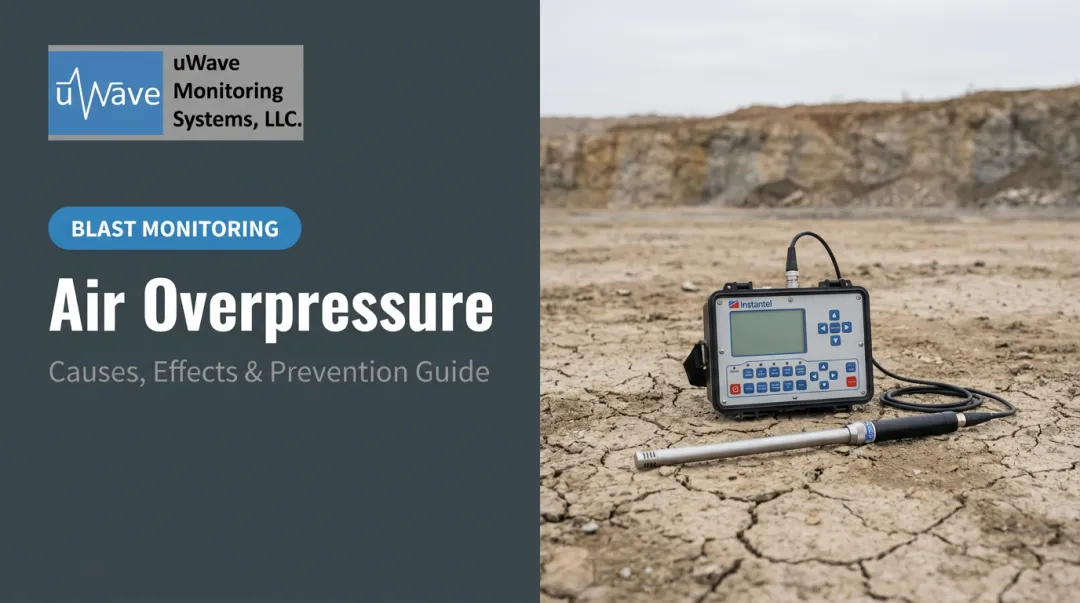
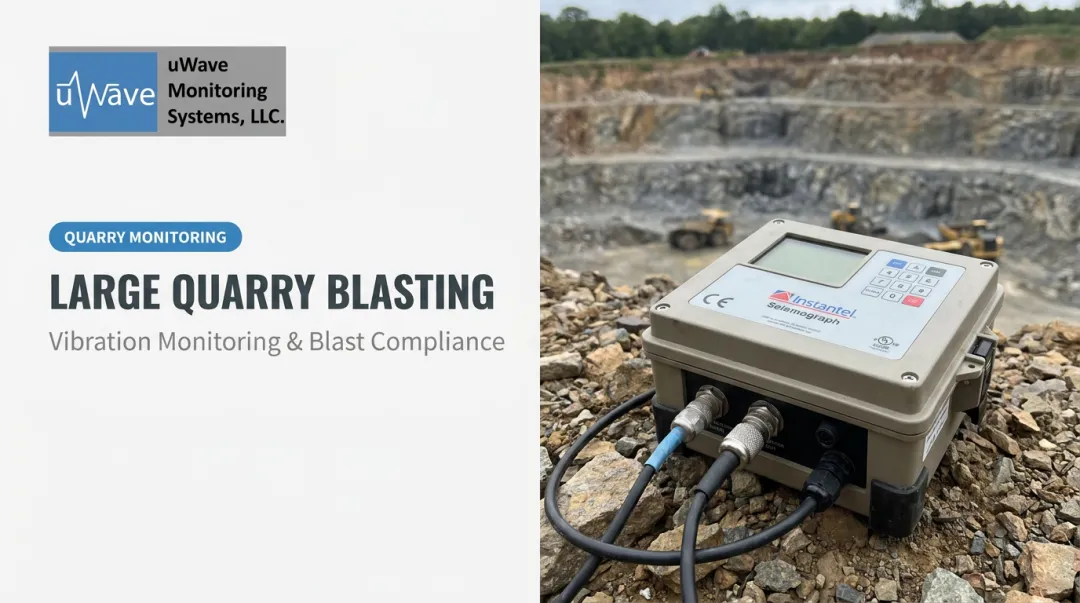
Seismographs at the nearest sensitive structures measure ground vibration and airblast overpressure in real time. That data confirms compliance on the current shot and gives crews hard numbers to refine the next design.
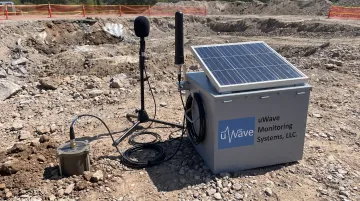
For that monitoring layer, uWave Monitoring Systems rents and sells the full Instantel line—Micromate, Minimate Pro, and Blastmate III—each paired with an air-overpressure microphone.
- Standard linear microphones: 88–148 dB(L) (about 0.0003–0.075 psi)
- High-pressure microphone option: up to 184 dB(L) (5.0 psi) for sites that need a wider window
Field deployments typically combine:
- A weather-resistant enclosure housing the seismograph, triaxial geophone, and air-overpressure microphone
- A 30-watt solar module with an AGM battery for off-grid power
- A cellular gateway that transmits data to the cloud
Once running, the system sends automated email and text alerts when a recorded event approaches a configured threshold, so crews find out about a problem before it becomes a complaint. This setup applies to every blast near occupied structures, not only when a complaint has already been filed.
Tips for Long-Term Prevention and Control
Individual blast controls matter, but long-term prevention comes from consistent habits across every shot on a site:
- Schedule routine pre- and post-blast monitoring to build a historical dataset for each location, not just a one-event snapshot
- Standardize training for blasters and operators on charge calculation, stemming procedures, and weather assessment
- Document every blast's design parameters and monitoring results—your best defense in a regulatory review or damage dispute
- Centralize records on a cloud platform such as uWave's Project Manager for hosted data, maintenance flags, and 24/7 multi-site access
Multi-site blasting operations can't rely on manual checks at each location. A centralized dashboard that flags anomalies and tracks equipment status closes that gap.
Conclusion
Overpressure has identifiable, preventable causes rooted in blast design, confinement, and weather conditions. Crews do not have to accept it as a cost of doing business.
Pairing sound blasting practices with continuous seismic and airblast monitoring keeps operations compliant and protects relationships with nearby communities. Monitoring every blast—not only after a complaint—reduces disputes, regulatory risk, and rework costs more effectively than reacting after the fact.
Frequently Asked Questions
What does overpressure mean?
Overpressure is the airborne pressure wave produced by a blast, measured in psi or decibels. It's distinct from ground vibration, which travels through soil and rock rather than air.
Is blast overpressure a real concern on job sites?
Yes. Active blast sites produce measurable air overpressure. Seismographs at nearby structures record it to verify compliance with regulatory limits.
How is blast overpressure measured?
Overpressure is recorded in decibels (linear) or psi using an air-overpressure sensor or microphone connected to a seismograph, usually placed at the nearest sensitive structure.
What is a safe overpressure limit for construction or mining blasting?
Limits vary by jurisdiction and permit conditions. The federal rule at 30 CFR 816.67 sets thresholds ranging from 129 to 134 peak dB depending on the instrument's frequency response, and state or local permits can set stricter limits.
Can overpressure damage structures even without visible ground vibration?
Airblast can rattle windows or trigger complaints independently of ground vibration, since it travels through air rather than soil. Both air overpressure and ground vibration should be monitored together.
How often should blasting sites monitor for overpressure?
Monitor every blast near sensitive receptors. Continuous remote monitoring is preferable so compliance is tracked on every shot, not only after complaints.