Machine monitoring addresses this gap directly. This article explains what machine monitoring is, why it matters for field and infrastructure operations, how it works end-to-end, and what to look for when evaluating a system.
Key Takeaways
- Machine monitoring continuously tracks equipment data — vibration, temperature, and operating status — to detect problems before they become failures
- The core benefits are reduced unplanned downtime, extended equipment reliability, improved safety, and data-driven maintenance decisions
- Modern systems transmit field data to cloud platforms, enabling remote access and automated alerts without on-site staff
- The right system depends on your environment, required parameters, and whether remote connectivity or compliance documentation is needed
What Is Machine Monitoring?
Machine monitoring is the systematic use of sensors, software, and data platforms to continuously track the operational condition, performance, and health of equipment. It's not limited to factory floors — construction equipment, seismographs, pumps, compressors, and infrastructure assets all qualify.
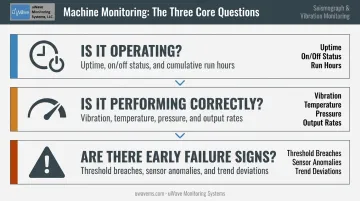
Machine monitoring answers three questions:
- Is this machine operating right now? (uptime, on/off status, run hours)
- Is it performing within expected parameters? (vibration levels, temperature, pressure, output rates)
- Are there early warning signs of failure? (abnormal sensor readings, threshold breaches, trend deviations)
What Data Gets Captured
The parameters monitored depend on the equipment and industry. Common examples include:
- Vibration levels and frequency signatures
- Temperature (bearings, motors, fluid systems)
- Pressure (hydraulic, pump discharge/suction)
- Operational state (on/off, run time, cycle counts)
- Acoustic and air overpressure data
- Energy consumption
Machine Monitoring vs. Condition Monitoring
These terms are often used interchangeably, but they're slightly different. Machine monitoring broadly tracks operational performance — uptime, output rates, run data. Condition monitoring focuses specifically on physical signals like vibration, heat, and pressure to assess equipment health. In practice, most modern systems combine both approaches, and the distinction matters less than having the right parameters covered for your application.
What those combined approaches depend on, however, is how data gets collected. The shift from manual methods — clipboards, periodic walkthroughs, delayed reporting — to automated, sensor-driven systems eliminates a critical vulnerability: intermittent events that happen between rounds. On active construction sites, mining operations, or pump stations running overnight, those gaps aren't just inconvenient — they're where failures begin.
Why Is Machine Monitoring Important?
Reduced Unplanned Downtime
Unplanned equipment failure is expensive across every industry segment. A 2023 Siemens analysis estimated heavy industry plants average 20 unplanned incidents and 25 lost production hours per month, with annual costs reaching $128M per plant at large industrial facilities. A separate Deloitte analysis estimates unplanned downtime costs industrial operations $50B annually and can reduce productive capacity by 5–20%.
Machine monitoring catches abnormal conditions — unusual vibration signatures, temperature spikes, pressure drops — before they result in failure. Teams get a repair window instead of an emergency shutdown.
Extended Equipment Reliability
The clearest field evidence of what monitoring delivers comes from Komatsu's remote monitoring deployment on nearly 100 open-pit mine trucks in Peru, where real-time component alerts and remote diagnosis produced:
- 53%+ higher mean time between failures (MTBF)
- 21% reduction in unplanned maintenance events
- 71% reduction in engine-electrical breakdowns over five months
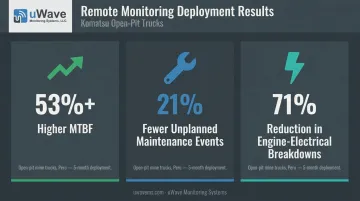
Monitoring shifted identified repair work from emergency response into scheduled maintenance cycles — reducing the compounding effect of deferred wear.
Improved Safety and Regulatory Compliance
In mining, quarrying, and urban construction, vibration and sound levels must stay within permitted thresholds to protect surrounding structures and meet project permit conditions. Federal surface coal operations, for example, are governed by 30 CFR 816.67, which sets ground peak particle velocity (PPV) limits at 1.25 in/s within 300 feet of occupied structures, with decreasing thresholds at greater distances.
Machine monitoring provides time-stamped, instrument-grade records that:
- Document compliance with permit-level thresholds
- Trigger automated alerts when readings approach limits
- Support project closeout and regulatory reporting requirements
Data-Driven Decision-Making
Without monitoring data, maintenance decisions default to two options:
- Fixed schedules — service everything at set intervals regardless of actual condition
- Reactive response — fix it after it breaks
Neither is efficient. Real-time and historical machine data lets managers identify performance trends, benchmark assets against each other, and make maintenance decisions based on what equipment actually needs — not what a calendar says.
Remote Visibility Across Dispersed Sites
Construction, mining, and infrastructure projects rarely operate from a single controlled facility. Equipment runs across dispersed sites where continuous human supervision isn't practical.
Cloud-based machine monitoring with automated alerts solves this: project managers receive notifications the moment a threshold is exceeded, without anyone needing to be physically present at the instrument.
How Does Machine Monitoring Work?
Data Collection
Sensors attach to or integrate with equipment to capture the relevant parameters — vibration, temperature, pressure, acoustic levels, operational state. Modern sensor hardware for field deployment is designed to be rugged, non-invasive, and practical to install on mobile or remote equipment.
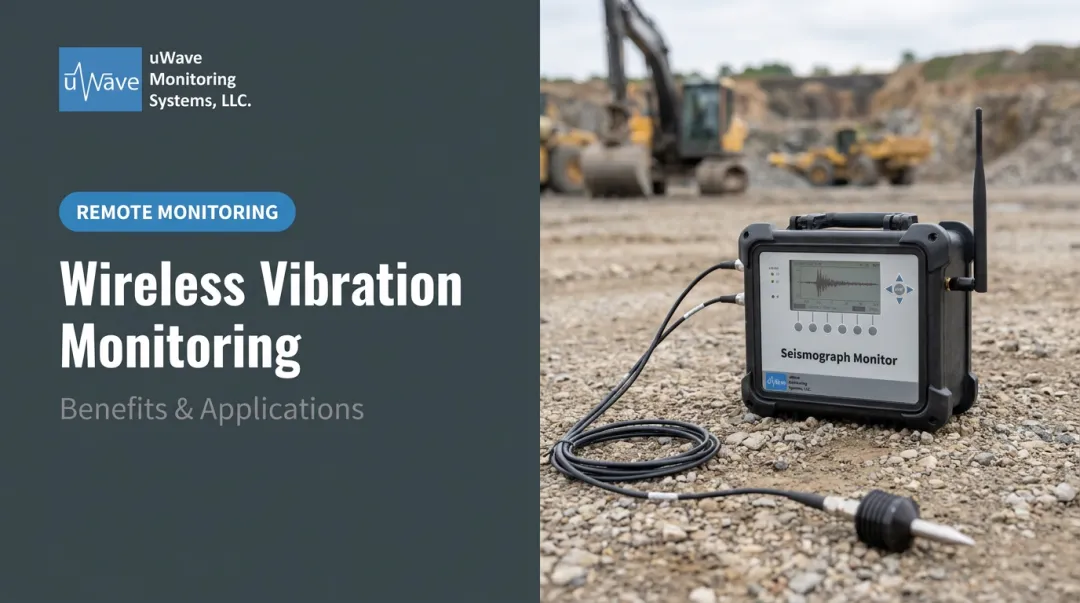
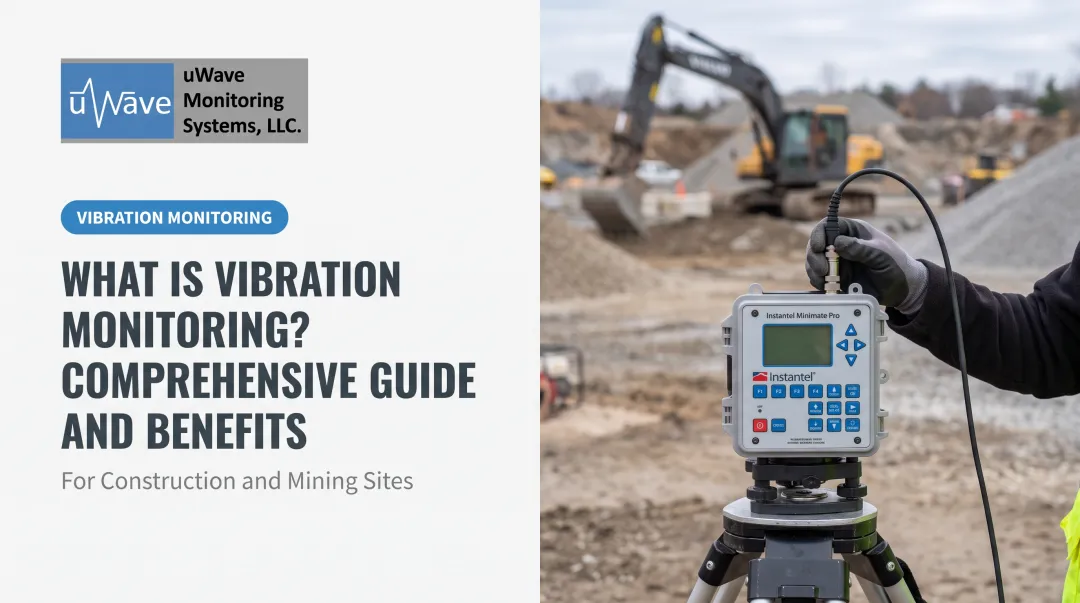
Instantel seismographs, for example, capture vibration via triaxial geophones across frequency ranges of 2–250 Hz (ISEE) or 1–315 Hz (DIN), plus air overpressure and sound data — all within instruments rated for field operation from -40°C to 55°C.
Data Transmission
Collected data travels from the field instrument to a central platform via wired connection, cellular network, or wireless communication. In remote environments — quarry sites, underground infrastructure, rural construction — reliable transmission requires deliberate system design.
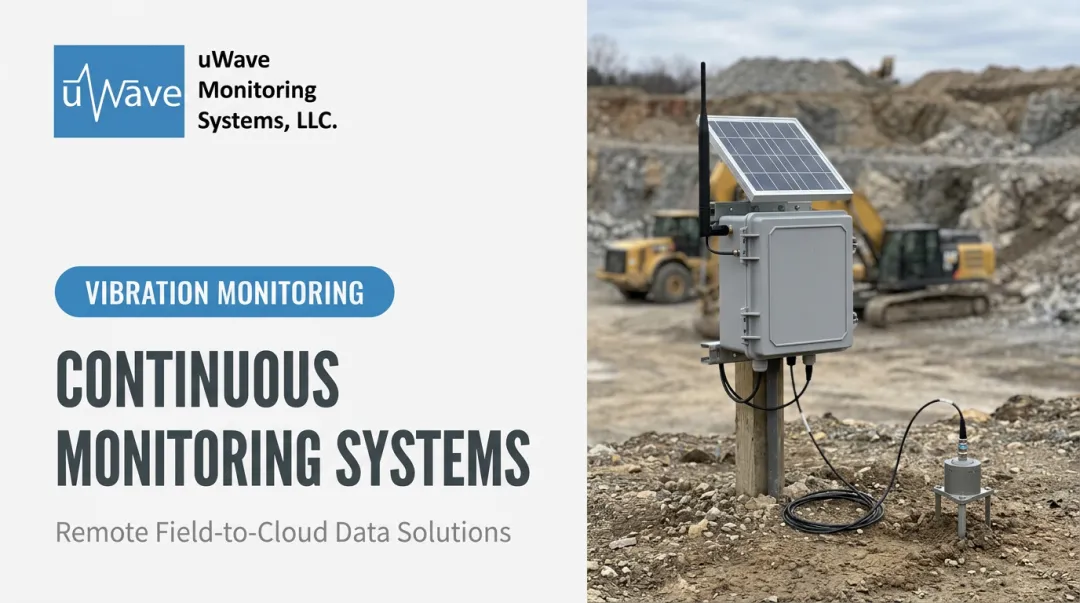
uWave Monitoring Systems' field stations use 4G LTE cellular modems (Sierra Wireless AirLink) supporting both Verizon and Sprint networks, integrated GNSS antennas, and solar-powered enclosures for off-grid operation. On-device local storage (up to 4,000+ events on Instantel instruments) preserves data during connectivity gaps, and AutoCall Home functionality transmits stored records when a connection is re-established.
Data Analysis and Alerting
On the platform side, incoming data is compared against established baselines and configurable thresholds. When a reading goes out of range, the system generates an automated alert — by email or SMS — without requiring anyone to manually watch the dashboard.
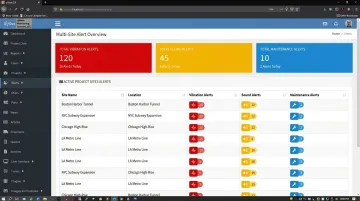
The uWave Project Manager platform delivers three alert categories:
- Vibration alerts — triggered when readings exceed permitted thresholds
- Sound alerts — flagging noise exceedances at monitored sites
- Maintenance alerts — catching equipment-level issues like low battery, connectivity loss, or calibration needs before they interrupt data collection
The dashboard shows a running count of alert activity across all monitored sites, giving project managers a clear view of where attention is needed.
Reporting and Records
Alerting handles the immediate response — but the record trail matters just as much. Monitoring platforms generate historical reports and trend data that document every reading against every threshold, timestamped and reviewable at project closeout by regulators, stakeholders, and clients.
Customizable reporting is especially valuable when permit conditions vary by jurisdiction or project type, allowing teams to match output format to specific compliance requirements rather than working around a fixed template.
Machine Monitoring in Heavy Construction, Mining, and Infrastructure
In heavy construction, mining, quarrying, and water infrastructure, machine monitoring takes on a dual role. It tracks the health and performance of the equipment doing the work — drills, pumps, compressors, haulage trucks — while simultaneously monitoring the environmental impact of that work, specifically ground vibration and airblast levels that affect neighboring structures and permit compliance.
Common field monitoring scenarios include:
- Blast monitoring at quarry and mining sites to document PPV and air overpressure against permit thresholds
- Pile driving and tunneling near existing structures, where vibration must stay below damage criteria for adjacent buildings and utilities
- Pump performance monitoring on water infrastructure projects, tracking flow rates, pressure, vibration, and motor condition
- Transit and urban construction, where vibration thresholds protect historic structures, utilities, and occupied buildings
For water infrastructure specifically, the parameters matter: flow, suction and discharge pressure, overall vibration, motor current, and bearing temperature together reveal whether a pump is operating efficiently or developing a fault.
uWave Monitoring Systems provides Field-to-Cloud vibration and sound monitoring solutions designed for these environments. Their services cover each layer of a monitoring deployment:
- Instantel seismograph rental, sales, and service — from the Micromate and Micromate Plus to the Minimate Pro4 for multi-sensor applications
- Cloud-hosted data management with automated vibration, sound, and maintenance alerts
- 24/7 remote project access with secure data backup
- Remote communications consulting for projects in areas with limited connectivity
How to Choose the Right Machine Monitoring System
Match the System to Your Environment
A remote quarry site has different requirements than an urban construction project adjacent to occupied buildings. Confirm the sensor types are appropriate (vibration, acoustic, air overpressure, temperature), that hardware is rated for outdoor or harsh field conditions, and that remote connectivity options — cellular, satellite — are available for your deployment locations.
Evaluate Data Access and Alert Capabilities
Look for:
- Real-time dashboards accessible remotely
- Configurable alert thresholds by parameter and location
- Automated notifications by email and SMS
- Customizable reports for compliance documentation
- Secure data backup and multi-user access for distributed teams
Consider Deployment Flexibility and Support
Key questions to ask any vendor:
- Do you offer rental for project-based needs and purchase for long-term assets?
- What technical support is available after deployment, and is 24/7 access included?
- Are volume discounts available for organizations managing multiple simultaneous projects?
- Is remote communications consulting available if connectivity design is a challenge?
uWave Monitoring Systems addresses each of these criteria directly. Rental and purchase options are available — including factory-certified used equipment and complete remote monitoring station rentals. Extended discounts apply to multiple unit purchases, and bulk monitoring package pricing is available for organizations running several projects through the uWave Project Manager cloud platform simultaneously.
Frequently Asked Questions
What is a performance monitoring system?
A performance monitoring system combines sensors, data transmission infrastructure, and analytics software to continuously track how equipment is operating: capturing uptime, output rates, vibration, and condition data to support maintenance and operational decisions.
What monitoring tools are used to track machine performance?
Common tools include physical sensors (vibration, temperature, acoustic, pressure), data loggers, wireless or wired communication hardware, cloud-hosted dashboards, and automated alerting platforms. The right combination depends on equipment type and operating conditions.
What is the best way to monitor equipment performance?
The most effective approach combines continuous sensor-based data collection with cloud-hosted analysis and automated alerts. The right method starts with defining which parameters matter most for your operation before selecting hardware and software.
What is the difference between machine monitoring and condition monitoring?
Machine monitoring broadly tracks operational performance data — uptime, output, run rates. Condition monitoring focuses specifically on physical signals like vibration, temperature, and pressure to assess equipment health. Modern systems typically combine both, using operational data alongside physical condition signals to give a full view of equipment health.
How does machine monitoring support predictive maintenance?
By tracking sensor data continuously against baselines, machine monitoring identifies early warning signatures of developing faults, allowing maintenance to be scheduled before a breakdown occurs. This shifts teams from reactive to proactive, reducing unplanned downtime and letting repairs fit around project schedules.