Introduction
Construction, mining, and infrastructure projects face a reality that hasn't changed: neighbors notice noise, and regulators act on complaints. What has changed is the volume of those complaints and the evidentiary standards that project teams are expected to meet.
In New York City alone, construction noise generated over 30,000 complaints in 2024. Each one carries the potential for permit scrutiny, stop-work orders, or drawn-out disputes — most of which are far more expensive to resolve than they would have been to prevent.
That expense is why ambient noise monitoring gets treated as a compliance checkbox. It shouldn't be. Done properly, it's legal protection, a direct line of communication with regulators, and an early-warning system that keeps projects on schedule.
This guide covers how ambient noise monitoring works, what the data actually tells you, and what projects risk when they skip it.
Key Takeaways
- Ambient noise monitoring creates an objective, time-stamped record that separates pre-existing noise from project-generated noise
- Pre-construction baselines are the foundation of any defensible response to a noise complaint or regulatory inspection
- Real-time monitoring enables project teams to catch threshold exceedances before they become violations
- Skipping monitoring doesn't eliminate noise risk — without it, the full legal burden falls on the project team
- Cloud-based platforms like uWave Project Manager provide 24/7 remote access and automated alerts when sound levels exceed set thresholds
What Is Ambient Noise Monitoring?
Ambient noise monitoring is the continuous or periodic measurement of the existing sound environment at a specific location — capturing all background sounds independent of any single source, and expressed in A-weighted decibels (dB(A)).
It answers a fundamental project question: what did the sound environment look like before we arrived, and how has it changed?
Where It's Applied
Ambient noise monitoring isn't limited to construction sites. It's used across:
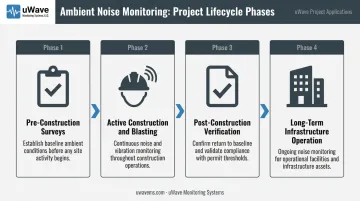
- Pre-construction surveys — establishing baseline conditions before any project activity begins
- Active construction and blasting phases — tracking sound levels against permit thresholds during high-impact operations
- Post-construction verification — confirming that project activity hasn't permanently altered the sound environment
- Long-term infrastructure operation — ongoing monitoring at water treatment facilities, transit corridors, and quarry operations
What Gets Measured
The key descriptors used in regulatory and engineering contexts include:
- LAeq — the average A-weighted sound level over a defined period
- L90 — the sound level exceeded 90% of the time, often used as the background reference
- L10 — the level exceeded 10% of the time, used for daytime assessment
- Lmax — the maximum instantaneous sound level during an event
ISO 1996-1:2016 and ISO 1996-2:2017 define the standard quantities and measurement procedures for environmental noise assessment. These aren't academic references — they're the framework regulators use when evaluating whether monitoring data is valid.
That validity matters: when a neighbor complaint or permit dispute arises, objective dB(A) records tied to ISO-compliant methodology are what project teams can actually defend — in reports, in meetings, and in front of regulators.
Key Advantages of Ambient Noise Monitoring
The advantages below focus on outcomes that project managers, contractors, and compliance officers directly experience — not theoretical benefits.
Advantage 1: Establishing Defensible Baselines for Regulatory Compliance
A pre-construction ambient noise survey documents the sound environment before any project work begins. That documentation creates the reference point that makes everything else verifiable.
Without a baseline, there's no way to separate a noise complaint about genuinely project-generated sound from one about traffic, a nearby facility, or a neighbor's HVAC system. With one, project teams can show exactly what conditions existed before the first excavator arrived.
Why baselines matter legally:
Several noise ordinances define compliance relative to existing conditions — not just absolute limits. Philadelphia's construction regulations, for example, restrict noise affecting residences to no more than 5 dB above background during specified nighttime and weekend periods. That threshold is unenforceable without a documented background level to measure against.
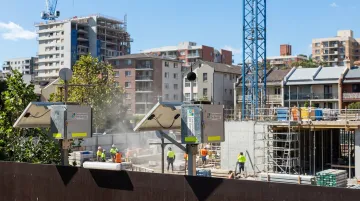
The Big Dig project in Boston required background measurements at receptor locations before construction began, an accepted Noise Monitoring Plan before any noise-generating equipment operated, and weekly compliance reports throughout. That baseline data served as evidence infrastructure — the kind regulators and courts can actually use.
KPIs directly impacted:
- Permit compliance rate
- Number of uncontested noise complaints
- Regulatory inspection outcomes
- Project delay frequency attributed to noise violations
When this matters most: Baseline surveys are most critical at project inception in urban and suburban environments, near residential zones, hospitals, and schools, and on long-duration projects where sound conditions shift significantly over months or years.
Advantage 2: Protecting Community Relationships and Project Continuity
Noise complaints create regulatory problems — but the political fallout is often worse. Community opposition rooted in noise concerns can escalate into public hearings, design changes, and schedule disruptions that far exceed the original issue.
Ambient noise monitoring changes that dynamic. When data is shared proactively with community liaisons or local authorities, conversations shift from accusations to evidence: here's what the monitoring shows, and here's what we're doing about it.
What proactive data-sharing looks like in practice:
Crossrail's London project used weekly coordination meetings between community relations, planning, and construction management teams to review upcoming noisy works. This structured approach kept the project from reactive escalation in a dense urban environment — monitoring and transparency working together, neither sufficient on its own.
The Big Dig took a similar position: when a complaint was filed, the contractor was required to conduct measurements at the complainant's location during representative operations. Complaints got answered with measurements, not assurances.
KPIs directly impacted:
- Formal noise complaint rate
- Schedule variance caused by community-driven delays
- Number of regulatory escalations
- Stakeholder satisfaction scores where tracked
When this matters most: Urban infill development, transit corridor projects near populated areas, and quarrying or mining operations adjacent to residential land — anywhere community tolerance for disruption is limited and scrutiny is high.
Advantage 3: Enabling Real-Time Operational Control and Early Warning
Continuous monitoring builds a historical record, but its operational value is immediate — it functions as a live signal for on-site decision-making.
When sound levels spike, continuous monitoring pinpoints when and where it happened. That allows site supervisors to trace the exceedance to a specific piece of equipment or activity, intervene before thresholds are formally breached, and document the corrective action taken.
Reference sound levels for high-impact activities (from FHWA's Highway Construction Noise Handbook):
| Equipment/Activity | Reference Sound Level |
|---|---|
| Impact/vibratory pile drivers | 95 dB |
| Concrete saws | 90 dB |
| Auger drill rigs | 85 dB |
| Blasting (Lmax) | 94 dB |
These levels highlight why passive monitoring isn't enough for high-impact work — exceedances can occur quickly and require immediate response.
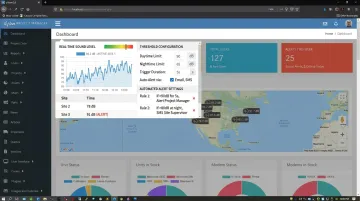
Cloud-based platforms close the response gap. uWave Monitoring Systems' uWave Project Manager platform provides 24/7 remote access to monitoring data, with automated email and text alerts triggered when sound levels exceed configured thresholds. Project managers don't need to be on-site or watching a dashboard — the system pushes alerts directly to them when action is needed.
KPIs directly impacted:
- Noise threshold exceedance rate
- Time-to-response when exceedances occur
- Regulatory fine frequency
- Equipment downtime linked to noise investigations
When this matters most: Blasting, pile driving, and tunneling operations; night-shift work subject to stricter noise curfews; and remote or multi-site projects where physical supervision of every location isn't possible.
What Happens When Ambient Noise Goes Unmonitored
Skipping ambient noise monitoring doesn't reduce risk. It removes the only tool for managing it.
The practical consequences:
- Without baseline data, every community noise complaint becomes the project team's problem to disprove — even complaints about pre-existing sounds unrelated to the work
- Permit violations discovered during regulatory inspections rather than caught internally result in stop-work orders, fines, and schedule delays that compound over time
- Noise events tied to specific equipment or activities go unidentified, meaning problems recur rather than being corrected at the source
NYC's Administrative Code includes stop-work authority for construction sites that violate noise requirements. The city's newer rules also require qualifying sound-level meters and monitoring-device compliance for certain after-hours operations.
Portland sets a hard limit of 85 dB(A) at 50 feet during allowed hours unless a variance applies. Violations can result in court-ordered stop-work orders.
The longer a project runs without monitoring data, the harder it becomes to reconstruct a defensible noise history. By the time a complaint or inspection surfaces, the window for accurate baseline reconstruction has already closed.
How to Get the Most Value from Ambient Noise Monitoring
Monitoring delivers compounding value when applied consistently from project start to finish, not reactively after a complaint or violation has already occurred.
Practices that maximize effectiveness:
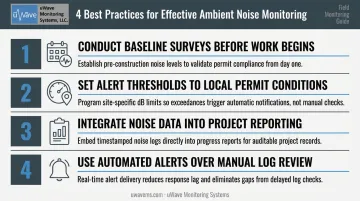
- Conduct baseline surveys before any noise-generating equipment operates. This is the single most important step — and one that cannot be reconstructed retroactively once work begins
- Set alert thresholds based on your local permit conditions, not generic standards. Philadelphia's 5 dB-above-background rule requires different threshold configuration than Portland's absolute 85 dB(A) limit
- Integrate noise data into regular project reporting. Reviewing it alongside schedule and cost metrics ensures exceedances are caught in the same cycle as other project risks
- Use automated alerts rather than manual log review. Data sitting in a monitoring log that no one checks provides no practical value when it matters most
uWave Monitoring Systems supports this workflow through field-to-cloud monitoring infrastructure that combines equipment, cellular data transmission, and the uWave Project Manager platform for 24/7 remote access. Beyond equipment, uWave also provides pre-construction assessment support and remote monitoring consulting — so baseline surveys are configured correctly before work begins, not improvised under schedule pressure. For multi-site projects, contact uWave at info@uwavems.com to discuss project-specific options.
Conclusion
Ambient noise monitoring delivers three practical advantages that matter across every project type: real-time data lets teams act on noise events before they become violations, documented baselines turn contested complaints into resolvable disputes, and regulators respond differently to projects that can actually show their work.
These advantages compound when monitoring is applied consistently from the start:
- A baseline established on day one provides protection for the project's full duration
- Real-time alerts prevent individual exceedances from hardening into enforcement patterns
- Documented compliance histories simplify permit renewals and community relations
Start monitoring at mobilization. By the time the first complaint arrives, it's already too late to establish the baseline that would have resolved it.
Frequently Asked Questions
What is ambient noise monitoring?
Ambient noise monitoring is the measurement of background sound pressure levels at a given location, capturing all sounds present in the environment, expressed in dB(A). It establishes a reference baseline used to track changes caused by new noise sources such as construction activity, providing an objective record for regulatory and community purposes.
What is the protocol for ambient noise monitoring?
The standard protocol involves a pre-project baseline assessment using a calibrated sound level meter, followed by continuous or periodic monitoring during active work phases. Data is reviewed against permit thresholds and reported to relevant regulatory bodies.
What is a normal ambient noise level?
Levels vary significantly by environment. FHWA guidance indicates quiet daytime rural areas may measure in the 30–40 dB(A) range, while the EPA identifies 55 dB for certain outdoor areas as a threshold for protecting against activity interference and annoyance. Urban environments typically run higher. Site-specific baselines matter more than generic averages.
Why is ambient noise monitoring required on construction sites?
Most municipalities, permit conditions, and federal frameworks — including OSHA and EPA guidelines — require construction noise to stay within defined limits to protect nearby residents and workers. Monitoring provides the documented evidence needed to demonstrate compliance, respond to regulatory inspections, and contest complaints with data rather than assertions.
How is ambient noise measured on a job site?
Job site noise is measured using calibrated sound level meters or remote monitoring units positioned at property boundaries or sensitive receptor locations. Measurements are typically taken continuously during active work hours and logged for regulatory reporting. Instruments like the Instantel Micromate® and Minimate Pro™ support sound level monitoring alongside vibration measurement in a single deployed unit.
What are the consequences of not monitoring ambient noise on a project?
Without monitoring, project teams have no defensible data to contest noise complaints, no early warning for threshold exceedances, and no documented record for regulators. This results in increased legal exposure, potential stop-work orders, and strained community relationships — outcomes that are far more disruptive and expensive than a monitoring program would have been.