Blasting-related complaints are the most frequent type received by the Office of Surface Mining Reclamation and Enforcement and state regulatory authorities — covering everything from annoyance to alleged property damage. The critical detail: most of those complaints involve events that were never properly measured.
Vibration velocity — specifically Peak Particle Velocity (PPV) — is the metric that determines whether your project stays compliant or triggers a claim. This guide covers what it is, why it matters, and how to measure it correctly from first sensor placement through final report.
Key Takeaways
- PPV (expressed in ips or mm/s) is the primary compliance metric under USBM RI 8507, ISEE, and federal regulations
- Safe PPV limits for residential structures range from 0.5 to 2.0 in/s; thresholds vary by frequency and structure type, not a single universal value
- Three-axis measurement (transverse, vertical, longitudinal) is federally required; the highest reading drives compliance
- Full waveform time histories hold up better than single-peak readings in disputes or regulatory reviews
- Automated, cloud-connected monitoring eliminates data gaps and creates a continuous, timestamped compliance record
What Is Vibration Velocity Measurement?
Vibration velocity measurement quantifies how fast particles in the ground or a structure oscillate when a vibration event passes through — a blast, a compaction pass, a pile driver strike. The result is expressed as Peak Particle Velocity (PPV): in inches per second (ips) for U.S. practice, or millimeters per second (mm/s) under metric and international standards.
This measurement applies wherever vibration-generating work occurs near sensitive receivers, including:
This measurement applies wherever vibration-generating work occurs near sensitive receivers, including:
- Construction blasting and quarrying operations
- Pile driving and pavement breaking
- Tunneling and deep excavation
- Work near structures, pipelines, water towers, or populated areas
How Velocity Compares to Other Vibration Parameters
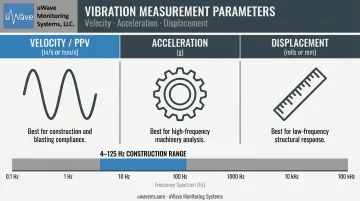
Three parameters can describe a vibration event:
| Parameter | Units | Best For |
|---|---|---|
| Velocity (PPV) | in/s or mm/s | Construction & blasting compliance |
| Acceleration | g | High-frequency machinery analysis |
| Displacement | mils or mm | Low-frequency structural response |
Velocity occupies the middle of the frequency spectrum. It avoids the over-amplification of high-frequency events that acceleration produces, while remaining more sensitive at higher frequencies than displacement allows.
That practical range is why every major construction and blasting standard — USBM RI 8507, ISEE, 30 CFR 816.67 — specifies PPV as the compliance metric.
Essential Parameters in Vibration Velocity Measurement
Peak Particle Velocity (PPV)
PPV captures the maximum rate of ground particle motion during a vibration event. Under 30 CFR 816.67, ground vibration must be measured in three mutually perpendicular directions — transverse, vertical, and longitudinal — and the PPV limit applies to each component individually. In practice, the highest reading across all three axes drives the compliance comparison.
ISEE's 2022 Performance Specifications require sensor accuracy of ±5% or ±0.5 mm/s (±0.02 in/s), whichever is larger, across the 4–125 Hz frequency range. That precision matters when readings are near a threshold.
Measurement Units
- ips (inches per second) — the U.S. standard, used in federal regulations and USBM research
- mm/s — the metric equivalent, required under ISO, European (BS 7385-2, DIN 4150-3), and some international project specifications
The applicable regulation or project specification determines which unit is required. Mixing them without converting introduces compliance errors.
Frequency as a Companion Parameter
A given PPV level is not equally damaging across all vibration frequencies. Lower-frequency events cause more structural distress at the same PPV than higher-frequency ones — which is why USBM RI 8507 establishes frequency-dependent thresholds, not a single universal limit.
Scaled Distance (Ds = D / W^0.5, where D is distance and W is maximum charge weight per 8-millisecond delay) relates explosive charge size and standoff distance to expected PPV without seismic monitoring. That said, measured PPV from a calibrated instrument is the more defensible compliance basis in any dispute or regulatory review.
PPV Threshold Ranges
| Source | PPV Threshold | Context |
|---|---|---|
| USBM RI 8507 | 0.5–2.0 in/s | Residential structures; varies by frequency and construction type |
| 30 CFR 816.67 | 1.25 in/s (0–300 ft); 1.00 in/s (301–5,000 ft); 0.75 in/s (>5,000 ft) | Federal surface coal mining |
| LA CEQA (2025 proposed) | 0.12–0.20 in/s PPV | Near sensitive or non-engineered structures |
| Maryland COMAR | 2.0 in/s | Adjacent to nearest protected structure |
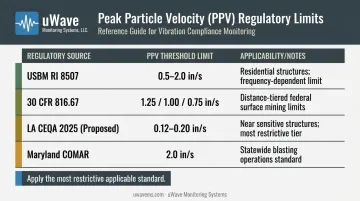
Project-specific or municipal limits frequently set lower thresholds than federal minimums. Always verify the most restrictive applicable requirement before setting alert levels.
Waveform Records vs. Single-Peak Values
ISEE Field Practice Guidelines 2020 are unambiguous: record the full time-history waveform. Summary or single-peak-only recording modes are explicitly not recommended for compliance-quality monitoring.
A full waveform record shows:
- Event duration and multiple peaks
- Frequency content across the event
- The complete time history needed for post-event analysis or dispute review
Single-peak readings capture only the maximum value. Full waveform records capture duration, frequency content, and the complete time history — the details that matter most when a reading is challenged.
Why Vibration Velocity Is the Standard Metric for Compliance
Velocity holds up across the full frequency range that matters for construction and blasting — roughly 4 to 125 Hz. Acceleration amplifies high-frequency signals; displacement inflates low-frequency events. Velocity avoids both distortions, giving a consistent picture of the energy a structure actually experiences.
The research evidence is direct. USBM's 1985 blast vibration damage study tied specific PPV ranges to observed structural effects:
- Below 0.5 in/s — cracking damage unlikely
- 0.88–1.34 in/s — cosmetic wallboard cracking
- 1.8–2.2 in/s — loosening of joints
- ~3.4 in/s — masonry mortar joint cracking
Those findings directly shaped the thresholds in USBM RI 8507 and, by extension, most U.S. blasting regulations. The FTA's 2018 Transit Noise and Vibration Impact Assessment Manual notes that PPV is preferred for construction vibration monitoring precisely because it relates to the stresses buildings actually experience.
The Liability Reality
Calibrated seismograph data is the primary evidence when a vibration damage claim is filed. Caltrans requires instruments to be calibrated by the manufacturer or a certified laboratory within one year of use, with NIST traceability, for records to hold up in litigation.
That standard exists for good reason. The 2021 mining dispute resolution paper published through Pennsylvania DEP confirms that seismograph records and blast logs are what regulators examine when assessing compliance — and what contractors rely on to defend against liability exposure.
Without that documentation, there's nothing to offer. An unmonitored event that generates a complaint leaves the contractor without any record to counter it.
How Vibration Velocity Measurement Works: A Step-by-Step Guide
Accurate PPV measurement requires more than placing a seismograph near the work. A defensible record depends on a consistent process — from project setup through final reporting — and each step matters.
Step 1 – Define the Monitoring Objective
Before any equipment goes in the ground, identify:
- The vibration source type (blast, pile driver, compactor)
- The proximity and sensitivity classification of nearby structures
- The applicable regulatory standard or project specification that sets the PPV limit
This determines sensor placement, alert thresholds, and reporting requirements for the entire project.
Step 2 – Select and Position the Equipment
Sensor placement drives data quality. Best practices:
- Position the seismograph at the closest sensitive structure or as directed by the applicable standard
- Ensure solid ground coupling — spike the geophone into firm soil, not loose fill or pavement
- Orient the sensor to capture all three vibration axes correctly (transverse, vertical, longitudinal)
- Use a calibrated, standards-compliant instrument — data from uncalibrated or expired equipment won't hold up in regulatory review or legal proceedings
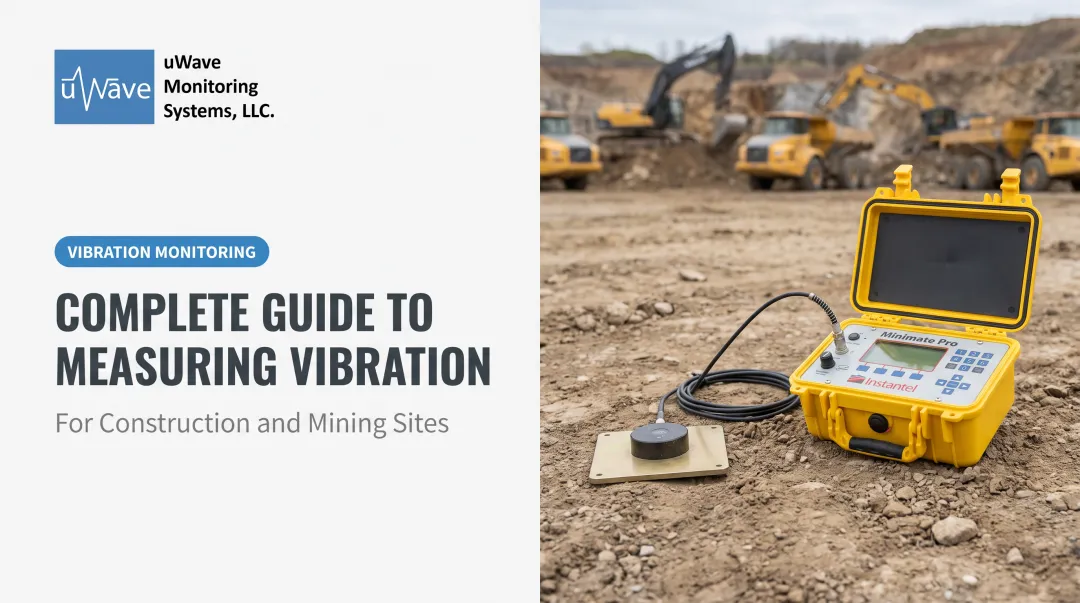
Instantel's Micromate Plus and Minimate Pro are configured with triaxial geophones meeting ISEE and DIN compliance specifications. uWave Monitoring Systems maintains annual calibration certification across its rental fleet for both models.
Step 3 – Capture a Pre-Activity Baseline
Document background vibration levels before any construction or blasting begins. This baseline:
- Separates project-generated vibration from ambient sources (traffic, nearby equipment)
- Provides evidence of pre-existing conditions if damage claims arise
- Satisfies 30 CFR 816.62, which requires pre-blast surveys of structures within 1/2 mile of a blasting permit area when requested by owners
Step 4 – Record Full Waveform Data During Each Event
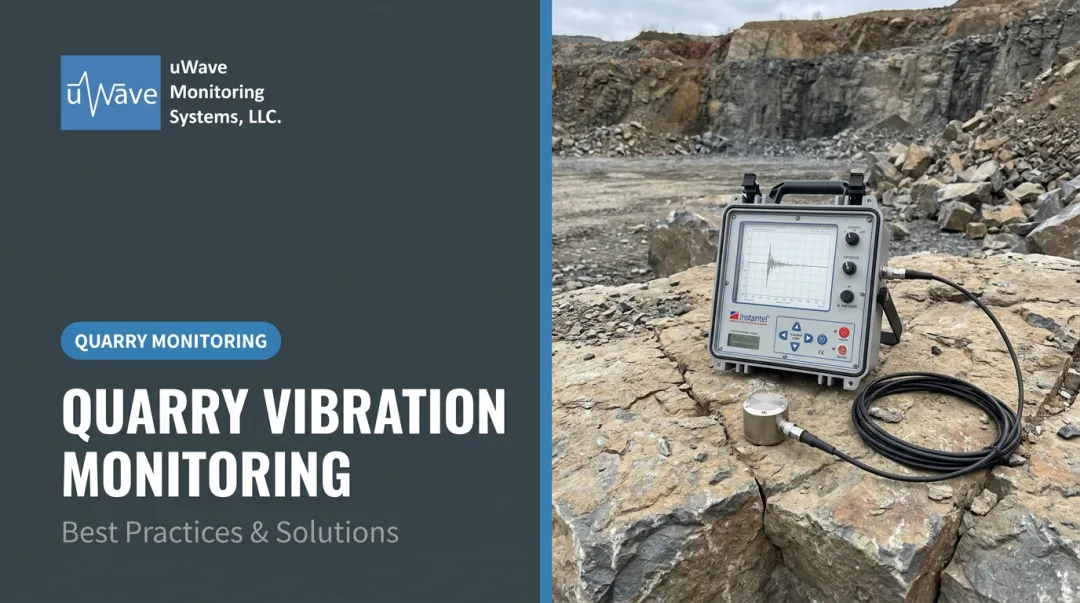
The seismograph records the complete waveform for each event — PPV per axis, event timestamp, frequency content, and waveform shape. Per ISEE guidelines, this full time history is the minimum standard for compliance monitoring. Single-peak summary modes are not adequate for regulatory or legal purposes.
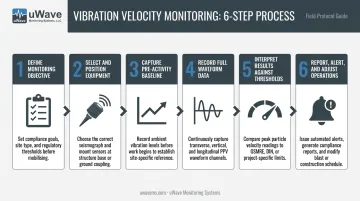
Step 5 – Interpret Results Against Applicable Thresholds
After each event:
- Compare recorded PPV values against the most restrictive applicable limit (federal, state, municipal, or project-specific)
- Flag any exceedances immediately
- Watch for trending — multiple events approaching a threshold signal cumulative risk, even when no single event exceeds the limit
Step 6 – Report, Alert, and Adjust Operations
Generate structured event reports after each recording session. When exceedances occur or thresholds are approached:
- Notify relevant parties via automated alerts
- Document the event and response action
- Adjust blast design, equipment proximity, or operational timing to bring subsequent events back within limits
How uWave Monitoring Systems Can Help
uWave Monitoring Systems, based in Golden, Colorado, specializes in complete field-to-cloud vibration velocity monitoring built around Instantel seismographs — the instruments specified in ISEE guidelines and deployed on construction, mining, quarrying, and infrastructure projects across North America.
Their service model addresses the practical gaps that create compliance risk:
- Rental stations in V3 and V5 enclosure configurations with solar power and Sierra Wireless cellular modems (including the RV55 LTE Industrial Gateway), suited for off-grid and harsh field deployments
- Automated PPV, sound, and maintenance alerts via email and SMS through the uWave Project Manager platform, triggered the moment a threshold event is recorded
- 24/7 remote project access and secure cloud data backup, creating a timestamped record of every vibration event — documentation that holds up in regulatory reviews and damage disputes
uWave's rental fleet includes the Micromate Plus, Micromate, and Minimate Pro — all with triaxial geophones, full waveform recording capability, and calibration current to ISEE and manufacturer standards. The Minimate Pro's adjustable sample rate (up to 65,536 samples per second) makes it well suited for high-frequency data capture or complex multi-sensor deployments.
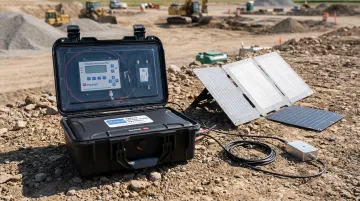
For projects ranging from single-site urban development to large-scale quarry or transit operations, uWave offers customized reporting packages and bulk monitoring discounts. Contact their team at info@uwavems.com or visit uwavems.com to discuss project-specific monitoring requirements.
Frequently Asked Questions
What is the measurement of velocity in vibration?
Vibration velocity measures how fast particles in the ground or a structure move during a vibration event. It is most commonly expressed as Peak Particle Velocity (PPV) in inches per second (ips) for U.S. projects or millimeters per second (mm/s) under international standards. PPV is the primary compliance metric in construction and blasting regulations.
What units are used to measure vibration velocity?
The U.S. standard is ips (inches per second), while metric practice uses mm/s — both appear in regulatory standards. ISEE specifies sensor accuracy in both mm/s and in/s. Check your project spec or local regulation to confirm which unit is required for reporting.
What is an acceptable vibration velocity level for construction sites?
USBM RI 8507 and ISEE guidelines set safe PPV ranges for residential structures at 0.5 to 2.0 in/s depending on frequency and structure type. Federal surface coal mining rules and municipal thresholds are often more restrictive. Always apply the most conservative standard applicable to your project.
What is 1X, 2X, 3X vibration?
These terms refer to vibration occurring at the fundamental running speed of a rotating machine (1X) and its harmonics (2X, 3X) — terminology used in rotating machinery condition monitoring and fault diagnosis. They don't apply to PPV-based ground vibration compliance used in construction and blasting contexts.
Can vibration cause fatigue?
Repeated vibration events can cause cumulative fatigue — loosening joints, cracking masonry, and weakening foundations over time. The 1985 USBM research found that repeated blasts above 1.0 in/s correlated with higher crack rates. Ongoing PPV monitoring throughout a project is more protective than spot checks.
How often should vibration velocity be monitored on a construction project?
Monitor during every significant vibration-generating activity near sensitive structures — each blast, compaction pass, or pile driving sequence. Under 30 CFR 816.67, a seismographic record is required for each blast. For high-risk urban or infrastructure projects, continuous automated remote monitoring closes the gaps that create liability exposure.