Introduction
Turn on the news after an earthquake, and you'll hear "seismograph" and "seismometer" used as if they mean the same thing. They don't.
This mix-up isn't just semantic. On a construction project with blasting—or any job that needs vibration records—the wrong instrument can mean incomplete data or failed regulatory audits.
It can also leave you with a compliance record that doesn't hold up if a damage claim lands on your desk.
The USGS draws a clear line between the two: a seismometer senses ground motion, while a seismograph records it.
That distinction matters when you need precise signal data—and when you need a defensible paper trail on site.
This article breaks down both terms, compares them side by side, and shows how each applies to real vibration monitoring work on construction and infrastructure sites.
Key Takeaways
- Seismometer senses ground motion; seismograph is the full system that records it as a seismogram
- Modern digital instruments blend both functions, which is why the terms get used interchangeably
- Seismometers dominate earthquake research; seismographs handle field compliance and blast monitoring
- Choose by goal: raw sensing data vs. a documented, reportable record
Seismograph vs Seismometer: Quick Comparison
Side-by-side, the difference looks like this:
| Category | Seismometer | Seismograph |
|---|---|---|
| Function | Detects and senses ground motion via inertia-based mechanisms | Complete system that senses, amplifies, records, and displays motion data |
| Output | Raw electrical signal proportional to ground movement | A seismogram: a time-stamped visual or digital record |
| Core components | Mass, spring or pendulum, damping system, transducer | Seismometer plus amplifier, data logger, and display/recording unit |
| Typical application | Research-grade earthquake detection, structural or planetary studies | Field deployment for blast monitoring, construction compliance, regulatory reporting |
The core idea: a seismometer is the sensing core, and a seismograph is the whole machine.
A useful parallel is a microphone versus a full recording studio. The microphone (seismometer) picks up sound. The studio setup (seismograph) captures, processes, and stores that sound as a file you can play back, share, or submit as evidence.
That's exactly why USGS uses the two terms carefully in official documentation, even while acknowledging that "seismometer" often gets used loosely as shorthand for the whole recording system.
Seismograph vs Seismometer: Which One Do You Need?
The right choice depends on what you need the instrument to do on site.
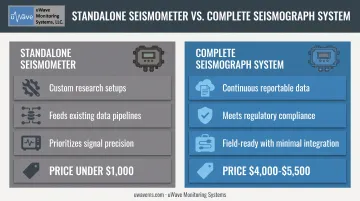
Choose a standalone seismometer or sensor when:
- Custom research or lab setups that only need the raw sensing element
- Raw sensor output must feed an existing data acquisition pipeline
- Signal precision matters more than a packaged compliance report
Choose a complete seismograph system when:
- You need continuous, reportable vibration data for a construction, mining, or blasting site
- Regulatory permits or contract terms require documented compliance records
- You want field-ready equipment with minimal custom integration work
Budget plays a role too. A bare geophone sensor can run under $1,000, but it typically needs a compatible digitizer or recorder and does not work as a complete monitoring unit on its own. A full seismograph package, complete with geophone, cables, microphone, and carrying case, generally lands in the $4,000-$5,500 range depending on the model and configuration.
For most active job sites, the complete system wins. It's the only setup that produces a record you can hand to an inspector, insurer, or attorney.
What is a Seismometer?
A seismometer is the internal sensing element of a seismograph. Historically, that meant a suspended mass or pendulum. Today, it's typically a mass-spring-transducer assembly.
The principle behind it hasn't changed in over a century: inertia. When the ground shakes, the instrument's housing moves with it, but the suspended mass resists that motion because of its own inertia. The relative movement between housing and mass gets converted into a measurable signal.
Sensitivity drives performance. A more sensitive seismometer detects smaller ground movements, which improves research accuracy and monitoring precision. That sensitivity supports:
- Earthquake research and aftershock analysis
- Volcano monitoring for early warning signs
- Construction and blast vibration monitoring where compliance thresholds matter
Types of Seismometers
Not all seismometers are built for the same job. The main categories:
- Broadband seismometers: cover a wide frequency range, roughly 0.01 Hz to 25 Hz, making them the standard for most passive earthquake research
- Short-period seismometers: tuned for higher frequencies, generally 1 Hz and up, used in active-source and volcanic studies
- Long-period seismometers: sensitive to slower, longer-wavelength motion useful for distant, large-magnitude events
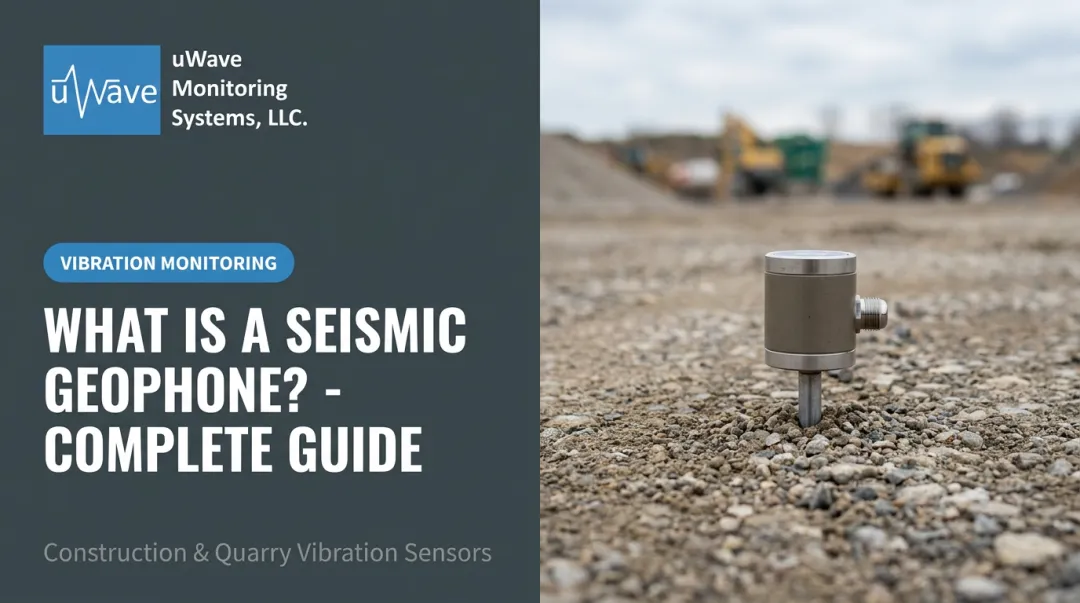
- Geophones: rugged, high-frequency sensors used heavily in exploration and subsurface mapping
- Strong-motion accelerometers: built to stay on-scale during large, high-amplitude shaking from nearby major earthquakes
Use Cases of Seismometers
Seismometers work as embedded sensors inside global and regional earthquake monitoring networks. Academic seismology labs, volcano observatories, and planetary science programs all rely on them. In industry, the same sensor principle sits inside portable seismographs used for blast vibration and construction monitoring.
The most striking example sits 140 million miles from Earth. NASA's InSight lander placed a seismometer, officially named SEIS (Seismic Experiment for Interior Structure), on the Martian surface on December 19, 2018. It was the first robotic seismometer placement on another planet, and it measured marsquakes and meteorite impacts to help scientists study Mars's crust, mantle, and core.
Closer to home, seismometers form the backbone of networks like the Global Seismographic Network, which operates roughly 150 stations worldwide, feeding free, real-time data to researchers around the globe.
What is a Seismograph?
A seismograph is the complete recording system: seismometer plus amplifier, data logger, and display. This is the instrument that actually produces something you can read, submit, or archive.
Outside of pure earthquake research, seismographs earn their keep on job sites. Continuous, timestamped, documented ground-motion records support:
- Regulatory compliance during blasting and excavation
- Safety assurance for nearby structures and residents
- Liability protection if a property-damage claim gets filed
The instrument type has evolved substantially. Legacy analog units used pen-and-paper drums; modern digital, cloud-connected seismographs log data automatically and push it to a dashboard in real time. Fixed observatory installations still exist for research, but portable field units dominate construction and blasting work.
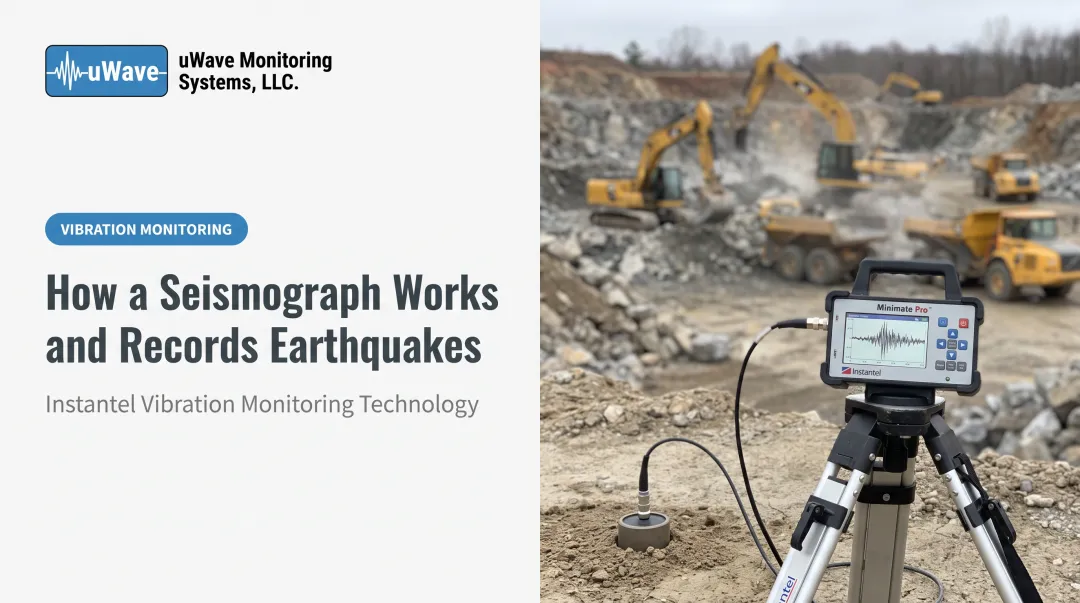
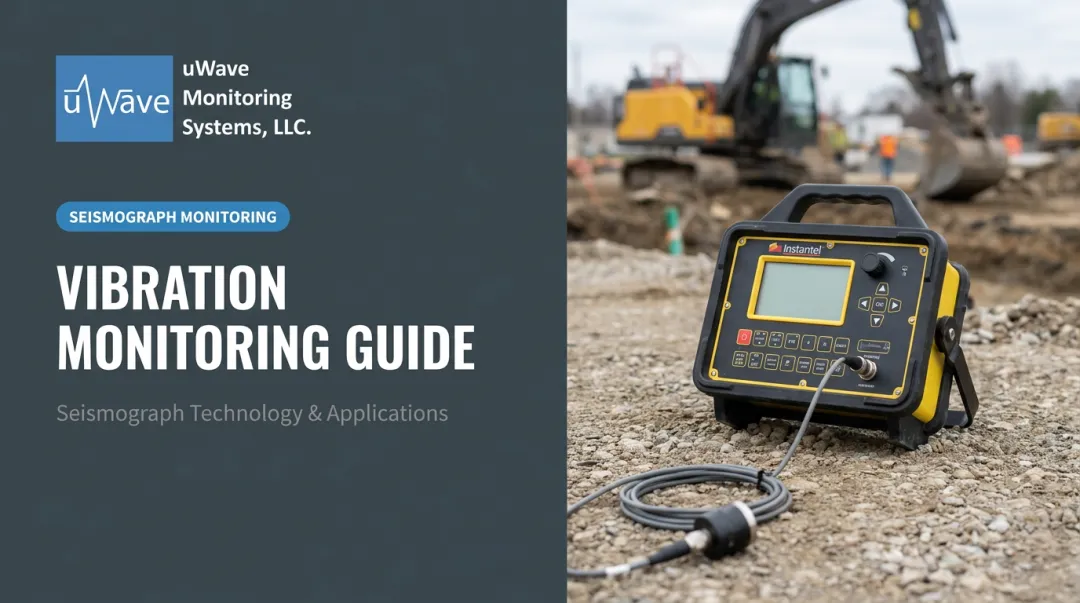
uWave Monitoring Systems supplies and services field-ready Instantel seismographs, including the Micromate, Minimate Pro, Minimate Plus, and Blastmate III lines. These units are built for jobsite deployment rather than pure research.
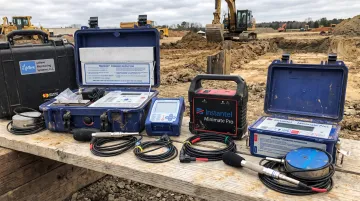
A complete field unit typically includes:
- Triaxial geophone
- Air-overpressure or sound-level microphone
- Mounting spikes, AC adapter, and carrying case
Some configurations add extension cables and solar power options for remote sites.
Seismograph Use Cases
Seismographs get deployed wherever ground vibration needs to be measured and documented, not just detected. That covers:
- Heavy construction and excavation
- Mining and quarrying blast operations
- Water infrastructure and utility upgrades
- Transit and urban development projects
Compliance thresholds make this mandatory. Under federal surface-coal-mining rules (30 CFR 816.67), peak particle velocity limits scale with distance from the blast:
| Distance from Blast | Maximum PPV |
|---|---|
| 0-300 ft | 1.25 in/s |
| 301-5,000 ft | 1.00 in/s |
| 5,001 ft and beyond | 0.75 in/s |
A seismographic record is required for every blast under this rule, with particle velocity measured in three perpendicular directions. That single requirement explains why real-time recording, not just sensing, is operationally necessary on active blast sites.
Real-World Application: Vibration Monitoring on Construction and Infrastructure Projects
Here's the scenario contractors face constantly: blasting, excavation, or heavy equipment vibration hits a threshold, a nearby resident files a complaint, and now there's a property-damage claim on the table. Without continuous data, there's no way to prove compliance or disprove liability.
That's the exact gap remote seismograph monitoring closes. Job sites need full seismograph systems—timestamped records of vibration, sound, and air overpressure—not a bare seismometer that only detects motion.
How Field-to-Cloud Monitoring Works
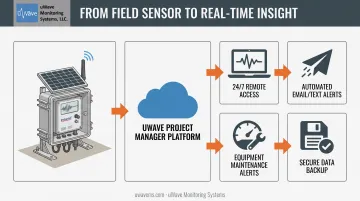
Project teams increasingly deploy remote, cloud-connected seismograph systems that run independently of staff being on-site. uWave's field-to-cloud model pairs Instantel seismographs with solar-powered enclosures, cellular gateways, and the uWave Project Manager platform.
That combination delivers:
- 24/7 remote access to live vibration, sound, and air overpressure data
- Automated email and text alerts when readings cross a set threshold
- Maintenance alerts flagging equipment issues before data gaps occur
- Secure data backup so records survive even if a station gets damaged or stolen
What Triggers the Decision to Add Monitoring
Most teams add remote monitoring for one of three reasons:
- Nearby resident complaints about noise or shaking
- Permit or regulatory requirements tied to blasting or pile-driving activity
- Pre-project risk mitigation for insurance or legal exposure
Industry guidance from firms like Terracon notes that remote monitoring programs help protect project teams from unreasonable damage claims, particularly when paired with baseline pre-construction surveys documenting existing conditions.
Why Continuous Records Matter
When a dispute arises, the seismograph's continuous, timestamped record is what settles it, not a standalone sensor reading taken after the fact. The full system, cloud connectivity included, protects contractors operationally and legally on active sites.
If you're planning a construction, mining, or infrastructure project with blasting or heavy equipment, uWave Monitoring Systems can help with seismograph rental, sales, and remote monitoring setup before you finalize your compliance plan.
Conclusion
Choosing between a seismometer and a seismograph isn't about picking the "better" instrument. One senses. The other records and reports.
For scientific research, sensor precision is what matters most. For construction, mining, and infrastructure work, a reliable cloud-connected seismograph system is what reduces downtime, disputes, and liability risk. That matters most when a claim shows up.
Frequently Asked Questions
What is the difference between a seismograph and a seismometer?
A seismometer is the sensing component that detects ground motion using inertia. A seismograph is the complete system, seismometer included, that amplifies, records, and displays that motion as a seismogram.
What is a seismometer?
A seismometer is an inertia-based device that detects ground motion. It uses a suspended mass that resists movement while its housing shifts with the ground, converting that relative motion into an electrical signal.
What are the different types of seismometers?
The main types are broadband, short-period, and long-period seismometers, plus geophones and strong-motion accelerometers. Each covers a different frequency range and application, from earthquake research to exploration surveys.
What is a seismogram?
A seismogram is the visual or digital record produced by a seismograph. It plots ground displacement on the vertical axis against time in seconds on the horizontal axis.
How do seismographs help with construction vibration compliance?
Seismographs generate continuous, timestamped vibration records that prove adherence to blasting or construction vibration limits, such as peak particle velocity thresholds required under federal mining regulations.
Can seismographs measure vibration from sources other than earthquakes?
Yes. Seismographs also detect vibration from blasting, heavy equipment, pile driving, and traffic. That's exactly why they're standard equipment for construction and infrastructure compliance monitoring.