Introduction
Ask any blasting engineer how to prove a shot didn't crack the neighbor's plaster, and they'll point to one document: USBM Report of Investigations 8507. Published in 1980, it's still the reference point for judging whether blast-generated ground vibration threatens nearby structures.
Many contractors and regulators run into the same problem: which PPV limit actually applies, and to what kind of vibration? Misreading the criteria, or applying them to the wrong vibration source, creates real exposure, from failed permits to contested damage claims.
This article breaks down what the USBM criteria represent, their PPV ranges, the assumptions behind them, how they're measured in the field, and where they get misapplied most often.
TL;DR
- USBM RI 8507 set frequency-dependent PPV limits of 0.5–2.0 in/sec for homes near surface mine blasting
- Plaster-on-lath homes face stricter thresholds than drywall construction
- Limits cover short blast pulses, not continuous vibration from compaction or pile driving
- Three-axis seismographs measuring PPV remain the accepted compliance metric
- Applying blasting limits to any vibration source is the most common misuse
What Do USBM Vibration Criteria Represent?
The USBM vibration criteria come from direct fieldwork. Researchers Siskind, Stagg, Kopp, and Dowding measured 76 homes and 219 production blasts. They combined that data with nine other blasting studies to set safe ground-vibration levels for homes near surface mining.
The result, USBM Report of Investigations 8507, published in 1980, remains the technical backbone of blast-vibration regulation in the US.
The criteria describe "threshold damage," meaning the most superficial cosmetic cracking, the kind that also shows up in homes that were never near a blast. Plaster on wood lath cracked more readily than modern gypsum drywall in the study data, which is why the limits split by wall type.
Peak particle velocity, or PPV, became the governing metric because it tracked damage more consistently than raw displacement or acceleration readings across the study's blast records. PPV is the peak speed of ground movement, typically recorded on three axes, and those readings correlate with the strain a structure experiences.
One point gets missed constantly: these are statistical boundary values, not a certainty for any single house. A reading below the curve reflects low population-level risk, not proof that a crack couldn't form.
The criteria serve three practical roles:
- Guiding blast design (charge weight, delay sequencing, distance)
- Setting compliance thresholds referenced in regulation, including 30 CFR 816.67
- Shaping monitoring setup and seismograph placement
Factors That Influence Application in Real-World Conditions
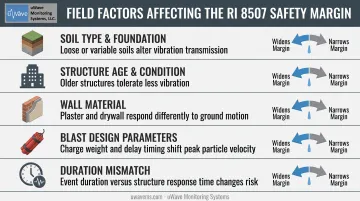
RI 8507's lab-clean assumptions don't always match field conditions. A few things routinely widen or narrow the safety margin the criteria assume:
- Soil type and foundation quality – soft or saturated soils transmit vibration differently than the firm foundations the study assumed
- Structure age and condition – older homes, or ones with pre-existing cracks, may respond at lower vibration levels than the study's benchmark
- Wall material – plaster-on-lath susceptibility versus drywall resilience determines which PPV limit is legitimate to use
- Blast design parameters – charge weight per delay, timing sequence, and confinement shape the frequency and duration of the resulting wave
- Duration mismatch – criteria assume a short blast pulse of a few seconds; compactors and pile drivers produce longer vibration the study never tested
That last point causes more disputed compliance readings than almost anything else in this field.
The Range of USBM Vibration Limits
RI 8507 doesn't give one number. It sets nominal safe levels for typical conditions, then adjusts them across a frequency spectrum.
| Structure type | Frequency | PPV limit |
|---|---|---|
| Older homes, plaster-on-lath | Below ~40 Hz | 0.5 in/sec |
| Modern homes, drywall | Below ~40 Hz | 0.75 in/sec |
| Both construction types | Above ~40 Hz | Up to 2.0 in/sec |
Nominal Safe Levels for Blasting Vibration
The 0.5 in/sec limit protects older, plaster-heavy homes at low frequency, where RI 8507 found the highest damage probability per unit of velocity.
The 0.75 in/sec threshold applies to modern drywall construction under the same low-frequency band. That figure later carried into the OSM regulatory framework as an alternative limit.
Frequency-Dependent Boundary Limits
Allowable PPV climbs as frequency increases. Above roughly 40 Hz, the ceiling reaches about 2.0 in/sec, reflecting lower damage risk at higher frequencies.
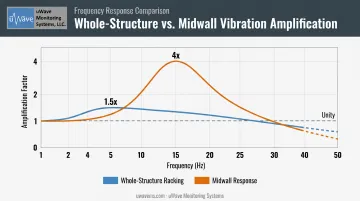
The stricter low-frequency limits track two resonance bands:
- Whole-structure racking, roughly 4–12 Hz, where an entire building sways as a unit
- Midwall response, roughly 10–25 Hz, where wall panels flex independently and amplify motion past the whole-structure response
These bands are why frequency matters as much as raw PPV when reading a compliance chart.
Safe Operating Margin and Underlying Assumptions
The built-in safety margin assumes a single, short-duration event lasting a few seconds, a firm foundation, and a residence of two stories or less.
Ignore those assumptions and the margin narrows fast. Soft soils, older or already-compromised structures, and longer-duration vibration sources all erode the protection the numbers were built to provide.
A PPV reading that looks compliant on paper can still coincide with real damage when field conditions don't match the study population.
Key Technical Properties of USBM Criteria
Four things define how these criteria behave in practice: frequency dependence, a statistical basis, sensitivity to structure and wall type, and duration and event-type coupling.
Frequency Dependence
Lower-frequency vibration produces greater displacement and strain per unit of velocity, so it gets penalized more heavily. A 0.5 in/sec event at 5 Hz can be riskier than a 1.5 in/sec event at 45 Hz, even though the second number looks bigger on a report.
Statistical, Not Absolute, Basis
RI 8507's 0.5 in/sec threshold reflects roughly a 5% probability of very superficial cracking for the most susceptible structures in the study, meaning it was built to protect more than 95% of residences under the study's assumptions. That's a population estimate, not a guarantee for the one house closest to a blast.
Structure and Wall-Type Sensitivity
RI 8507 reported typical amplification factors of about 1.5 for whole-structure racking and roughly 4 for midwall response, each at its own resonance frequency. Above 40 Hz, amplification for typical frame residences drops below unity. That fourfold midwall figure is exactly why low-frequency limits stay conservative.
Duration and Event-Type Coupling
The criteria were validated against blast wave trains generally lasting 1-2 seconds. Continuous sources such as compaction rollers, pile driving, and sustained traffic don't fit that mold. Applying a blast-derived PPV number to a source running for minutes or hours rests on an assumption the original research never tested.
How USBM Criteria Are Specified, Measured & Validated
RI 8507 itself isn't a regulation, it's research. Its limits became enforceable where regulators adopted them.
The operative federal provision is 30 CFR 816.67, which sets maximum allowable ground vibration and requires three-component PPV recording. Numerous state and local blasting ordinances reference similar frequency-dependent frameworks.
Measurement method:
- Three-axis geophones on a seismograph capture longitudinal, transverse, and vertical PPV components simultaneously
- Each axis is recorded independently, and the maximum allowable PPV applies to every measurement, not just the largest one
- Results are plotted against frequency on a compliance chart, showing where the reading falls relative to the allowable curve
This is where field practice decides whether a compliance record actually holds up. A seismograph placed poorly, calibrated late, or logging at too low a sample rate produces numbers that won't survive scrutiny.
Continuous, remote monitoring closes that gap. uWave Monitoring Systems provides Instantel seismograph rentals and sales—including Micromate, Minimate Pro, and Blastmate III units—paired with solar-powered remote stations and cellular connectivity for hard-to-reach sites.
Data flows into the uWave Project Manager platform, giving project teams:
- 24/7 remote access to monitoring data
- Automated email and text alerts when readings approach a threshold
- Maintenance alerts tied to Instantel's recommended annual calibration schedule
For a project running months of blasting or heavy equipment work, that auditable, timestamped PPV record is what gets referenced when a compliance question surfaces later.
Implications of Exceeding Limits & Common Misinterpretations
Exceeding a USBM-derived PPV limit doesn't automatically mean a structure was damaged. It means the reading crossed into a zone the research associates with higher damage probability, which is a signal to investigate, not an automatic verdict.
Ignoring an exceedance carries real consequences:
- Higher probability of cosmetic cracking in nearby structures
- Contractor liability exposure if a claim surfaces without supporting monitoring data
- Permit or regulatory non-compliance where limits are legally adopted
Even careful monitoring programs stumble when the criteria themselves are misread.
Common Misinterpretations to Avoid
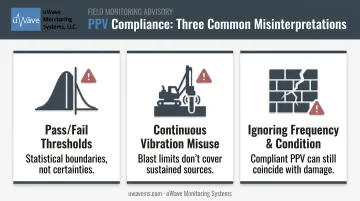
- Treating PPV limits as pass/fail thresholds. They're statistical probability boundaries, not a certainty test for any individual building.
- Applying blasting limits to continuous vibration. A 2013 Florida DOT-sponsored study found USBM/OSM criteria were developed for surface-mine blasting on one- to two-story homes, not continuous sources like pile driving or compaction. Using them there has no solid legal or technical basis.
- Ignoring frequency composition and structure condition. A compliant PPV number at the wrong frequency, or measured on an already-cracked wall, is not automatically a safe reading.
Conclusion
USBM vibration criteria are a frequency-dependent, statistically grounded framework that only works correctly within its original assumptions. Getting the standard right, and reading it the way the researchers intended, matters as much as the published PPV figures themselves.
That's why consistent monitoring matters over the life of a project, not just at the start. Field-to-cloud systems capture three-axis PPV continuously, flag threshold approaches automatically, and keep a defensible record. That documentation turns a compliance requirement into something you can stand behind if a dispute comes up.
Frequently Asked Questions
What is the ISO standard for vibration severity?
ISO 4866 is the international standard for measuring and evaluating vibration effects on fixed structures, covering sources from explosions to traffic and machinery. It's broader than USBM's PPV-based blasting criteria, which apply specifically to US mining and construction blast compliance.
What are the legal requirements regarding HAVS?
Hand-Arm Vibration Syndrome covers occupational exposure to tool and equipment vibration under OSHA guidance and ISO 5349, not ground vibration criteria. It is a separate hazard category from the structural blast-damage limits covered here.
What is peak particle velocity and why is it the standard metric?
PPV measures the maximum speed of ground particle movement during a vibration event. USBM research found it correlated more consistently with structural damage than displacement or acceleration across its blast study data.
What is the Z-curve (Siskind curve)?
The Z-curve is a common name for the frequency-versus-PPV chart from RI 8507 that separates allowable vibration levels from levels linked to higher damage probability. Federal regulation refers to this chart as "Figure 1."
Do USBM blasting limits apply to construction vibration too?
No. They were developed and validated for short-duration blasting events. Applying them to longer, continuous construction vibration relies on assumptions the original research never tested.
Are USBM vibration criteria legally binding?
RI 8507 itself is a research report, not a regulation. Its limits become enforceable where adopted into rules like 30 CFR 816.67 or incorporated into state and local blasting ordinances.