Introduction
When a construction crew starts pile driving 50 feet from an occupied apartment building, the stakes become clear fast. Without proper vibration monitoring, there's no way to know whether those shockwaves are cracking plaster, shifting foundations, or approaching the threshold that triggers a stop-work order — or a lawsuit.
The consequences of skipping vibration monitoring aren't abstract. Travelers describes vibration damage losses as costly and frequent for contractors, while J.S. Held notes that damage claims often arise over real or perceived construction vibration. The global construction vibration monitoring service market was valued at $1.65 billion in 2025, projected to reach $3.55 billion by 2034 — a growth rate that reflects just how seriously the industry now treats this issue.
This guide covers what every project team needs to know:
- How seismograph technology works
- The standards that govern vibration limits
- Components of a complete monitoring system
- Key industry applications
- How cloud-based remote monitoring is changing compliance
Key Takeaways
- PPV in inches per second is the standard metric for determining whether ground vibration stays within safe limits
- USBM RI 8507 sets PPV thresholds from 0.5 to 2.0 in/s for residential structures based on vibration frequency
- Triaxial geophones capture all three axes of ground movement — a single-axis reading isn't sufficient for regulated work
- Pre-construction baseline surveys are essential before setting trigger thresholds
- Automated, cloud-connected monitoring eliminates manual data retrieval and enables real-time alerts
What Is Vibration Monitoring and Why Does It Matter?
Vibration monitoring is the measurement and recording of ground or structural movement using a seismograph. The primary metric is Peak Particle Velocity (PPV) — the maximum speed at which a soil or rock particle oscillates as a seismic wave passes through it, expressed in inches per second (in/s). The Federal Transit Administration defines PPV as the peak signal value of an oscillating vibration velocity waveform, and 30 CFR requires ground vibration from blasting to be measured this way.
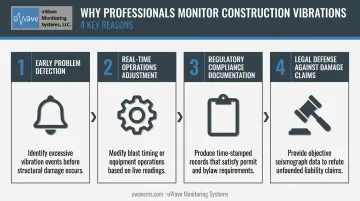
Four Reasons Professionals Monitor Vibrations
- Catch problems early by identifying when PPV levels approach structural damage thresholds before damage actually occurs
- Adjust operations in real time — modifying blast designs, equipment usage, or compaction methods to stay within safe limits
- Satisfy federal, state, and local documentation requirements with verified, timestamped compliance records
- Defend against damage claims with court-admissible data that distinguishes pre-existing conditions from construction-related causes
Construction Monitoring vs. Seismic Monitoring
Construction vibration monitors aren't the same as geophysical instruments used for earthquake research. Purpose-built construction seismographs are threshold-based instruments: they record PPV events against programmable trigger criteria and produce compliance-style reports. Factory-calibrated units with ISEE and DIN certification are specifically built to generate defensible documentation — not raw research data.
How Seismograph Technology Works
The core sensor in a vibration monitoring system is the geophone (also called a transducer). Inside the geophone, a spring-mounted magnetic mass moves within a wire coil when the ground vibrates. That movement generates an electrical signal proportional to particle velocity, which the seismograph unit then processes and records.
Triaxial Measurement
Geophones used for construction and blasting monitoring measure vibration along three orthogonal axes simultaneously:
- Transverse — side-to-side movement
- Vertical — up-and-down movement
- Longitudinal — back-and-forth movement toward and away from the vibration source
Ground movement during a seismic event isn't confined to one plane, which is why capturing all three vectors matters. Federal blasting regulations under 30 CFR require particle velocity to be recorded in three mutually perpendicular directions, and compliance is based on the maximum PPV across all three — so a single-axis reading isn't sufficient for regulated work.
The seismograph continuously samples signals from the triaxial geophone against preset trigger thresholds. When a threshold is exceeded, the unit records a full waveform event. Between events, background PPV readings log at regular intervals to generate histogram data.
Microphones for Sound and Air Overpressure
Most construction seismographs support two microphone types alongside the triaxial geophone:
- Linear "L" microphones — Measure low-frequency air overpressure (air blast) from blasting operations; standard range of 88–148 dB(L) at 2–250 Hz
- A-weighted microphones — Capture audible noise levels on a scale closer to human hearing, measured in dB(A)
uWave's rental inventory reflects this split:
- Linear "L" microphones — Included as standard with most Instantel units (Micromate, Minimate Pro4, Blastmate III)
- A-weighted microphones — Available as add-ons for projects requiring audible noise documentation
- Minimate Pro4 + Instantel Type 1 Sound Level Meter — The combination for simultaneous vibration and acoustic monitoring on projects with strict noise compliance requirements
Accurate sensor readings are only as reliable as the last calibration. ISEE requires seismographs and sensors to be calibrated before initial use, annually thereafter, and after any repairs that could affect response. This annual cadence is the accepted standard for data defensibility in regulatory and legal proceedings. uWave sends all units to the manufacturer for annual calibration, and a calibration label on each instrument shows the next due date.
Key Industry Standards and Vibration Damage Thresholds
Three frameworks govern most construction vibration compliance work in the United States.
USBM RI 8507
The foundational reference is USBM Report of Investigations 8507, Structure Response and Damage Produced by Ground Vibration from Surface Mine Blasting (Siskind et al., 1980). It provides the widely cited PPV-vs.-frequency limit chart used to assess whether recorded vibration falls within safe limits.
| Structure Type | Frequency | Safe PPV Limit |
|---|---|---|
| Older homes — plaster on wood lath | Below 40 Hz | 0.50 in/s |
| Modern homes — drywall | Below 40 Hz | 0.75 in/s |
| Residential structures generally | Above 40 Hz | 2.0 in/s |
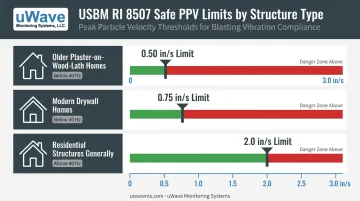
Any recorded PPV above the limit line signals potentially damaging vibration. Originally developed for surface mine blasting, RI 8507 now serves as the de facto compliance baseline for construction vibration in most US jurisdictions.
FTA Transit Construction Manual
The FTA Transit Noise and Vibration Impact Assessment Manual (Report No. 0123, 2018) applies to federally funded transit projects and urban construction near sensitive areas. It provides an attenuation equation — PPV(equip) = PPV(ref) × (25/D)^1.5 — for estimating PPV at various distances, along with equipment-specific reference values at 25 feet:
- Impact pile driver: 0.644–1.518 in/s
- Vibratory roller: 0.210 in/s
- Large bulldozer / hoe ram: 0.089 in/s
- Loaded trucks: 0.076 in/s
The FTA also sets structure-sensitive damage criteria, down to 0.12 in/s for extremely susceptible buildings.
Local Codes and Facility-Specific Standards
Beyond the FTA framework, most builders work within local codes that adopt or adapt RI 8507/OSMRE guidelines as their compliance baseline. Vibration-sensitive facilities — hospitals, data centers, laboratories — often impose stricter internal thresholds that supersede those general standards.
Types of Vibration Damage
Three damage categories apply across industry and insurance contexts:
- Cosmetic — Cracked plaster, drywall, masonry, or joint separation; affects appearance, not structural integrity
- Structural — Differential settlement, loss of foundation support, or damage to load-bearing elements
- Functional — Disruption of sensitive equipment or operations, even without visible physical damage
Older plaster-on-wood-lath homes, non-engineered timber or masonry structures, and historic buildings are the most susceptible. Modern engineered concrete and steel structures tolerate significantly higher PPV levels.
Pre-construction baselines matter. If trigger thresholds are set below the site's existing background vibration level, every passing truck will trigger a stop-work alert. Pre-construction photo surveys documenting existing structural defects are standard practice — and sometimes legally required — before any heavy work begins.
Essential Components of a Vibration Monitoring System
Triaxial Geophones
uWave's rental inventory centers on standard triaxial geophones, available in three variants:
- Standard ISEE triaxial geophone: 2–250 Hz frequency range; used in approximately 95% of applications
- Extended range (DIN 45669-1 Class 1): 1–315 Hz; suited for broader frequency coverage or longer cable runs (up to 3,280 ft)
- High-frequency triaxial geophone: 28 Hz–1 kHz; recommended for near-field monitoring with particle velocity up to 100 in/s
Proper installation is straightforward but matters: the arrow on the geophone casing should point toward the vibration source, and the unit must be level within 10 degrees.
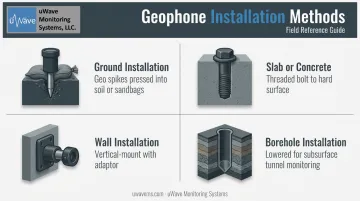
Common installation methods include:
- Ground installation — Geo spikes pressed into soil; sandbags used when spiking isn't feasible
- Slab/concrete — Anchored via threaded bolt to a hard surface
- Wall installation — Vertical-mount geophone with appropriate adaptor
- Borehole installation — Lowered to depth for subsurface monitoring of tunnels and utilities
Seismograph / Vibration Monitor
The seismograph unit handles the full signal chain from sensor to stored record. Core functions include:
- Powers the geophone and converts raw electrical signals into PPV values
- Compares readings against preset thresholds in real time
- Stores histogram data at regular intervals
- Records full waveform events when thresholds are exceeded
Key specifications for Instantel units available through uWave:
| Model | Channels | Sample Rate | Display |
|---|---|---|---|
| Micromate / Micromate Plus | 4 | 1,024 sps (recommended) | Touch screen |
| Minimate Pro4 / Pro6 | 4 or 6 | 512–65,536 sps | Touch screen |
| Minimate Plus | 4 or 8 | — | Button-based LCD |
| Blastmate III | 4 | — | Button-based |
Instantel seismographs are available through uWave for rental, purchase, or certified used sale. Certified used units come complete with recent annual calibration, making them a compliant, cost-effective option for projects with strict documentation requirements.
Processing Software and Compliance Reports
Seismograph data is stored in a proprietary format, so two software tools handle different parts of the workflow. THOR serves as the primary platform for data management, event importing, scheduler configuration, and report generation. Blastware handles ASCII data conversion and compliance setup configuration.
The four key report types for compliance documentation:
- Histogram report — PPV over time across the monitoring period
- Waveform event report — Full waveform for a single triggered event
- FFT report — Full velocity-vs.-frequency spectrum analysis
- Vibration limit chart — PPV plotted against the RI 8507 safe-limit line
uWave's cloud platform provides customized reports accessible 24/7 through the uWave Project Manager web portal.
Applications Across Construction and Industry
Heavy construction and urban development represent the most common monitoring scenarios. Typical activities include:
- Pile driving and vibratory compaction near adjacent structures
- Excavation and demolition in urban environments
- Vibratory roller and compactor operations during site prep
Continuous vibrations from rollers and compactors actually carry greater damage potential than transient events like blasting, because they increase the chance of resonant amplification in nearby structures. Caltrans notes vibratory pile drivers produce peak vibration during startup and shutdown — a direct consequence of resonance effects.
Mining and quarrying is where most seismograph standards originated. RI 8507 was developed for surface mine blasting, and OSMRE/eCFR anchors blasting regulation for coal mining operations. The Blastmate III is designed specifically for these conditions, capturing both ground vibration and air overpressure from explosive charges. The Micromate also complies with the Swedish blasting standard (SS4604866), confirming blast monitoring as a core competency.
Transit, water infrastructure, and utility projects shift the focus from surface structures to what lies beneath: pipelines, tunnels, and sewers are all at risk during nearby construction. The FTA manual requires quantitative vibration assessment for transit-adjacent projects lasting a month or more, particularly those involving pile driving, blasting, or demolition near sensitive structures.
Automated and Remote Vibration Monitoring
A standalone seismograph records data at the job site, but retrieving that data still requires someone to show up in person. Remote monitoring removes that requirement entirely.
How Remote Monitoring Works
Cellular modems transmit recorded data to the cloud at regular intervals (or immediately when a threshold is exceeded). uWave's cloud-hosted uWave Project Manager platform automatically processes incoming data and makes histogram and waveform reports accessible 24/7 via web browser — no on-site visits required for routine data collection.
Hardware Configurations
uWave offers two remote monitoring station enclosures:
- V3 Heavy Duty Station — Built for demanding, long-term deployments; includes 30W solar module, charge controller, external programmable timer, Sierra Wireless cellular modem (RV50 or RV55), GPS/cellular antenna, AGM battery backup, and weatherproof lockable enclosure
- V5 Medium Duty Station — Lighter, portable alternative with the same core components; dimensions 22" × 24" × 24", weighing 60 lbs
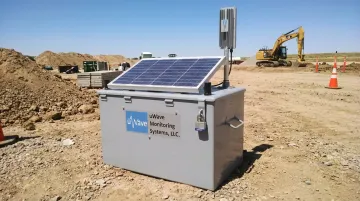
Both stations support the full Instantel instrument lineup and are designed for unattended operation in outdoor environments. The Sierra Wireless RV55 is uWave's currently recommended cellular gateway, supporting LTE-A Pro with compatibility across Verizon, AT&T/FirstNet, US Cellular, and other major carriers.
Alert System and Data Integration
The uWave Project Manager delivers automated email and SMS alerts when predetermined thresholds are exceeded. Supported alert types include:
- Vibration levels
- Sound and noise readings
- Air overpressure events
- Equipment maintenance schedules
Remote Alarm Controllers are also available for on-site physical alerting via a dual-relay system that can trigger warning lights or sirens. Alert thresholds are configured on a per-project basis, and bulk monitoring package discounts apply when multiple units are deployed across a work zone.
Frequently Asked Questions
What is Peak Particle Velocity (PPV) and why is it the standard measurement for vibration monitoring?
PPV is the maximum velocity at which a ground particle moves during a vibration event, measured in inches per second. Engineers and regulators rely on it because it correlates most directly with structural damage potential under standards like USBM RI 8507, and federal regulations under 30 CFR require it as the measurement unit for blasting ground vibration.
What vibration levels are considered safe near residential or commercial structures?
USBM RI 8507 sets frequency-dependent limits between 0.50 and 2.0 in/s for residential structures — lower for older plaster homes below 40 Hz, higher at frequencies above 40 Hz. The FTA manual uses lower thresholds for extremely susceptible buildings (0.12 in/s). Local ordinances may impose stricter limits, so verify requirements before deployment.
What is the difference between a geophone and a seismograph?
A geophone is the sensor — it detects ground motion and converts it to an electrical signal. The seismograph is the recording unit that powers the geophone, processes the signal into PPV readings, compares those readings against preset thresholds, and stores the data for compliance reporting.
When should vibration monitoring begin on a construction project?
Before construction starts — to establish background vibration baselines and document pre-existing structural conditions. Monitoring should continue throughout all operations involving heavy equipment near existing structures. GDOT, for example, requires activity logs and monitoring for excavation and compaction within 75 feet of a building.
How often do seismographs need to be calibrated?
ISEE requires annual calibration, plus recalibration after any repairs affecting instrument response. uWave sends all units to the Instantel factory for calibration, and each unit carries a calibration label showing the next due date. Clients needing court-admissible documentation should confirm the specific unit's calibration date before deployment.
Can a seismograph also measure construction noise and air overpressure?
Yes. Most construction seismographs support microphone attachments: Linear "L" microphones for low-frequency air overpressure from blasting, and A-weighted microphones for audible noise levels. uWave rental units support both types, including configurations that capture simultaneous vibration and acoustic data in a single deployment.