For construction, mining, water infrastructure, and transit projects, that distinction matters. According to the ASA Standards definition, structure-borne sound is any sound for which a significant portion of the source-to-receiver path runs through a solid structure rather than air — meaning the walls, floors, and foundations of adjacent buildings become the transmission medium.
Left unaddressed, structural noise escalates from nuisance to liability. This guide breaks down where it comes from, what happens when it's ignored, and what a layered control strategy actually looks like.
Key Takeaways
- Structural noise travels through solid materials, not air — making standard soundproofing insufficient on its own
- Primary sources include pile driving, rigid equipment mounts, impact forces, and ground-borne traffic vibration
- Uncontrolled structural noise risks micro-cracking, regulatory violations, and legal exposure
- Effective control requires source isolation, structural decoupling, and continuous PPV monitoring
- Monitoring records are your primary defense in regulatory audits and damage claims
Common Causes of Structural Noise
Structural noise begins the moment a mechanical force contacts a solid surface. That energy propagates as waves through whatever rigid material it touches, traveling through floor slabs, beams, and foundations before radiating as audible sound in spaces far from the original source.
This distinguishes it from airborne noise, which travels as pressure waves through air and can be partially blocked by mass alone.
Identifying the specific source type is the first step toward selecting the right control strategy. The four main categories each require a different approach.
Construction and Demolition Activity
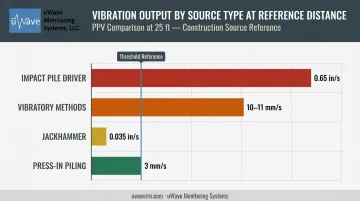
Heavy construction generates some of the highest structural vibration levels encountered in any built environment. Caltrans benchmark data puts the reference PPV for an impact pile driver at 0.65 in/s at 25 feet — roughly 18 times higher than a jackhammer at the same distance (0.035 in/s).
High-risk scenarios include:
- Urban building projects driving piles or blasting near occupied residential structures
- Quarry and mining operations adjacent to homes or infrastructure
- Tunnel boring running beneath active transit lines or commercial buildings
The impulse nature of these sources — sudden, high-energy bursts — makes them particularly damaging compared to continuous low-frequency sources.
Rigidly Mounted Mechanical Equipment
When pumps, generators, compressors, and HVAC units are hard-mounted directly to structural frames without isolation, their operating vibration transfers continuously into the building. ASHRAE identifies blade-pass frequencies from forward-curved fans as common low-frequency rumble sources in the 16, 31.5, and 63 Hz bands. These frequencies travel efficiently through concrete and steel, losing little energy along the way.
This is a persistent problem in water treatment facilities, transit stations, and commercial buildings where mechanical systems run around the clock.
Impact and Direct Contact Forces
Direct impact sources transmit energy into structural assemblies almost instantly, with reverberation persisting throughout the frame long after the event. Common sources include:
- Dropped materials and equipment on concrete floors
- Heavy vehicle traffic on rigid warehouse or job site slabs
- Repetitive footfall on hard flooring in multi-story structures
Ground-Borne Vibration from Traffic and Transit
FTA guidance identifies rapid transit systems as commonly generating 70 VdB or more near tracks, with freight locomotives producing 3–8 dB higher vibration than rail cars. Heavy trucks on rough pavement can also couple ground vibration into building foundations, especially where road surfaces are deteriorated.
Because the source itself is rarely controllable, mitigation focuses on the transmission path or the receiver — making monitoring at the structure the critical first step.
What Happens If Structural Noise Is Ignored
Structural damage from ignored vibration rarely announces itself all at once. It typically starts as micro-cracking in mortar joints and plaster, loosening of threaded connections and pipe joints, and fatigue in structural members. Near high-energy sources like pile driving or blasting, these effects can escalate to wall or foundation damage.
The regulatory and legal consequences follow the same pattern: slow to appear, serious when they arrive.
Warning Signs You Are Experiencing Structural Noise Problems
Recognizing early indicators prevents minor issues from becoming costly ones:
- New hairline cracks in plaster, mortar joints, or concrete near construction activity or mechanical rooms — often the first physical signal that vibration levels are elevated
- Persistent low-frequency hum or rumble in rooms far from any obvious source, typically indicating vibration traveling through the structural frame rather than airborne sound
- Rattling windows, door frames, and fixtures — when connections and fittings begin working loose, vibration energy in the structure is high enough to cause mechanical fatigue over time
Blasting and heavy construction vibration limits vary by jurisdiction. Maryland COMAR sets blasting PPV at 2 in/s maximum at the nearest structure; Alabama's surface-mining rules step down from 1.25 in/s within 300 feet to 0.75 in/s beyond 5,000 feet. Exceeding these thresholds can trigger citations, stop-work orders, and legal liability.
Courts take documented damage seriously. In Lowenburg v. Sewerage and Water Board of New Orleans, a Louisiana appellate court upheld liability and damage awards after finding that construction activity caused new structural damage or aggravated pre-existing conditions.
Without measurement records, project teams have no way to demonstrate compliance, or to defend against claims that predate their work entirely.
How to Prevent and Reduce Structural Noise
Effective structural noise control requires a layered strategy. The goal is to stop vibration at the source, break transmission paths within the structure, and verify through monitoring that measures are actually working.
Vibration Isolation at the Source
Mounting vibrating equipment on rubber pads, spring isolators, or neoprene mounts breaks the rigid connection that allows vibration to transfer into structural frames. AMCA data shows that a disturbing-to-natural-frequency ratio of 3.31 achieves 90% theoretical isolation — though actual performance depends on load, damping, and installation quality.
Key implementation points:
- Install isolation during initial equipment installation — retrofitting is possible but harder
- ASHRAE recommends isolator natural frequency no more than 40% of fan speed for fans below 300 rpm
- Include resilient hangers on connected piping near isolated equipment; rigid pipe connections bypass isolation entirely
- Verify effectiveness with vibration measurement before and after installation, not just after
Structural Decoupling and Damping
Where isolation at the source isn't sufficient, breaking rigid connections within the structure reduces transmission:
- Floating floor systems with acoustic underlayment interrupt impact transmission through floor slabs
- Resilient wall channels and isolation clips behind drywall break the direct connection between studs and finish surfaces
- Suspended ceiling assemblies decouple ceilings from floor structures above
- Damping materials — viscoelastic compounds and damping sheets — absorb vibration energy within the structure, converting it to heat rather than sound
Performance values for these systems are frequency-, temperature-, and installation-dependent. Treat manufacturer data as directional guidance, not guaranteed insertion loss.
Engineering Controls and Site Planning
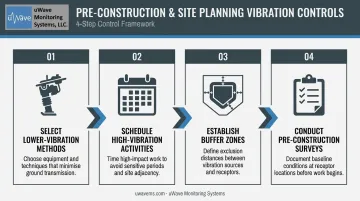
For construction projects, the control strategy starts before a shovel hits the ground:
- Select lower-vibration methods where feasible — press-in piling generates measurably lower ground vibration than impact driving (measured at roughly 3 mm/s at 2 meters for press-in, versus 10–11 mm/s for vibratory methods in comparable Singapore site data)
- Schedule high-vibration activities away from sensitive hours and away from the closest sensitive structures
- Establish buffer zones and coordinate with adjacent property owners before work begins
- Conduct pre-construction vibration surveys of adjacent structures — this establishes a documented baseline that protects project owners from liability claims tied to pre-existing damage
That baseline documentation matters most when work is near occupied buildings. uWave Monitoring Systems provides pre-construction vibration assessment services that establish those conditions on record before any construction activity begins.
Continuous Vibration and Sound Monitoring
Real-time monitoring converts good intentions into documented compliance. Seismograph-based systems track PPV continuously against regulatory thresholds, enabling corrective action before a violation occurs, not after.
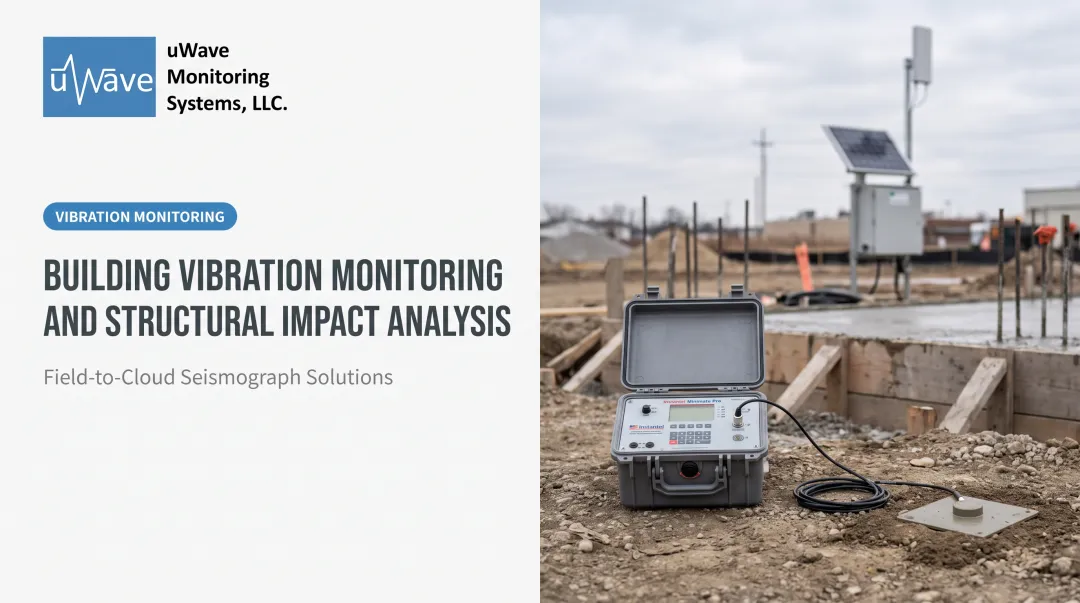
uWave's Field-to-Cloud monitoring systems pair Instantel seismographs (Micromate, Micromate Plus, Minimate Pro4, Blastmate III) with the uWave Project Manager cloud platform, delivering:
- 24/7 remote data access without requiring on-site personnel
- Automated vibration, sound, and maintenance alerts via email and SMS when readings approach configured thresholds
- Secure cloud-hosted data records with customized reporting for compliance documentation
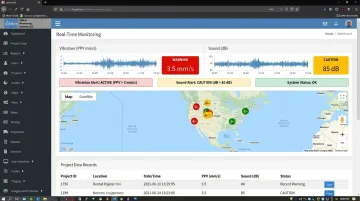
The Micromate Plus records at 1,024 samples per second with a geophone frequency range of 2–250 Hz (ISEE), measuring PPV in both in/s and mm/s alongside sound levels in dB on a single unit.
For projects requiring multiple deployment points, uWave offers bulk monitoring package discounts. Multi-unit pricing makes continuous coverage practical across large construction or mining footprints where a single sensor wouldn't capture the full picture.
Tips for Long-Term Structural Noise Control
Initial installation gets the controls in place — active program management keeps them working. Long-term structural noise control depends on consistent oversight across four areas:
- Inspect isolation mounts and resilient connections regularly — rubber and neoprene mounts stiffen and degrade over time, and maintenance work sometimes bypasses them inadvertently
- Set documented alert thresholds for every project phase — uWave's platform supports configurable vibration and sound alerts that notify site managers before readings reach regulatory limits, not after
- Maintain a complete timestamped monitoring log — this record is your primary defense during regulatory audits and third-party damage claims; cloud-hosted platforms with secure backup and customized report generation make this straightforward
- Train equipment operators to understand how placement, operating speed, and load handling affect vibration transmission into adjacent structures — operator behavior is often the easiest variable to change
Beyond day-to-day practices, annual seismograph calibration is non-negotiable. uWave coordinates Instantel-recommended annual calibration for all rented and leased instruments, managing the RMA process on behalf of clients to minimize project downtime.
Conclusion
Structural noise has identifiable physical causes and proven engineering responses for each one. Rigidly mounted equipment gets isolation mounts. Impact sources get decoupled floor and wall assemblies. High-vibration construction methods get replaced with lower-impact alternatives where feasible. Ground-borne vibration gets managed through path interruption and continuous monitoring.
Measurement ties all of it together. Without documented PPV and sound data, you cannot verify that controls are working, demonstrate regulatory compliance, or defend against damage claims. Projects that control structural noise rather than react to it rely on a layered approach:
- Source isolation to cut vibration at the origin
- Structural decoupling to interrupt transmission paths
- Site planning to keep sensitive uses away from high-energy work
- Continuous cloud-based monitoring to catch threshold exceedances in real time
Frequently Asked Questions
What is structural noise?
Structural noise (also called structure-borne noise) is sound that travels through solid building materials — walls, floors, beams, and foundations — rather than through air. It starts when a mechanical impact or vibration transfers into a solid surface and travels as wave energy through the structure, re-emerging as audible sound far from the original source.
How to reduce structure-borne noise?
The most effective approach combines three layers: isolating vibrating equipment at the source with rubber or spring mounts, decoupling structural assemblies using resilient channels or floating floors, and monitoring vibration levels with seismograph-based systems to confirm that measures are achieving target reductions before problems escalate.
What are the noises you hear in house walls?
Sounds in walls are almost always structure-borne — pipes vibrating against framing, studs transmitting footstep impacts, or mechanical equipment sending vibration through the frame. Unlike airborne noise that leaks through gaps, the transmission path runs through the solid material itself, so sealing gaps won't stop them.
What are the 4 types of noise?
The four main categories are airborne noise, structure-borne noise, impact noise, and flanking noise. Each travels by a different path — airborne through air, structure-borne through solids, impact through direct contact, and flanking via indirect routes around partitions — and each requires a different control strategy.
What are the effects of structural noise on buildings?
Prolonged or high-level structural noise can cause micro-cracking in masonry and plaster, loosen mechanical connections and fixtures, and accelerate fatigue in structural members. Near high-energy sources like pile driving or blasting, effects can extend to more significant foundation or wall damage, particularly in older or unreinforced construction.
How is structural noise measured on construction sites?
Structural noise is measured using seismographs that record Peak Particle Velocity (PPV) in mm/s or in/s, compared against regulatory thresholds. Continuous cloud-connected monitoring systems — such as those offered by uWave Monitoring Systems — provide real-time compliance data and timestamped records accessible remotely, without requiring permanent on-site personnel.