Introduction
A single noise complaint can shut down a construction site faster than a failed inspection. Regulators, neighbors, and workers are all watching, and the scrutiny never lets up.
The stakes go beyond fines. About 27 million U.S. workers were exposed to hazardous occupational noise in the past year, according to CDC/NIOSH surveillance data. Construction workers face this risk at a higher rate than most industries.
This guide covers how construction noise gets measured, the equipment options available, practical control strategies, and how to pick a monitoring system that actually fits your project.
Key Takeaways
- Noise monitoring splits into two tracks: occupational (worker exposure) and environmental (community compliance)
- Equipment must meet IEC 61672 for sound meters and IEC 61252 for dosimeters
- Cloud-connected alert systems catch threshold breaches before they become violations
- Combined noise-vibration monitors simplify data collection on blasting and quarrying sites
- Rental fits short-term jobs; purchase pays off for multi-site programs
Why Noise Monitoring Matters on Construction Projects
Noise compliance covers two distinct fronts: protecting workers on-site and protecting the public around it.
Regulatory Pressure From Both Directions
On the occupational side, OSHA's construction noise standard (29 CFR 1926.52) sets a permissible exposure limit of 90 dBA over 8 hours. That threshold drops to 92 dBA at 6 hours and 95 dBA at 4 hours as exposure time shortens. Impulsive noise from equipment like jackhammers cannot exceed 140 dB peak.
On the environmental side, municipalities layer on their own rules. New York City requires a Construction Noise Mitigation Plan before work starts, restricting work to roughly 7 a.m.–6 p.m. on weekdays. Washington, DC caps most construction noise at 80 dBA measured 25 feet from the site boundary during permitted hours.
Undocumented violations rarely end quietly. A neighbor's complaint without your own data to counter it often results in stop-work orders, fines, or drawn-out disputes — the exact opposite of what a tight project schedule needs.
The Worker Health Reality
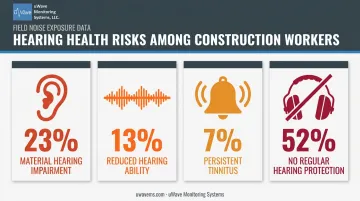
The numbers on hearing damage are hard to ignore. About 37% of construction workers were exposed to hazardous noise in the past year, according to CDC construction industry statistics. Among noise-exposed workers with audiogram data:
- 23% show material hearing impairment
- 13% report hearing difficulty
- 7% report tinnitus
- 52% say they don't wear hearing protection regularly
That last figure is the one that should worry safety managers most. Documented exposure data supports hearing-conservation programs and gives project leads a factual basis for enforcing PPE use, not just a policy on paper.
How Construction Noise Is Measured
Decibels don't behave like a normal number scale. The dB scale is logarithmic, meaning a 10 dB increase represents a tenfold increase in sound energy, not just a small step up.
For reference, based on FTA construction noise data:
| Source | Approximate Level |
|---|---|
| Normal conversation | 60 dBA at 3 ft |
| Excavator | 85 dBA Leq at 50 ft |
| Jackhammer | 85 dBA Leq at 50 ft |
| Concrete saw | 90 dBA Leq at 50 ft |
The Metrics That Actually Matter
Raw decibel readings aren't useful on their own. Reports rely on specific metrics:
- Leq(T): The equivalent continuous sound level over a time period. It's the standard metric for cumulative construction noise assessment.
- Lmax: The single highest level reached during a discrete event, useful for capturing spikes an average would hide
- LAeq,8h: An 8-hour equivalent level used for occupational exposure tracking
Frequency Weighting and Standards
These metrics only hold up if the instrument captures sound the way it actually affects people and equipment, which is where frequency weighting comes in. Instruments apply A-weighting to mimic human hearing sensitivity. This is what OSHA and NIOSH use for occupational limits. C-weighting captures low-frequency energy more accurately, which matters for heavy machinery and blasting where deep rumble dominates but A-weighting would understate it.
Equipment also has to meet formal accuracy classes:
- IEC 61672 Class 1 or Class 2 for sound level meters (Class 1 is tighter tolerance)
- IEC 61252 for personal noise dosimeters
Matching Method to Purpose
Certified equipment still needs to be deployed the right way. Three distinct measurement approaches exist, and picking the wrong one skews your data:
- Personal/worker monitoring: dosimeters worn on the body for shift-long exposure tracking
- Fixed perimeter monitoring: stationary units at property lines for community compliance
- Continuous unattended stations: 24/7 logging for long-duration or sensitive projects
Spot checks work fine for a one-day compliance snapshot. Projects near schools, hospitals, or residential zones typically need continuous logging to build a defensible record over weeks or months.
Types of Construction Noise Monitoring Equipment
Not every job needs the same tool. Here's how the main categories break down.
Sound Level Meters
Handheld sound level meters require an operator on-site and are best for spot-checking a specific machine or task. They're the go-to tool for identifying which piece of equipment or process is driving elevated readings before you invest in a fix.
Noise Dosimeters
These small, shoulder-worn devices track an individual worker's total exposure across a full shift. They're ideal for roles where workers move between task areas — a crew member operating a saw one hour and standing near a compressor the next builds a very different exposure profile than a stationary reading would show.
Environmental/Perimeter Noise Monitoring Stations
Weatherproof, unattended units placed at site boundaries provide continuous, long-term compliance data near sensitive receptors. These stations run without a technician present, logging Leq and Lmax data around the clock for as long as the project requires.
Combined Noise & Vibration Monitors
Blasting, quarrying, and heavy earthmoving generate both airborne sound and ground vibration simultaneously, and regulators often want both tracked. Combined instruments solve this by capturing sound, vibration, and air overpressure in a single unit rather than running two separate systems.
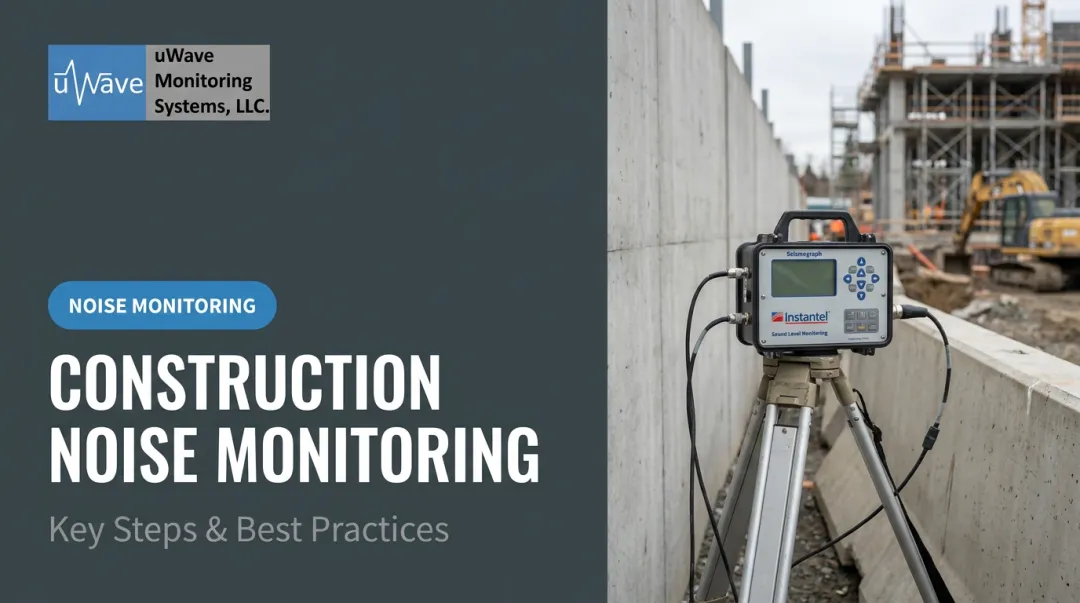
uWave deploys Instantel seismograph systems (including the Micromate, Minimate Pro, and Blastmate III series) in the field for exactly this purpose. These units record vibration, sound, and air overpressure through one device, which cuts down on equipment duplication and simplifies reporting for mining, quarrying, and heavy construction sites.
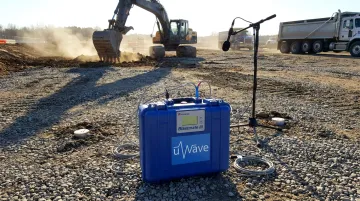
Cloud-Connected Data Logging Systems
Wireless-enabled stations transmit data remotely instead of requiring someone to physically retrieve a memory card. This matters for:
- Multi-site programs needing a single dashboard view
- Long-duration projects where daily site visits aren't practical
- Teams that need real-time visibility, not weekly summaries
Matching Equipment to the Job
Use this quick reference to match your project type to the right tool:
| Project Need | Best Equipment |
|---|---|
| One-time task assessment | Handheld sound level meter |
| Ongoing personal exposure tracking | Noise dosimeter |
| Long-term perimeter compliance | Environmental monitoring station |
| Blasting/quarrying with vibration risk | Combined noise & vibration monitor |
How to Control Noise at a Construction Site
Measuring noise only tells you there's a problem. Controlling it requires action on three fronts.
Engineering controls target the equipment itself:
- Install sound barriers or enclosures around stationary equipment like generators or compressors
- Keep machinery on a regular maintenance schedule — worn parts and loose components add unnecessary noise
- Choose quieter equipment models when specifying rentals or purchases for a job
Administrative controls manage how and when work happens:
- Restrict noisy work (demolition, pile driving) to permitted hours under local ordinances
- Rotate workers through high-noise tasks to limit individual exposure duration
- Schedule the loudest activities when fewer people are on-site or nearby
Real-time alerts change the response time. Waiting for a monthly report to discover a threshold breach means the violation already happened. Automated email and text alerts flip that timeline. When a monitor detects a reading above a set threshold, the project manager receives immediate notification and can intervene before a neighbor calls the city.
That's the difference between reacting to a violation and preventing it.
Choosing and Deploying the Right Noise Monitoring System
Picking the right system comes down to a handful of practical questions.
Key Selection Factors
- Project type and duration — a two-week utility repair needs different coverage than a two-year transit build
- Proximity to sensitive receptors — schools, hospitals, and residential zones typically demand tighter, continuous monitoring
- Regulatory requirements — local noise ordinances often set decibel limits and reporting frequency
- Budget — rental fleets flex with short projects; purchased units make sense for recurring programs
Why Cloud Access Matters
With those factors weighed, the next question is how data reaches the team. For multi-site or long-duration work, daily manual data pulls waste time and create gaps in the record. A cloud-based platform solves this with 24/7 remote access to readings from any location.
The uWave Project Manager platform, for example, gives users a centralized dashboard showing live data across every deployed unit, along with:
- Automated maintenance alerts flagging equipment that needs servicing
- Email/text threshold notifications for rapid corrective action
- Customized reports formatted for regulatory submissions or community documentation
Rental vs. Purchase
The next decision is whether to rent or own the hardware:
| Factor | Rental | Purchase |
|---|---|---|
| Best for | Short-term or single projects | Ongoing or multi-site programs |
| Upfront cost | Lower | Higher initial investment |
| Flexibility | High — scale up/down per job | Fixed asset, owned outright |
| Long-term cost | Higher per-project if used repeatedly | Lower over multiple projects |
Bulk purchase discounts typically make ownership the better economic choice once a company is running several monitoring points across concurrent jobs.
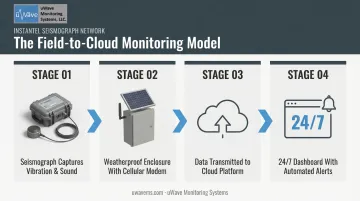
The Field-to-Cloud Approach
Rented or purchased, the hardware works best within a connected system. uWave Monitoring Systems builds its monitoring programs around a Field-to-Cloud model: Instantel seismographs, which capture both vibration and sound levels, sit in custom weatherproof enclosures connected via cellular modem. They feed data into a 24/7 cloud-hosted platform with built-in alerting. This setup fits heavy construction, mining, quarrying, water infrastructure, and transit projects where teams need reliable data without a technician stationed on-site every day.
Frequently Asked Questions
How to measure construction noise?
Calibrated sound level meters or personal dosimeters measure noise in decibels. Technicians track readings against metrics like Leq (average level) and Lmax (peak level) and compare them to regulatory limits.
How to control noise at a construction site?
Combine engineering controls (barriers, equipment maintenance) with administrative controls (scheduling, worker rotation). Real-time alert systems add a layer of rapid response when thresholds are breached.
What are the different types of noise monitoring equipment?
The main categories are handheld sound level meters, worn noise dosimeters, fixed environmental/perimeter monitoring stations, and combined noise-and-vibration monitors for blasting or heavy equipment work.
What is an acceptable noise level for a construction site?
Limits vary by local ordinance and time of day, but OSHA's occupational benchmark is 90 dBA over an 8-hour shift, with impulsive noise capped at 140 dB peak. Municipal environmental limits are often lower.
How long should noise monitoring be conducted on a construction site?
Duration depends on project length and sensitivity. Short jobs may only need periodic spot checks, while long or sensitive projects near residences often require continuous 24/7 monitoring.
Do I need a professional noise survey for my construction project?
Projects near sensitive receptors like schools or hospitals often need, and sometimes require, a baseline noise survey. It establishes pre-construction conditions and supports compliance documentation later.