Key Takeaways
- Construction site monitoring spans two distinct disciplines: project performance and physical/environmental monitoring — yet most teams focus on only one
- Ground vibration from pile driving and blasting can damage adjacent structures silently; continuous monitoring catches threshold breaches before liability follows
- Automated alert systems notify crews immediately when PPV or sound thresholds are exceeded, enabling real-time response before violations occur
- The uWave Project Manager platform makes multi-site, 24/7 monitoring manageable from a single dashboard
What Is Construction Site Monitoring?
Construction site monitoring is the systematic process of observing, measuring, and reporting on construction activities to ensure a project meets its plans, safety standards, and regulatory requirements throughout the active build phase.
Most project teams think of monitoring in one dimension — are we on schedule? But effective monitoring spans two interconnected categories:
- Project performance monitoring — tracking schedules, budgets, quality, and scope against the plan
- Physical and environmental monitoring — measuring ground vibration, sound levels, structural movement, air quality, and other site conditions that affect surrounding communities and existing structures
These categories serve different audiences, each with distinct stakes:
- General contractors and project owners — focused on schedule, budget, and scope
- Regulatory agencies — concerned with noise and vibration compliance
- Neighboring property owners and insurers — watching for damage to adjacent structures
A complete monitoring program addresses all of them.
Key Areas of Construction Site Monitoring
Scheduling and Progress Monitoring
Progress monitoring means comparing actual work completed against the planned schedule — in real time, not at the monthly owner meeting.
The data tells a clear picture. According to a McKinsey analysis of global projects, construction projects average 70% cost overruns and 61% time overruns relative to original budgets and schedules. A separate 2019 study found that 44% of 2,700 construction projects ended at a loss.
The tools are straightforward — daily logs, Gantt charts, photographic documentation, and progress tracking software. The discipline is harder. Schedule slippage caught in week one is a schedule adjustment. The same slippage discovered in month three is a budget crisis.
Common progress monitoring approaches:
- Daily site logs with labor counts and work completed by trade
- Weekly Gantt chart reviews comparing planned vs. actual milestones
- Timestamped jobsite photography for billing approval and dispute resolution
- Cloud-based dashboards that consolidate progress data from multiple subcontractors
Safety Monitoring
Construction remains one of the most hazardous industries in the United States. The Bureau of Labor Statistics recorded 1,064 construction fatalities in 2024, with falls accounting for the largest share.
Technology has shifted safety monitoring from reactive to proactive. Modern approaches include:
- Wearable sensors that detect falls, heat exposure, and worker fatigue
- Geofencing that triggers alerts when workers or equipment enter restricted zones
- AI-powered camera feeds that identify missing PPE, unsafe behaviors, or unauthorized access in real time
The shift matters because traditional safety audits catch violations after the fact. These tools flag them as they happen.
Quality Control and Environmental Monitoring
Safety and quality failures share a common thread: both are far cheaper to catch early than to remediate later.
Quality monitoring involves inspecting materials, workmanship, and installation accuracy against specifications and building codes. Catching a defect during installation costs a fraction of what it costs after concrete has cured or drywall has been hung.
Environmental and physical monitoring is where most teams have blind spots. This category covers:
- Ground vibration from pile driving, blasting, and heavy excavation
- Airborne noise relative to local ordinances and permitted construction hours
- Dust levels and air quality near sensitive receptors
- Structural displacement in adjacent buildings
Urban, suburban, and transit-adjacent projects face the highest exposure here. When construction operations vibrate the foundations of neighboring buildings or exceed municipal noise limits, the project team bears the consequences — whether or not anyone was measuring at the time. Without monitoring records, there's no data to defend against claims and no early warning to prevent them.
Critical Technologies for Construction Site Monitoring
The technology stack for effective monitoring has matured considerably. Here is how the core components fit together:
Visual monitoring tools — Fixed jobsite cameras, pan-tilt-zoom (PTZ) cameras, and drones form the documentary backbone of any project.
Visual monitoring tools — Fixed jobsite cameras, pan-tilt-zoom (PTZ) cameras, and drones form the documentary backbone of any project. They provide timestamped records that support billing approvals, dispute resolution, and stakeholder reporting. Drones are particularly useful for large sites where ground-level inspection misses progress across multiple zones.
IoT sensors — Temperature, humidity, equipment telematics, and structural strain gauges feed real-time environmental data to centralized dashboards. Teams can detect equipment failures, material risks, or unsafe conditions without a physical site visit.
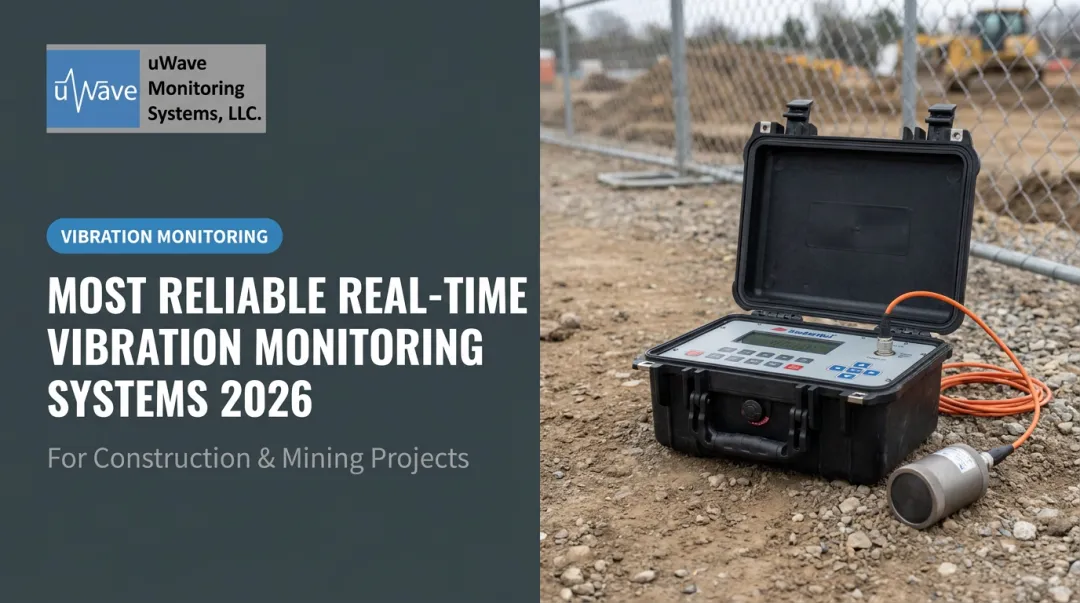
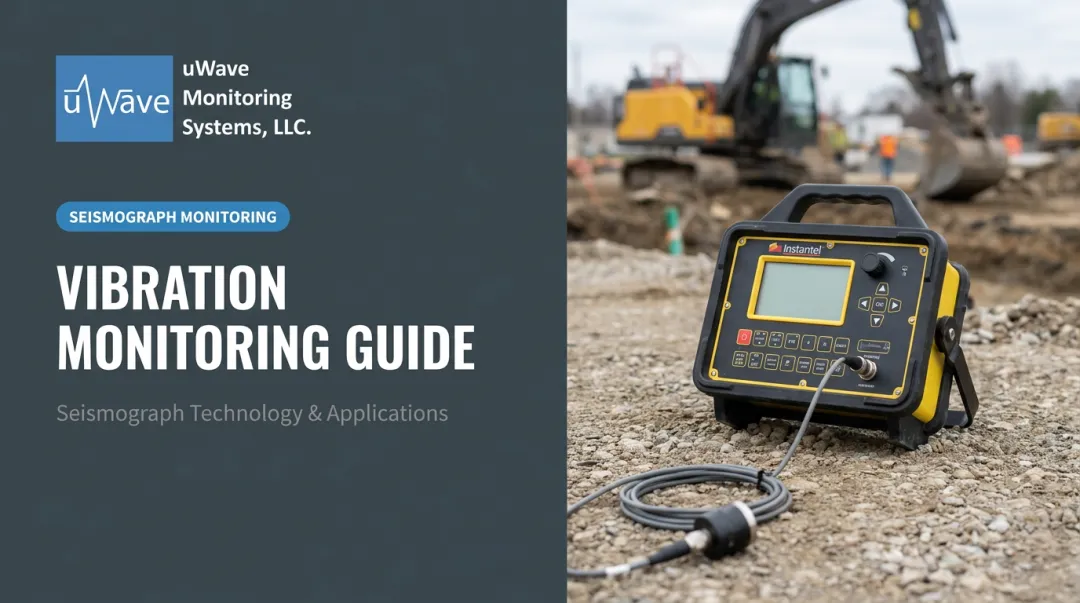
Seismographs and vibration/sound monitoring equipment — These are the specialized instruments that measure peak particle velocity (PPV), air overpressure, and decibel levels on heavy construction, mining, and demolition projects. Instantel seismographs — including the Micromate, Micromate Plus, and Minimate Pro4 — are the industry standard for this work. Without them, teams are managing one of their largest liability risks without any defensible data.
Cloud-based monitoring platforms — According to a 2025 AGC survey, 61% of construction firms now use cloud-hosted technology for project management. Platforms tie all data streams together, providing 24/7 remote project access, automated threshold alerts via email and text, and secure data backup — making it practical to manage remote or multi-site projects from a single dashboard.
That adoption rate, however, only tells part of the story. 53% of general contractors still do not use technology for most of their processes — meaning the competitive advantage for firms that monitor comprehensively is substantial, and growing.
Ground Vibration and Sound Monitoring: The Discipline Most Teams Overlook
This is the category where liability exposure is highest and monitoring is least consistent.
Why Ground Vibration Is a Serious Risk
Heavy construction activities generate ground vibration that travels through soil and rock into adjacent structures. The activities with the highest vibration output include:
- Impact pile driving (predicted PPV at 25 feet: 0.644 to 1.518 in/sec)
- Vibratory pile driving (0.170 to 0.734 in/sec at 25 feet)
- Blasting and demolition
- Heavy excavation and tunneling
Compare those output levels to what structures can actually tolerate. Research from the Transportation Research Board documents damage thresholds that are uncomfortably close to operating conditions:
| Structure Type | Damage Threshold (PPV) |
|---|---|
| Fragile historic buildings | 0.08 in/sec (continuous) |
| Residential with plaster walls | 0.2–0.3 in/sec |
| Older plaster-on-lath homes | 0.50 in/sec |
| NYC landmarks | 0.50 in/sec |
| Modern industrial buildings | Up to 2.0 in/sec |
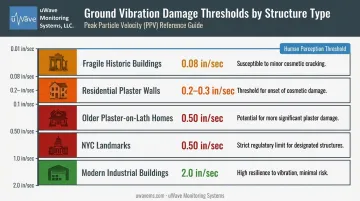
Human perception starts at 0.01 in/sec — meaning residents feel vibrations well before structural damage begins. That combination of perception and proximity generates complaints, then lawyers.
Regulatory Standards That Apply
OSMRE regulations (30 CFR 816.67) set maximum PPV limits based on distance from the blast: 1.25 in/sec within 300 feet, 1.00 in/sec from 301 to 5,000 feet, and 0.75 in/sec beyond 5,000 feet. International standards including DIN 4150-3 and BS 7385-2 apply to non-blasting construction vibration in many jurisdictions.
Exceeding these limits without documented monitoring leaves project teams with no defense when property damage claims arrive — and they do arrive.
How Automated Alerts Change the Equation
Continuous monitoring with automated alerts gives crews the ability to act before a violation occurs — not after. When a seismograph detects a reading approaching the threshold, the system sends an immediate email or text to designated personnel.
The Iowa DOT uses exactly this approach: an alarmed vibration monitoring system halts operations immediately upon threshold exceedance, protecting historic structures and maintaining compliance with the National Historic Preservation Act. In one documented case, a bridge contractor used continuous monitoring records to successfully defend against a vibration damage lawsuit.
The Field-to-Cloud Approach
uWave Monitoring Systems' Field-to-Cloud approach combines Instantel seismographs with cloud-hosted data services and automated email/text alerts into a complete solution for heavy construction, mining, quarrying, water infrastructure, and transit projects.
Their monitoring station rentals — including the V3 (heavy duty) and V5 (medium duty, 60 lbs with handles for portability) — arrive complete with 30-watt solar panels, Sierra Wireless cellular modems, GNSS antennas, and all mounting hardware. The seismograph transmits data to the uWave Project Manager cloud portal via cellular modem using the AutoCall Home feature, making data available 24/7 from any internet-connected device.
The platform aggregates vibration, sound, air overpressure, and equipment maintenance data into a unified dashboard. Automated alerts are dispatched immediately after a threshold-exceeding event is recorded — with a default delay of zero minutes post-event. Project teams get time-stamped compliance records, customized reports, and secure cloud backup without manually retrieving data from field units.
For multi-site or extended deployments, uWave offers bulk monitoring package discounts. Their equipment lineup covers the full spectrum of project requirements:
- Minimate Pro4 — multi-channel recording and hydrophone applications
- Micromate Plus — touchscreen interface, up to 10 in/s PPV, full sound monitoring capability for standard heavy construction
- Blastmate III — Series III instrument for more straightforward blasting applications
How to Build an Effective Construction Site Monitoring System
A monitoring program that actually works starts with a needs assessment before any equipment is ordered.
Step 1: Identify what you're monitoring and why
- What site activities will generate vibration, noise, or air quality impacts? (blasting, pile driving, demolition, tunneling)
- How close are existing structures, utilities, or sensitive receptors?
- What regulatory thresholds apply — OSMRE, local ordinance, DIN 4150-3, or project-specific limits?
- Who requires monitoring data — the owner, a permitting agency, an insurer, adjacent property owners?
Step 2: Layer technologies to match project risk
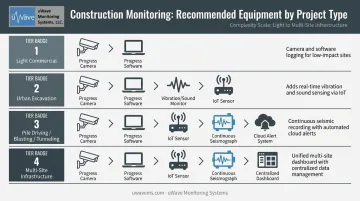
Not every project needs every tool. A general framework:
| Project Type | Recommended Monitoring Stack |
|---|---|
| Light commercial construction | Visual cameras, progress tracking software |
| Urban excavation near existing buildings | Add vibration/sound monitoring, IoT sensors |
| Pile driving, blasting, or tunneling | Add continuous seismograph monitoring with cloud alerts |
| Multi-site infrastructure (water, transit) | Full Field-to-Cloud system with centralized dashboard |
Step 3: Establish thresholds, alert recipients, and reporting cadences before work begins
- Who receives automated alerts, and what is their required response time?
- What documentation must be retained for compliance, insurance, and dispute resolution?
- What report format does the permitting authority require?
Blasting records must be retained for at least three years and remain available for regulatory inspection. Pre-configuring these requirements into the monitoring platform before work begins keeps records complete, audit-ready, and far easier to defend if a complaint arises.
Frequently Asked Questions
What is construction monitoring?
Construction monitoring is the systematic process of tracking construction activities to keep a project on schedule, within budget, and compliant with quality, safety, and environmental standards. It covers both project management tracking and physical measurement of site conditions like ground vibration and noise.
How do you monitor construction site quality?
Quality monitoring involves regular site inspections, material testing, and comparing workmanship against design specifications and building codes. Photographic documentation and daily logs help identify defects early, before they require costly rework or create structural liability.
What is the best software for construction management?
The right solution depends on project type. Platforms like Procore or Autodesk Construction Cloud handle scheduling, documents, and collaboration well. For heavy construction, mining, or infrastructure projects with vibration and noise compliance requirements, a cloud-hosted platform like uWave Project Manager is also essential, since general project management tools don't capture physical environmental data.
What is vibration monitoring in construction?
Vibration monitoring uses calibrated seismographs to measure ground vibration (peak particle velocity) from activities like pile driving, blasting, or heavy excavation. Time-stamped data records demonstrate regulatory compliance and protect contractors from liability claims by adjacent property owners.
How do you monitor noise levels on a construction site?
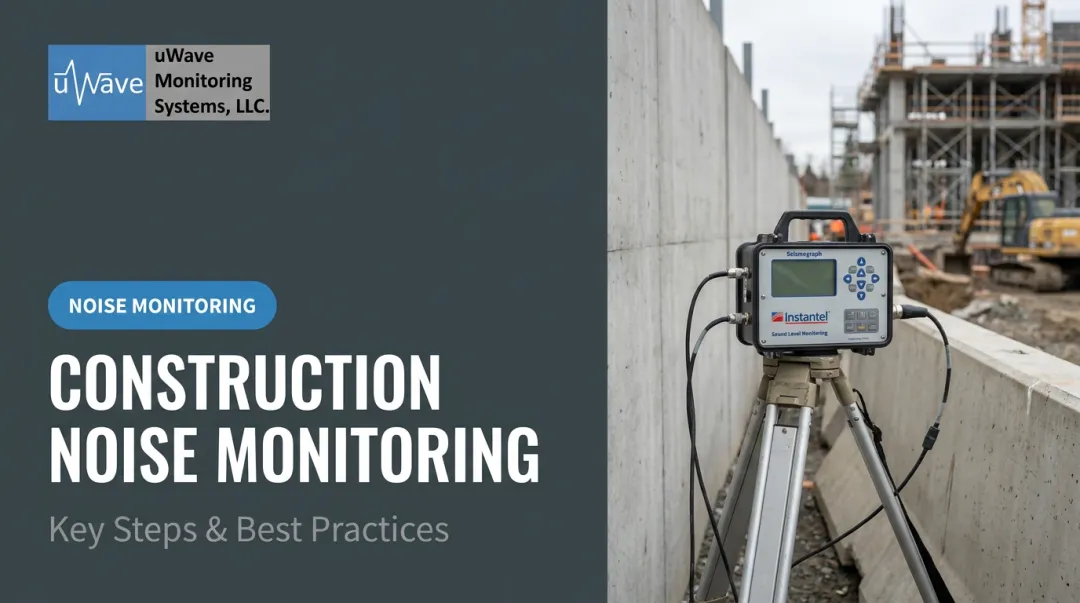
Noise monitoring uses calibrated sound level meters or integrated monitoring systems placed near sensitive receptors to continuously record decibel levels. Automated alerts notify crews when readings approach permitted limits — allowing operational adjustments before a municipal noise ordinance violation triggers fines or work stoppages.