Introduction
Managing assets scattered across multiple remote job sites is a genuine operational headache. No on-site technician at 3 AM. No warning before a compressor fails. And if a blast event exceeds vibration limits near an occupied structure, the cost of discovering that after the fact — through a compliance breach or structural complaint — is far higher than preventing it.
According to a 2024 Siemens report, unplanned downtime costs the world's 500 largest companies roughly $1.4 trillion per year — equal to 11% of revenues.
For industrial operations specifically, ABB's 2023 Value of Reliability survey puts the average outage cost at $125,000 per hour.
Remote asset monitoring platforms have matured well beyond basic GPS trackers. Today's leading systems integrate real-time telemetry, automated threshold alerts, edge processing, and cloud-hosted compliance data — all in a single field-to-cloud workflow. Picking the right platform affects both operational uptime and your regulatory standing.
This article evaluates the top five platforms and explains what to look for when your assets live on construction sites, in mines, or along water infrastructure corridors.
Key Takeaways
- Remote asset monitoring platforms eliminate the need for on-site personnel to track equipment health, location, and environmental conditions.
- The best 2026 platforms combine edge hardware, cellular connectivity, cloud analytics, and configurable alerting.
- General-purpose IoT platforms suit many industries, but construction and mining teams typically need domain-specific sensor support and compliance reporting.
- Platform selection should match your asset types, connectivity conditions, and regulatory requirements, not just feature counts.
- For vibration, seismic, and noise compliance monitoring, purpose-built field-to-cloud systems outperform horizontal IoT platforms without costly customization.
What Is Remote Asset Monitoring and Why It Matters in 2026
Remote asset monitoring uses connected sensors, edge hardware, and cloud software to continuously track the condition, location, and performance of physical assets — without requiring anyone on site to do it.
In practice, that means a geophone picks up ground vibration, transmits readings over a cellular modem to a cloud dashboard, and triggers an SMS alert to a project manager's phone if a threshold is exceeded — or a machine gateway detects abnormal equipment temperature and logs a maintenance alert before a compressor fails.
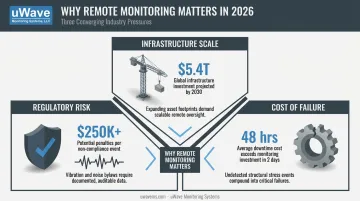
Three converging pressures are making this capability harder to ignore in 2026:
- ASCE forecasts $5.4 trillion in US public and private infrastructure investment through 2033, spreading assets across more remote locations than ever before.
- Vibration, noise, and blast overpressure monitoring near occupied structures carry real legal and financial consequences for non-compliance — and regulators are paying attention.
- Catching equipment problems early costs a fraction of reactive repairs, and far less than an unplanned project delay.
The platforms below are evaluated against the needs of construction, mining, quarrying, water infrastructure, and transit project teams — not general IT asset management.
Best Platforms for Remote Asset Monitoring in 2026
The platforms below were evaluated across six criteria: real-time data capabilities, sensor and hardware compatibility, alert systems, cloud data management, connectivity in remote environments, and scalability across multi-site deployments. Each profile identifies where a platform performs well — and where operational requirements may push teams toward a more specialized tool.
Samsara
Samsara is a US-based industrial IoT and fleet monitoring platform widely used in construction, logistics, and physical operations. Its unified dashboard combines real-time GPS tracking, equipment utilization analytics, geofencing, and environmental sensor support, all backed by cellular-connected hardware with a cloud backend.
Its strength is breadth: Samsara handles large, distributed equipment fleets well, with plug-and-play hardware that doesn't require specialized IT configuration. A documented case shows DeSilva Gates Construction recovering $250,000 in stolen equipment and achieving $2.34 million in annual savings through equipment delay prevention using the platform.
Where it fits — and where it doesn't: Samsara supports temperature, humidity, and environmental monitoring, but does not natively support vibration, seismic, or construction noise measurement. Teams requiring ISEE or DIN-standard compliance reporting — common in blasting, heavy construction, and mining — will need a purpose-built solution such as Instantel seismograph-based systems for that use case.
| Key Features | Real-time GPS + sensor telemetry, geofencing, equipment utilization reports, mobile alerts, open API integrations |
| Best Fit For | Construction fleets, heavy equipment monitoring, logistics operations requiring outdoor asset visibility |
| Connectivity & Deployment | 4G LTE cellular, cloud-hosted; scalable across multi-site deployments; plug-and-play hardware |
IBM Maximo Application Suite
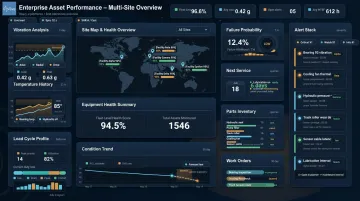
IBM Maximo is an enterprise-grade asset performance management (APM) platform used by utilities, mining operators, oil and gas companies, and large infrastructure organizations. It combines asset lifecycle management with IoT-enabled condition monitoring, predictive analytics, and work order automation in a single platform.
IBM reports Maximo APM can reduce unplanned downtime by up to 47% — a vendor-reported figure, but consistent with the broader case evidence: Transport for London projects £21 million in London Underground savings over 10 years, and Autostrade per l'Italia monitors 700,000 components across 4,500 structures using the platform.
Maximo was named a leader in both Enterprise Asset Management and Asset Performance Management in Verdantix's 2024 Green Quadrant reports.
Where it fits — and where it doesn't: Maximo is built for large organizations managing complex, long-lifecycle asset portfolios. The AppPoints licensing model and enterprise deployment requirements make it a poor fit for smaller project teams or short-duration monitoring deployments.
| Key Features | Predictive maintenance, IoT sensor integration, work order automation, compliance reporting, AI-driven failure prediction |
| Best Fit For | Utilities, mining, oil and gas, large infrastructure organizations with enterprise-level asset management needs |
| Connectivity & Deployment | Cloud (IBM Cloud or hybrid); supports OPC-UA, MQTT, REST APIs; enterprise AppPoints licensing |
PTC ThingWorx
ThingWorx is an industrial IoT application platform that enables organizations to build custom remote monitoring applications for specific asset types and operational contexts. Paired with PTC's Kepware Server — which supports 150+ industrial device drivers and converts proprietary protocols to OPC-UA and MQTT — ThingWorx connects to a wide range of industrial hardware.
Flowserve used ThingWorx for IoT-based condition monitoring of field fluid-control systems and avoided a $16 million cavitation failure through early detection. SIG connected global production machines to benchmark energy use and reduce downtime across locations.
Where it fits — and where it doesn't: ThingWorx requires engineering resources to build monitoring applications. It's powerful for teams with in-house IIoT expertise, but high-friction for organizations that need a ready-to-deploy solution.
| Key Features | Custom IoT application development, real-time dashboards, multi-protocol sensor support (OPC-UA, MQTT), anomaly detection, 150+ device drivers via Kepware |
| Best Fit For | Industrial manufacturers, engineering-driven teams needing custom monitoring applications for specific asset classes |
| Connectivity & Deployment | Cloud or on-premise; open API architecture; broad hardware and sensor ecosystem |
Siemens Xcelerator — Insights Hub
Formerly MindSphere, Insights Hub is Siemens' industrial IoT and AI operations platform, purpose-built for monitoring industrial equipment and infrastructure. It supports edge-to-cloud data processing, high-frequency equipment telemetry, and industrial protocol integration including OPC-UA, MQTT, Modbus, and Siemens S7.
The platform's Edge Analytics capability specifically supports high- and low-frequency data preprocessing and vibration-related condition monitoring — meaningful for teams monitoring rotating equipment or structural assets. BorgWarner uses Insights Hub to monitor energy consumption across 63 locations in 20 countries.
Where it fits — and where it doesn't: Insights Hub delivers most value for organizations already running Siemens automation or control infrastructure. Without that foundation, integration effort increases substantially.
| Key Features | Edge and cloud processing, high-frequency equipment telemetry, energy analytics, partner app marketplace, SCADA and PLC integration |
| Best Fit For | Industrial facilities, infrastructure operators, and organizations with existing Siemens automation or control systems |
| Connectivity & Deployment | Cloud-native; supports OPC-UA; hybrid edge deployment available for bandwidth-constrained sites |
AWS IoT SiteWise
AWS IoT SiteWise is Amazon's managed cloud service for collecting, organizing, and analyzing data from industrial equipment. SiteWise Edge gateways (running on AWS IoT Greengrass) process data locally before transmitting to the cloud, which reduces bandwidth demands at remote or constrained sites. The platform connects to OPC-UA data sources and organizes assets using structured models and hierarchies.
Toyota Motor North America used SiteWise in an industrial data foundation project, improving machine availability from 78–82% to 92% and cutting monthly downtime from 40 hours to 20 hours.
Where it fits — and where it doesn't: SiteWise works best for teams already embedded in the AWS ecosystem. Data engineers can build powerful analytics pipelines using S3 and SiteWise Monitor. Organizations without AWS infrastructure face a steeper onboarding curve.
| Key Features | Managed edge gateways, asset model templates, real-time telemetry, AWS analytics integration (S3, SiteWise Monitor), configurable alarms |
| Best Fit For | Organizations already leveraging AWS infrastructure; data engineering teams needing scalable cloud-native IoT pipelines |
| Connectivity & Deployment | AWS Cloud; SiteWise Edge for local processing; pay-as-you-go pricing; integrates with OPC-UA data sources |
How We Chose the Best Remote Asset Monitoring Platforms
Platforms were not assessed on general software features or market recognition alone. The evaluation focused on factors directly relevant to physical asset monitoring in demanding field environments.
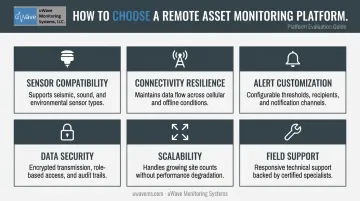
The key criteria:
- Sensor compatibility: native support for vibration, seismic, environmental, and GPS sensors — not just IT or indoor-tracking hardware
- Connectivity resilience: edge processing and local data buffering for sites with limited or intermittent cellular signal
- Alert customization: per-asset threshold configuration with escalation logic that avoids excessive false positives
- Data security: encryption in transit and at rest, with audit-ready cloud storage
- Scalability: stable performance across dozens of assets on multiple concurrent sites
- Field support: vendor responsiveness for deployment issues, where remote configuration errors are costly
A common selection mistake: choosing platforms optimized for IT asset management or indoor GPS, which lack the sensor protocol support, environmental data handling, and connectivity resilience needed for construction, mining, and infrastructure projects.
For teams monitoring vibration, blast events, and noise levels near occupied structures — where regulatory compliance with ISEE, DIN 45669-1, or BS 7385 standards is required — the five platforms above are not the complete picture. General-purpose IoT platforms require extensive custom development to approximate what purpose-built field-to-cloud systems deliver natively.
uWave Monitoring Systems designs and manages remote monitoring systems built around Instantel seismographs, with pre-configured ISEE and DIN 45669-1 compliance profiles and automated vibration and sound threshold alerts.
Cloud-hosted data through the uWave Project Manager platform provides 24/7 remote project access and secure backup — capabilities that general-purpose IoT platforms can only match after significant custom engineering work.
Conclusion
No single platform dominates every remote asset monitoring use case. The right fit depends on your existing infrastructure, team, and operational scale:
- Samsara — best for large construction equipment fleets
- IBM Maximo — suited to enterprise organizations with complex, long-lifecycle assets
- ThingWorx — gives engineering teams maximum application flexibility
- Insights Hub — integrates deeply with Siemens industrial infrastructure
- AWS IoT SiteWise — works best when an AWS data stack is already in place
Before committing a platform across your entire operation, pilot it on representative assets. Track leading indicators — alert accuracy, false positive rate, data latency — alongside lagging ones like downtime avoided and inspection hours saved. Verify vendor support quality before signing, particularly for remote site deployments where response time matters.
For construction, mining, quarrying, transit, and water infrastructure teams with specific vibration, seismic, and noise monitoring requirements, contact uWave Monitoring Systems to discuss your project. Their Field-to-Cloud monitoring systems — built around Instantel seismographs and available for rental or purchase — include 24/7 remote project access, automated compliance alerts, and customized reporting designed for the demands of regulated field environments.
Frequently Asked Questions
What are the top platforms for remote asset monitoring in 2026?
The leading platforms in 2026 are Samsara, IBM Maximo Application Suite, PTC ThingWorx, Siemens Xcelerator (Insights Hub), and AWS IoT SiteWise. The right choice depends on your asset types, connectivity conditions, and use case — general industrial equipment versus specialized monitoring like vibration and noise compliance.
What is remote asset monitoring and how does it work?
Remote asset monitoring uses connected sensors, edge hardware, and cloud software to track physical asset condition, location, and performance in real time. Data transmits over cellular, satellite, or Wi-Fi to a central dashboard, which triggers alerts when configurable thresholds are exceeded — without requiring anyone physically on site.
What industries benefit most from remote asset monitoring?
Heavy construction, mining, quarrying, water utilities, transit infrastructure, oil and gas, and manufacturing benefit most. These industries share dispersed field assets where equipment failure or regulatory non-compliance carries serious operational or safety consequences.
What is the difference between remote asset monitoring and traditional SCADA systems?
SCADA systems are fixed, wired control systems built for process automation inside facilities. Remote asset monitoring platforms, by contrast, are cloud-native and designed for distributed field assets — connecting over cellular or satellite with scalable data management and API-based integrations.
What should I look for in a remote asset monitoring platform for construction or mining?
Key criteria include: compatibility with vibration, seismic, environmental, and GPS sensors; reliable connectivity in remote or low-signal sites; configurable alert thresholds for regulatory compliance; secure cloud data storage with audit-ready reporting; and vendor expertise in field deployment and support.
Can remote asset monitoring platforms support regulatory compliance reporting?
Specialized field-to-cloud systems like uWave's Instantel-based monitoring ecosystem generate compliance-ready reports aligned with standards such as ISEE and DIN 45669-1. General-purpose IoT platforms typically require significant custom configuration to produce equivalent outputs, if they can at all.