That's the risk every construction, mining, and infrastructure team faces when blasting, pile driving, or heavy equipment pushes vibration past safe limits: property damage claims, litigation, and stalled permits.
The bigger problem? Multiple overlapping standards, OSM, FTA, ISO, and dozens of state and local codes, create real confusion about which limit actually applies to your project.
This guide breaks down the major vibration standards, explains how PPV criteria are set by structure type, flags the compliance mistakes that get contractors in trouble, and covers the monitoring equipment used to prove you stayed within limits.
Key Takeaways
- Peak Particle Velocity (PPV) is the industry-standard metric for vibration damage risk (in/sec or mm/sec)
- Blasting (OSM/USBM) and construction (FTA) standards aren't interchangeable; the wrong choice raises damage and liability risk
- PPV limits are frequency-dependent and probabilistic, not a guaranteed damage-free threshold
- Continuous monitoring with automated alerts documents compliance and catches exceedances in real time
- Local and state agencies often set limits stricter than federal standards
Why Vibration Standards Matter for Construction & Industrial Projects
Uncontrolled vibration from demolition, excavation, or compaction doesn't stay contained to the work zone. It travels through soil and structural elements, and it can crack drywall, loosen mortar joints, and stress underground utilities in buildings you're not even working on.
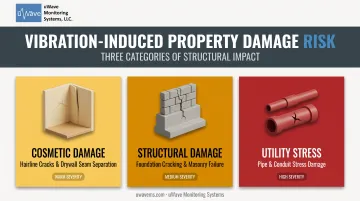
The risks fall into a few categories:
- Cosmetic damage — hairline cracks in plaster, drywall seams, tile grout
- Structural damage — foundation cracking or masonry failure in older, unreinforced buildings
- Utility stress — damage to buried pipes, conduits, and service lines near excavation
Risk management is only half the picture. Compliance and community relations matter just as much.
Documented monitoring against a recognized standard gives regulators, adjacent property owners, and your legal team a defensible record. Without it, a single complaint can trigger a stop-work order even when your vibration levels were never a problem.
The SR-29 project outside Napa shows how seriously agencies take this. Its vibration risk assessment requires weekly reporting against a 0.20 in/sec PPV threshold near a historic structure. Any exceedance forces an immediate halt until the contractor switches to an alternative method.
That's not theoretical. A vibration limit written into a permit can dictate your construction method, schedule, and budget long before any damage occurs.
Key Vibration Standards You Need to Know
USBM RI 8507 and the Current OSM Blasting Rule
The U.S. Bureau of Mines published RI 8507 in 1980 after studying 76 homes and 219 production blasts. It recommended PPV limits of 0.5 in/sec for older homes with plaster-on-lath walls and 0.75 in/sec for modern drywall construction, both below 40 Hz.
Today's federal blasting rule, 30 CFR 816.67, replaced that older-versus-modern distinction with a distance-based table:
- 0–300 ft: 1.25 in/sec
- 301–5,000 ft: 1.00 in/sec
- Beyond 5,000 ft: 0.75 in/sec
Measure in three perpendicular directions. A seismographic record is required for every blast.
Here's where teams get into trouble: RI 8507 and the OSM rule were written for surface mine blasting, a transient, single-event source. Applying those same limits to continuous construction vibration (compaction, excavation, pile driving) sets a threshold far too lenient for the actual damage risk involved.
Construction and Transit Standards
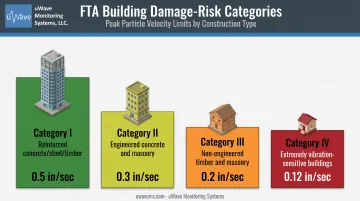
For roads, transit, and general construction in the U.S., the Federal Transit Administration's Transit Noise and Vibration Impact Assessment Manual is the standard most contractors should use. It organizes buildings into four damage-risk categories, covered in detail in the next section.
Switzerland's SN 640 312a separates limits by structure sensitivity and by source type. Continuous-source PPV limits (machinery, traffic, vibratory compaction) sit at roughly half the single-event blasting limits for the same structure class — a distinction many U.S. projects overlook.
International Measurement Standards
ISO 4866, ANSI S2.47, and DIN 4150-3 mostly govern measurement and evaluation procedure rather than set hard PPV limits:
| Standard | Status | Scope |
|---|---|---|
| ISO 4866:2010 | Current | Vibration measurement and data processing principles |
| ANSI S2.47-1990 | Withdrawn | Legacy building-vibration evaluation guideline |
| DIN 4150-3:2016 | Current | German structural-effects evaluation with guideline values |
Most developed countries maintain their own versions too: the UK (BS 7385-2), Australia (AS 2187.2), and Brazil (NBR 9653), typically tailored to blasting or urban construction.
Municipal, county, and state agencies often set their own limits, sometimes derived from OSM blasting values but applied more broadly. Before defaulting to a national standard, check your local DOT or municipal code and confirm you're on the latest published version.
Vibration Criteria and PPV Limits by Structure Type
What PPV Measures and Why It's the Standard Metric
Peak Particle Velocity measures how fast a particle of soil or structure moves as a vibration wave passes through it, typically in inches per second in the U.S. or millimeters per second elsewhere. PPV correlates better with damage potential than peak vector sum (PVS), acceleration, or displacement because it relates directly to the strain energy transmitted into a structure at peak stress.
Monitoring captures vibration along three directions: longitudinal, transverse, and vertical. When one axis moves noticeably faster than the others, the structure experiences shear stress. That's often what causes cosmetic cracking or, in worse cases, structural damage.
FTA Damage Criteria by Building Category
The FTA's construction vibration damage table sets PPV limits by building type:
| FTA Category | Building Type | PPV Limit |
|---|---|---|
| I | Reinforced concrete, steel, or timber (no plaster) | 0.5 in/sec |
| II | Engineered concrete and masonry (no plaster) | 0.3 in/sec |
| III | Non-engineered timber and masonry | 0.2 in/sec |
| IV | Buildings extremely susceptible to vibration damage | 0.12 in/sec |
Always verify current published values before applying them. These are damage-risk screening criteria, not a guarantee that vibration below the limit produces zero damage.
Frequency, Source Type, and Damage Probability
Not every PPV reading carries equal risk. Lower-frequency vibration near a structure's resonant frequency amplifies movement and does more damage than the same PPV at a higher frequency. Most standards set stricter limits below roughly 40 Hz. RI 8507 found whole-structure resonance typically falls between 4 and 12 Hz, with midwalls resonating between 10 and 25 Hz.
Source duration changes the picture as well:
- Transient sources (blasting, impact pile driving) produce short, isolated vibration events
- Continuous sources (vibratory compaction, excavation, drilling) sustain vibration over longer periods
Continuous sources generally carry higher damage risk. Sustained vibration is more likely to hit and amplify at a structure's resonant frequency, even at a lower peak PPV than a single blast event.
Meeting a PPV limit reduces the probability of damage; it doesn't eliminate it. USBM's own analysis found damage probability drops below 5% under about 0.5 in/sec, which still isn't zero. Older, historic, or already-cracked structures carry higher risk at any given PPV level. That's why pre-construction surveys matter (more on that below).
Avoiding Common Compliance Mistakes
Three mistakes show up again and again in vibration monitoring programs. Each one can void your compliance record or leave you liable for damage you did not cause.
Using Blasting Limits for Continuous Vibration
The most expensive mistake in the industry is applying OSM/USBM blasting limits to continuous, non-blasting construction vibration. Those limits were built for single blast events, not hours of vibratory compaction or excavation.
Borrowing them sets a threshold that is far too lenient. You stay exposed if a neighboring structure is damaged despite "compliant" readings.
Engineering guidance treats continuous-source thresholds as roughly half of the equivalent transient blasting limit for the same structure class. Confirm which category your work falls into before setting a project-wide PPV threshold.
Establish Baselines Before Work Starts
Two steps prevent most disputes before they happen:
- Record background vibration levels at the site before construction begins to establish a true baseline.
- Conduct a pre-construction structural survey of nearby buildings, with photos and notes on existing cracks or damage.
Skip either step, and every crack that appears during construction becomes your liability—including ones that were already there.
Confirm Which Standard Actually Applies
Don't assume a generic national standard covers your project. Check whether:
- A state DOT or municipal code sets its own limit
- The project involves vibration-sensitive equipment, like an MRI suite or a semiconductor facility, with a facility-specific threshold
- A transit authority or utility owner has contractual vibration requirements tied to permits
Getting this wrong doesn't just risk damage. It risks the validity of your compliance documentation if regulators later determine you monitored against the wrong benchmark.
Vibration Monitoring Equipment and Compliance Reporting
Core Hardware: Geophones, Sample Rates, and Trigger Thresholds
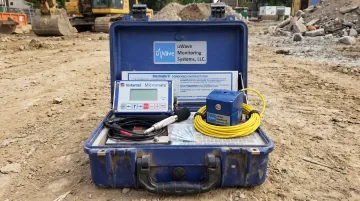
Proving compliance starts with a triaxial geophone that captures vibration data across all three axes simultaneously. For remote construction monitoring, a sample rate of 1,024 samples per second and a trigger level of at least 0.2 in/sec are a common baseline configuration, fast enough to capture a true peak without flooding storage with noise-level readings.
Instantel's seismograph line — the Micromate, Minimate Pro, and Blastmate III — is built for this kind of field work. The Minimate Pro alone supports sample rates from 512 up to 65,536 samples per second per channel, giving projects room to scale monitoring intensity to the sensitivity of the structure involved.
uWave Monitoring Systems specializes in the rental, sale, and service of these Instantel units for heavy construction, mining, quarrying, water infrastructure, and transit projects. Every rental package includes the monitoring unit, a triaxial geophone with a 2-meter or 8-meter cable, and a lockable hard case for field protection.
Field-to-Cloud Monitoring Beats Manual Data Collection
Manual data retrieval means someone drives to the site, downloads a card, and hopes nothing important happened between visits. Field-to-cloud monitoring removes that gap.
uWave's remote monitoring stations pair a solar-powered enclosure, battery bank, and cellular modem with a compatible Instantel monitor, uploading data automatically through the instrument's Auto Call Home function. Combined with the uWave Project Manager platform, this gives project teams:
- 24/7 remote access to monitoring data from any device
- Secure, automatic data backup
- Customized reports built for the project's specific standard
Alerts That Catch Problems in Real Time
Automated email and text alerts fire when a monitored threshold is exceeded, so the field team hears about a problem within minutes, not after a complaint call weeks later. uWave also provides maintenance alerts, flagging equipment issues before they turn into gaps in your compliance record.
Reporting Mapped to Your Standard
Histogram and waveform reports document exactly what a seismograph recorded—the raw evidence that regulators and legal teams ask for. Reports can be customized to the standard that governs the project, whether FTA, OSM, or an ISO-based measurement procedure.
On multi-unit deployments, bulk monitoring packages and extended-purchase pricing help keep that documentation continuous without driving up cost per station.
Frequently Asked Questions
What standards apply to vibration testing?
It depends on the vibration source. Blasting typically falls under OSM/USBM limits, and general construction under FTA criteria. Measurement procedures often reference ISO or ANSI standards. Check your permit or local code to confirm which applies.
What are the 5 elements of condition monitoring?
For machinery, condition monitoring usually covers data acquisition, baseline/trend analysis, alarm thresholds, diagnostics, and maintenance reporting. That discipline tracks equipment health—unlike ground vibration compliance monitoring, which protects structures.
What is an acceptable level of vibration?
There's no single universal number. Acceptable PPV depends on structure type and the governing standard. FTA's Category I-IV limits, for example, range from 0.12 to 0.5 in/sec depending on building sensitivity.
What's the difference between PPV and peak vector sum (PVS)?
PPV is the peak velocity on a single axis at a given moment. PVS is the scalar combination of all three axes at that instant. Some standards, including the Swiss framework, use PVS for stricter compliance thresholds.
How often should vibration monitoring equipment be calibrated?
Seismographs should be calibrated annually by a manufacturer-authorized facility, per Instantel and ISEE guidance. uWave supports this process for both rented and purchased units, including RMA coordination with Instantel.
Do I need a permit or specific standard for vibration monitoring on my project?
Requirements vary by municipality, state, and project type. Verify your local code or consult a monitoring specialist before work begins—don't assume a national standard automatically applies.