The stakes are real. Blasting, pile driving, compaction, and rotating equipment can all trigger property damage claims, community complaints, and unplanned downtime. On the industrial side, a 2023 survey of 3,215 maintenance decision-makers commissioned by ABB found that unplanned outages typically cost businesses close to $125,000 per hour, with more than two-thirds of respondents reporting an outage at least monthly.
This guide covers vibration fundamentals, testing methods, instrumentation types, safety standards, and how modern remote monitoring simplifies compliance for construction, mining, and infrastructure projects.
Key Takeaways
- Vibration monitoring catches structural and mechanical problems before costly damage or downtime
- Match instruments to the job—seismographs for ground/structural work, accelerometers and probes for machinery
- PPV charts, the FTA manual, and ISEE standards define the safe thresholds construction teams must meet
- Field-to-Cloud monitoring with automated alerts cuts manual site visits and speeds up compliance response
- Rental vs. purchase decisions hinge on project length, portability, and available bulk-package discounts
What Is Vibration Monitoring and Why It Matters
Vibration monitoring measures oscillatory motion, whether it's a bearing wearing out inside a pump or the ground shaking near a demolition site. The goal is the same either way: catch a developing problem before it becomes a failure or a claim.
This guide addresses two distinct contexts:
- Industrial/machinery condition monitoring — tracking motors, pumps, compressors, and bearings for early signs of imbalance or wear
- Construction/ground vibration monitoring — measuring the effects of blasting, demolition, pile driving, and compaction on nearby structures and utilities
Key Vibration Parameters to Understand
Three measurements form the backbone of any vibration program:
- Frequency (Hz) — the number of oscillations per second
- Amplitude — the magnitude of motion, expressed as displacement, velocity, or acceleration
- Particle velocity — how fast soil particles move, typically reported in inches or millimeters per second
For construction and ground work, Peak Particle Velocity (PPV) is the standard metric. It captures the single greatest particle velocity recorded during an event, not the speed at which the vibration wave itself travels.
Vibration data typically shows up in two forms:
- Waveform — plots motion against time, which is how you read peak values like PPV
- Spectrum — FFT processing breaks the signal into frequency components, revealing resonant frequencies inside a seemingly random shake
Monitoring matters differently depending on the application. For construction teams, it's about risk management, regulatory compliance, community relations, and having documentation ready if a claim shows up.
The Caltrans vibration guidance manual documented mortar-joint crumbling near a parking structure during sustained pile driving at roughly 0.30–0.35 in/s peak vertical velocity. Even "acceptable" vibration can cause cosmetic damage under the wrong conditions.
For industrial equipment, the case is predictive maintenance, cost reduction, and safety. Catching a bearing defect during routine monitoring costs far less than a $125,000-per-hour downtime event.
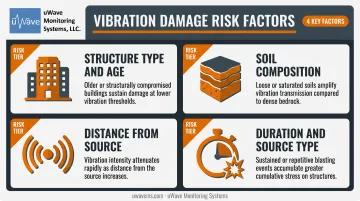
Several factors shape how risky a given vibration source really is:
- Structure type and age — historic, unreinforced, or plaster-finished buildings tolerate far less than modern reinforced concrete
- Soil composition — clay can produce higher near-source amplitudes than sand, though it attenuates faster with distance
- Distance from source — vibration energy typically drops by about two-thirds with each doubling of distance, according to Caltrans's Transportation and Construction Vibration Guidance Manual
- Duration and source type — continuous sources like compaction generally carry lower damage thresholds than short, transient events like blasting
Types of Vibration Testing
Vibration testing covers the methods used to measure and evaluate vibration under real operating or project conditions. How you test depends on the source, the stakes, and how much warning time you need.
Continuous (Online) vs. Periodic (Offline) Monitoring
Continuous monitoring transmits data in real time, wired or wireless. It's the right call for critical construction sites near sensitive structures or high-value machinery where an immediate alert matters.
Periodic monitoring relies on technicians taking portable readings on a set route or schedule. It costs less but won't catch an event as it happens — you're reviewing history, not watching live.
Construction and Ground Vibration Testing
Before any demolition, piling, or excavation begins, teams should run a pre-construction baseline survey to record background vibration levels. Without this, there's no way to prove what changed once work starts.
From there, compliance monitoring splits by source type. Continuous sources such as compaction, excavation, and grading produce ongoing vibration that needs sustained threshold tracking. Transient sources such as blasting and impact pile driving create short, high-intensity peaks with event-based limits. Damage thresholds differ for each, so the monitoring setup has to match the source type.
Machinery and Structural Vibration Testing
On equipment and structures, the focus shifts from ground compliance to asset health. Technicians evaluate rotating equipment with time waveform and FFT frequency analysis, which detects imbalance, misalignment, and bearing defects long before a breakdown.
Resonance and modal testing serves a different purpose. It identifies natural frequency issues in structures or machine foundations by applying controlled excitation and measuring the response with accelerometers and a signal analyzer.
Common Vibration Measuring Instruments
Instrument selection comes down to one question: is this a ground/structural application or a machinery application? The two rarely share the same toolkit.
Ground and Structural Vibration Instruments
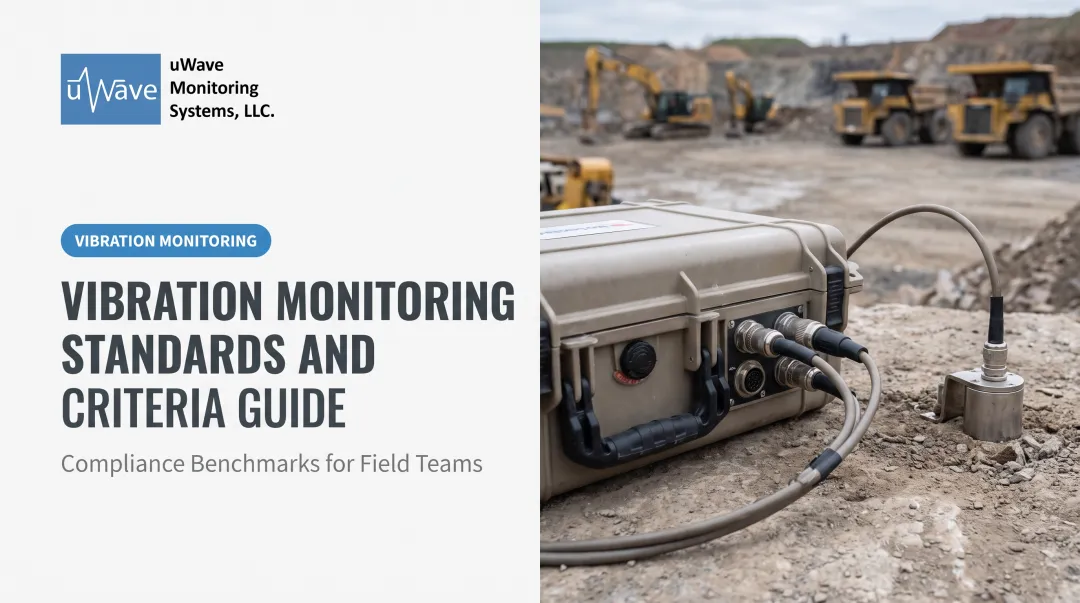
Triaxial geophones measure transverse, vertical, and longitudinal motion simultaneously. The ISEE-standard geophone, used in most applications, covers a 2–250 Hz range with a velocity capacity up to 10 in/s and cable runs to 250 feet.
A DIN-standard alternative extends response down to 1 Hz and supports cable runs up to 1,000 meters, useful when the sensor needs to sit far from the recording unit. Borehole and wall-mount configurations exist for specialized installations where a standard surface mount won't work.
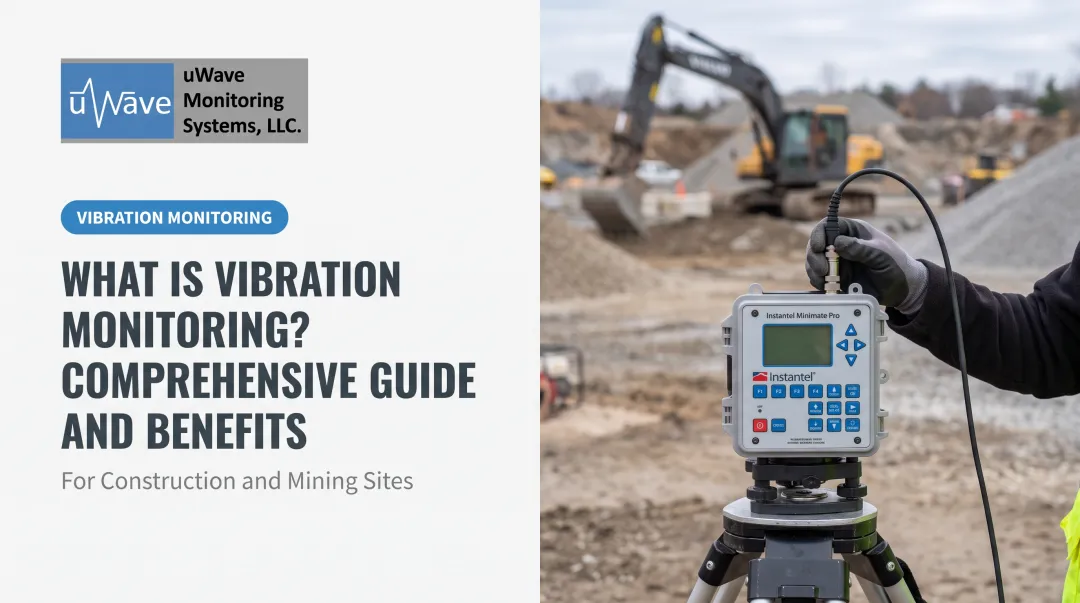
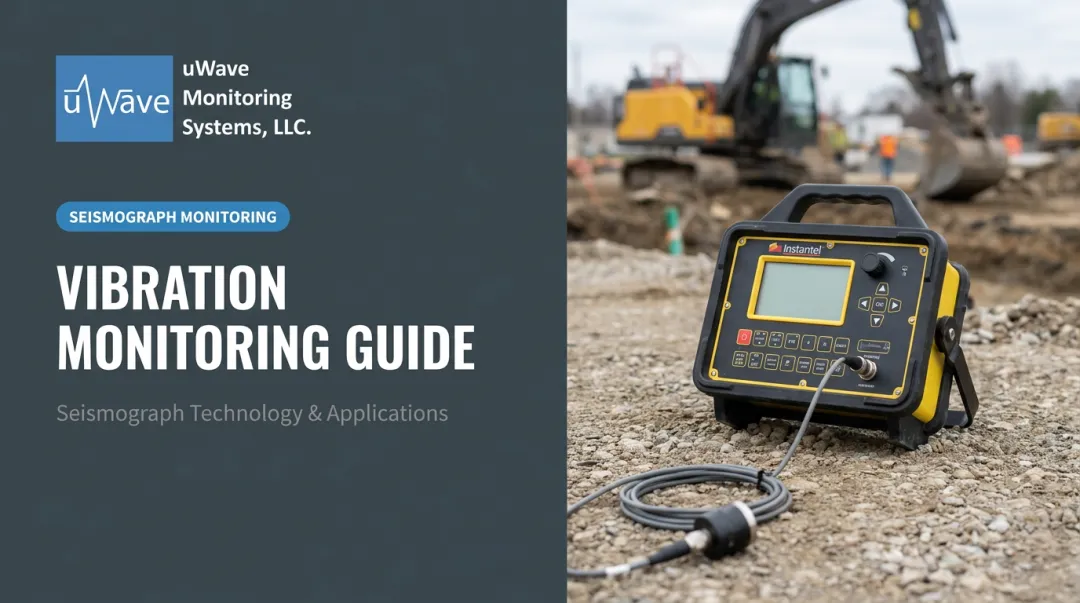
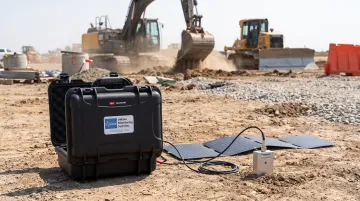
The geophone alone doesn't do much without a seismograph to power it, calculate PPV, and generate a compliance report. This is uWave Monitoring Systems' core specialty: the rental, sale, and service of Instantel seismographs, including the Micromate, Micromate Plus, Minimate Pro, Minimate Plus, and Blastmate III.
The Micromate Plus, for example, runs four channels (three for the geophone, one for sound or overpressure) and operates 10 to 15 days on internal battery, with solar options for remote sites.
Blast compliance also depends on sound and overpressure data:
- Linear air-overpressure microphones measure 88–148 dB(L) for standard blasting and pile-driving work
- High-pressure microphones extend to 184 dB(L) for unusually forceful events
- Type 1 sound level meters, paired with a Micromate or Minimate Pro4, record sound and vibration together
Machinery Vibration Sensors
Machinery diagnostics call for a different sensor family entirely:
- Accelerometers (piezoelectric and MEMS) — capture high-frequency vibration in motors, pumps, and compressors
- Velocity sensors/transducers — handle mid-frequency diagnostics on rotating equipment
- Proximity probes — measure shaft displacement directly, common on large turbines and compressors
Quick tip: Match the sensor's frequency range and environmental rating to the job. A geophone rated for 2–250 Hz won't capture the high-frequency signature of a failing bearing, and a sensor without proper weatherproofing won't survive a season on an outdoor jobsite.
Vibration Limits, Standards, and Risk Factors
Every vibration program needs a threshold to measure against. That's where PPV limit charts come in.
The USBM RI 8507 chart plots particle velocity against frequency to separate safe vibration from potentially damaging levels. Limits depend on both frequency and interior finish:
| Structure type | Low-frequency PPV limit | Above 40 Hz |
|---|---|---|
| Modern drywall interior | 0.75 in/s | 2.0 in/s |
| Older plaster-on-wood-lath interior | 0.50 in/s | 2.0 in/s |
Construction teams working outside blasting contexts often reference the FTA Transit Noise and Vibration Impact Assessment Manual instead. Its construction damage screening criteria break down by building category:
| Building category | PPV screening limit |
|---|---|
| Reinforced concrete, steel, or timber (no plaster) | 0.50 in/s |
| Engineered concrete and masonry (no plaster) | 0.30 in/s |
| Historic buildings; non-engineered timber or masonry | 0.20 in/s |
| Buildings extremely susceptible to vibration damage | 0.12 in/s |
These figures come from the FTA's vibration damage risk assessment guidance, and they're screening values, not a guarantee that everything below the line is automatically safe.
ISEE calibration standards require annual calibration and specific performance benchmarks for seismographs used in the field. Details are covered in the FAQ section below.
Not every facility fits neatly into these charts. Hospitals, laboratories, and data centers often need custom limits far stricter than standard residential or commercial thresholds. Sensitive lab equipment can be disrupted by amplitudes as small as one-millionth of an inch — well below anything a standard PPV chart would flag as a concern.
Building a Remote, Cloud-Based Monitoring Program
Manual data collection used to mean daily site visits, a technician downloading data from a seismograph, and a report compiled hours or days after an event occurred. Field-to-Cloud systems removed that lag.
Wireless, cellular-enabled seismographs now upload data automatically, generate reports, and trigger alerts the moment a threshold gets exceeded. uWave's Project Manager platform, for instance, provides web-based data hosting, automated email and text alerts, maintenance notifications, and 24/7 remote project access. No daily drive to the site required.
A typical dashboard might show 58 alerts in a given week, giving a project team a live pulse on every monitoring point at once.
A few practices make these programs work better:
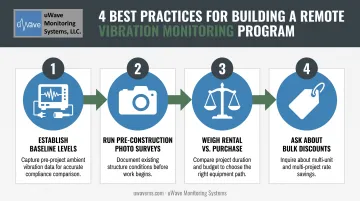
- Establish background vibration levels before the project starts. Baseline data sets sensible trigger thresholds and cuts false stop-work orders from ambient noise.
- Run pre-construction photo surveys on neighboring structures. Documented existing conditions reduce disputes when a claim comes in later.
- Weigh rental against purchase based on project length and how many monitoring points you need. A short-term job with two sensors rarely justifies a purchase; a multi-year infrastructure program often does.
- Ask about bulk-package discounts. Multi-unit deployments across large sites typically qualify for extended pricing, so check before you lock in a rental or purchase quote.
Those practices hold up even off the grid. Complete remote stations pair a solar module, a 12-volt battery bank, and a cellular gateway with the seismograph, so teams can place monitoring points where power and wired internet are unavailable.
Frequently Asked Questions
What are the common types of vibration measuring instruments?
Geophones and seismographs measure ground and structural vibration, while accelerometers, velocity sensors, and proximity probes handle machinery diagnostics. Choose based on the frequency range and whether you need ground/structural or machinery diagnostics.
What are the different types of vibration testing?
Testing falls into four broad categories: continuous/online monitoring, periodic/offline route monitoring, construction/blast compliance testing, and machinery FFT or time-waveform analysis. Pick the method based on whether you need real-time alerts, compliance records, or diagnostic depth.
How often should vibration monitoring equipment be calibrated?
ISEE standards require calibration before initial use, annually thereafter, and after any repair affecting sensor response. Calibration must be traceable to NIST or an equivalent national standards body.
What is considered a safe vibration level (PPV) for construction near structures?
Safe PPV varies by structure type, age, and construction material. The FTA manual sets limits from 0.12 in/s for extremely sensitive buildings up to 0.50 in/s for reinforced concrete, while USBM RI 8507 governs residential blasting scenarios.
Should I rent or buy a vibration monitoring system?
Rentals suit short-term or variable projects where equipment needs change site to site. Buying fits ongoing programs with steady monitoring needs; multi-unit purchases often qualify for discounted pricing.
Can vibration monitoring be done remotely?
Yes. Cellular-enabled seismographs paired with cloud hosting platforms like uWave's Project Manager provide 24/7 remote access, automated alerts, and centralized reporting without requiring daily site visits.