Introduction
Construction noise is among the most persistent occupational hazards on any job site. Unlike a chemical spill or a structural failure, noise damage builds shift after shift, with no visible warning — until hearing loss becomes permanent.
The numbers are sobering. According to CDC/NIOSH data updated in April 2026, 23% of noise-exposed construction workers have material hearing impairment — higher than the 20% average across all other industries combined.
Knowing what construction noise actually measures, how loud specific equipment gets, and what regulatory thresholds require is the starting point for any defensible hearing conservation program, site compliance plan, or community impact assessment.
This guide covers the dBA scale, equipment-specific noise benchmarks, OSHA and NIOSH exposure limits, field measurement methods, and the real consequences of getting it wrong.
Key Takeaways
- Most construction equipment generates 80–130+ dBA, well above safe exposure thresholds
- OSHA's construction PEL is 90 dBA over 8 hours; NIOSH recommends a stricter 85 dBA
- The decibel scale is logarithmic: a 10 dB increase sounds twice as loud and represents 10x the actual sound energy
- 72.6% of full construction shifts exceed the NIOSH recommended exposure limit
- PPE alone isn't enough; real-world NRR attenuation is roughly half the labeled value
What Construction Site Noise Means: Understanding the dBA Scale
Construction noise refers to sound pressure levels generated by machinery, tools, impact activities, and vehicles. The unit used in occupational health isn't plain decibels (dB)—it's dBA, or A-weighted decibels.
The A-weighting filter adjusts raw measurements to reflect how human hearing actually responds across frequencies. It de-emphasizes low-frequency rumbles and increases sensitivity around 2,000–4,000 Hz—the range where hearing damage is most likely. That's why every major occupational noise standard uses dBA, not unweighted dB.
The Logarithmic Reality
The decibel scale trips up a lot of people because it doesn't work like a ruler. A few relationships worth memorizing:
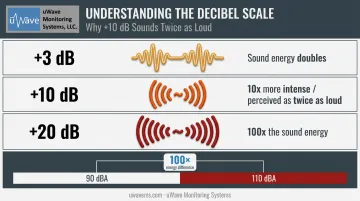
- +3 dB = sound energy doubles (two identical 90 dBA sources together = 93 dBA, not 180)
- +10 dB = perceived as roughly twice as loud, but actually 10 times more intense
- +20 dB = a perceptual shift most listeners describe as overwhelming—far beyond what the number suggests
In practice, the gap between 90 dBA and 110 dBA isn't 20 points on a linear scale—it's 100 times the sound energy. Site managers who treat a 5 dBA overrun as a minor infraction are misreading the physics.
Continuous vs. Impulsive Construction Noise
Not all construction noise works the same way physiologically:
Continuous noise (generators, excavators, cement mixers) causes harm through cumulative dose—total sound energy absorbed over an entire shift. Even moderate levels become dangerous with prolonged exposure.
Impulsive noise (pile drivers, jackhammers, powder-actuated tools) delivers sudden, high-intensity bursts. OSHA's construction standard under 29 CFR 1926.52(e) sets a 140 dB peak sound pressure level ceiling for impulsive and impact noise—measured as true peak, not A-weighted. A-weighting is not appropriate for instantaneous impulse peaks, a position OSHA reaffirmed in a 2025 interpretation.
How Loud Is Common Construction Equipment? A Reference Guide
Noise levels vary by equipment model, age, maintenance condition, and proximity to the operator. The benchmarks below are drawn from NIOSH construction noise research and should be treated as field reference ranges, not guaranteed operator-position values.
High-Noise Equipment (Above 95 dBA)
| Equipment | Benchmark Range |
|---|---|
| Pneumatic chip hammer | 103–113 dBA |
| Jackhammer | 102–111 dBA |
| Pile driving | 110–120 dBA (operator vicinity) |
| Concrete joint cutter | 99–102 dBA |
| Portable/circular saw | 88–102 dBA |
| Bulldozer (heavy-duty) | 97–107 dBA |
Mid-Range Equipment (80–95 dBA)
| Equipment | Benchmark Range |
|---|---|
| Front-end loader | 86–94 dBA |
| Backhoe | 84–93 dBA |
| Bulldozer (light-duty) | 93–101 dBA |
| Generator (>25 KVA) | ~82 dBA at 50 ft |
| Cement mixer | ~85 dBA at 50 ft |
Every piece of equipment in the mid-range table still exceeds or approaches NIOSH's 85 dBA recommended limit. A worker operating a backhoe for a full shift without hearing protection isn't safe just because the equipment sounds quieter than a jackhammer.
Regulatory Exposure Thresholds
OSHA's construction noise standard under 29 CFR 1926.52 establishes these permissible exposure limits:
| Duration per Day | Sound Level (dBA) |
|---|---|
| 8 hours | 90 |
| 6 hours | 92 |
| 4 hours | 95 |
| 3 hours | 97 |
| 2 hours | 100 |
| 1.5 hours | 102 |
| 1 hour | 105 |
| 30 minutes | 110 |
| 15 minutes or less | 115 |
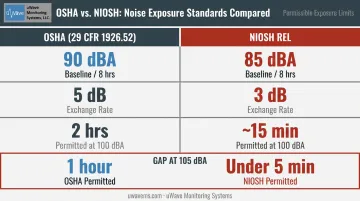
OSHA uses a 5 dB exchange rate: for every 5 dB increase above 90 dBA, maximum permitted exposure time is cut in half. NIOSH applies a stricter 3 dB exchange rate from an 85 dBA/8-hour baseline.
The gap between the two standards widens sharply at higher levels. At 100 dBA, OSHA permits 2 hours of exposure; NIOSH allows approximately 15 minutes. At 105 dBA, OSHA's limit is 1 hour — NIOSH's derived limit falls under 5 minutes. Construction workers routinely operate in that gap.
OSHA's 85 dBA action level and mandatory hearing conservation program trigger exist under the general industry standard (29 CFR 1910.95), not the construction rule. The construction standard (1926.52) requires a continuing hearing conservation program when Table D-2 levels are exceeded, but does not use the same 85 dBA action-level language.
Factors That Affect Construction Noise Levels in the Field
Benchmark dB readings tell you what equipment produces under controlled conditions. On an active site, distance, multi-source stacking, and environmental factors routinely push actual worker exposure well above those figures.
Distance and the Inverse-Square Law
Sound intensity decreases by approximately 6 dB every time distance from the source doubles. A jackhammer reading 110 dBA at 1 meter drops to roughly 86–87 dBA at 15 meters under ideal free-field conditions. That's still above the NIOSH REL, but it illustrates why equipment placement decisions have real, calculable effects on both worker and community exposure.
This math also matters for neighboring properties. Equipment that reads 100 dBA at 1 meter will register around 76 dBA at 16 meters—before accounting for reflective surfaces and weather effects.
Multi-Source Exposure and Full-Shift Reality
When multiple pieces of equipment run simultaneously, noise sources combine non-linearly. Two identical 90 dBA sources produce roughly 93 dBA together—not 180. That math, however, only captures a single moment. The cumulative dose across an entire shift reveals a much more serious picture.
A peer-reviewed construction cohort study analyzing 1,310 full-shift measurements found:
- 72.6% of shifts exceeded the NIOSH REL
- 33.2% exceeded the 85 dBA action-level criterion used for comparison
Periodic spot checks at a single location miss this variability entirely.
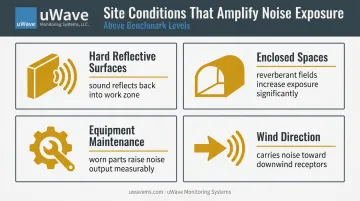
Site Conditions That Amplify Exposure
Several factors push real-world exposure above benchmark values:
- Hard reflective surfaces — concrete slabs, masonry walls, and building facades reflect sound energy back into the work zone
- Enclosed spaces — tunnels, basements, and building interiors create reverberant fields that significantly increase exposure compared to open-air conditions
- Equipment maintenance — worn parts, loose fasteners, and degraded muffling raise noise output measurably
- Wind direction — prevailing winds carry noise toward downwind receptors, including neighboring residences and sensitive sites
How Construction Noise Is Measured and Monitored on Site
Noise measurement serves two purposes simultaneously: regulatory documentation and operational risk management. Neither purpose is well-served by guesswork.
Measurement Instruments and Methods
Two instruments do most of the work:
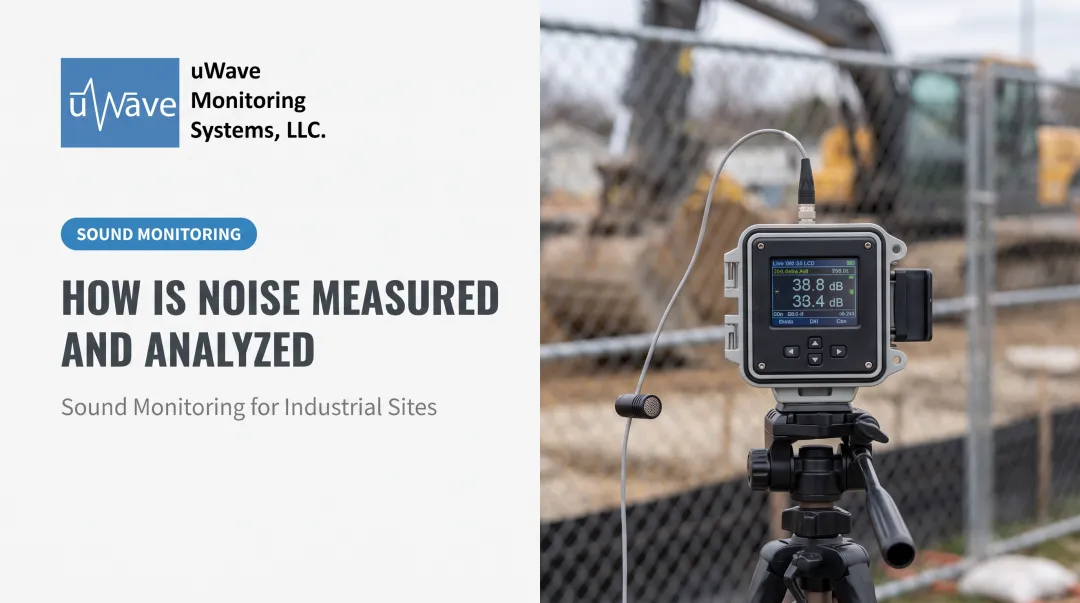
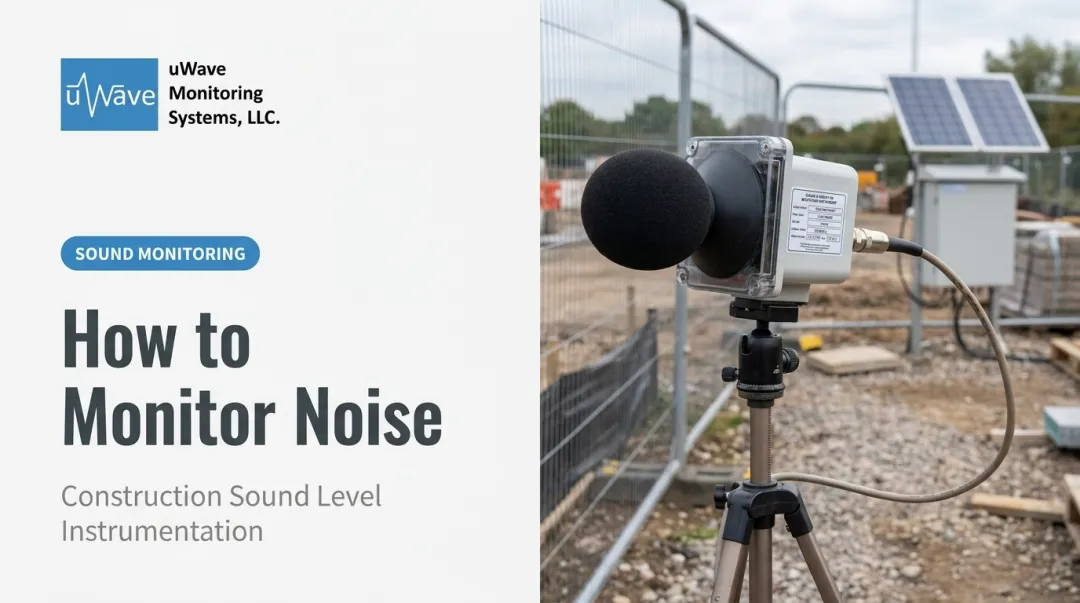
Sound level meters (SLMs) — provide instantaneous dBA readings at a fixed point. Useful for characterizing specific equipment and mapping noise zones across a site. OSHA calls for calibrated ANSI Type 1 or Type 2 meters (Type 2 accuracy is ±2 dBA).
Noise dosimeters — worn by individual workers to capture personal exposure as a time-weighted average across a full shift, including movement between high- and low-noise areas. Dosimetry is the right tool when exposure is variable, mobile, or suspected to be near threshold.
When instruments aren't available, OSHA offers a practical field check: if two workers must raise their voices to communicate at 3 feet apart, noise is likely at or above 85 dBA. This is a screening indicator, not a substitute for calibrated measurement.
Continuous and Remote Monitoring
Periodic spot readings miss the variability inherent in construction work: phases change, equipment moves, and conditions evolve throughout the workday. Continuous monitoring systems that log sound levels over time produce a far more complete exposure and compliance picture.
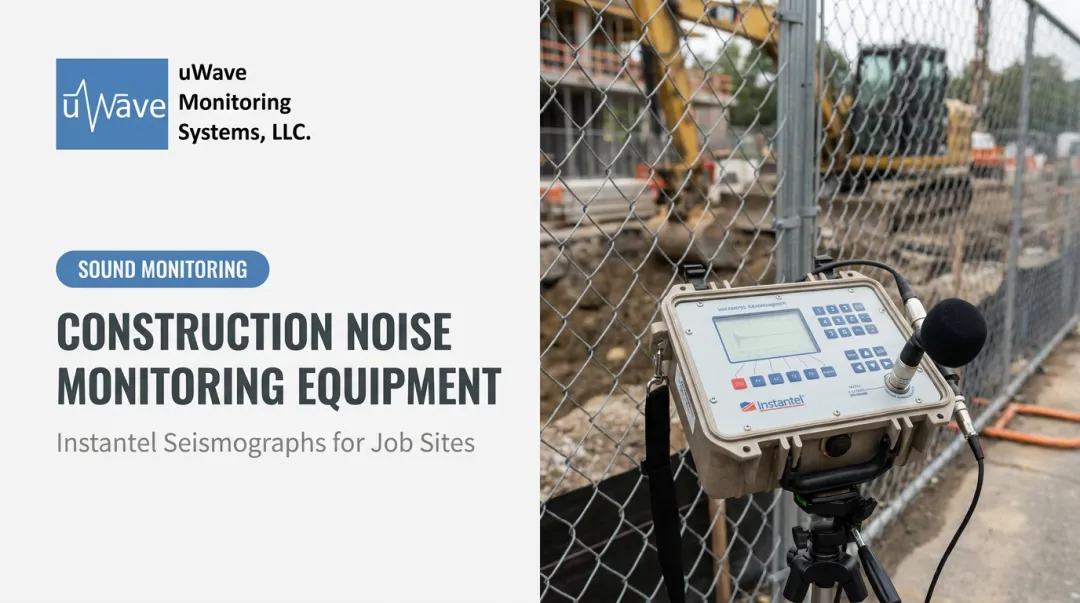
For urban projects, long-duration deployments, and sites near residential areas, field-to-cloud monitoring systems have become a practical standard. uWave Monitoring Systems deploys Instantel seismographs (including the Micromate, Micromate Plus, and Minimate Pro4) inside solar-powered V3 and V5 remote monitoring enclosures that capture vibration and sound data simultaneously, transmitting via 4G LTE cellular modem to the uWave Project Manager cloud platform.
From that platform, project teams can:
- Review real-time sound and vibration readings remotely
- Receive automated email and text alerts when thresholds are exceeded
- Generate documentation packages for regulatory reporting
- Access project data 24/7 without requiring on-site personnel
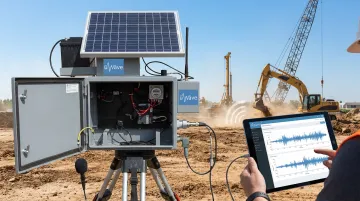
The Minimate Pro4, for example, supports professional-grade simultaneous sound and vibration monitoring on a single unit when paired with the Instantel Type 1 Sound Level Meter. This matters most on projects near hospitals, schools, or residential neighborhoods, where documentation gaps create compliance exposure — not just operational inconvenience.
Health and Compliance Consequences of Exceeding Noise Limits
Occupational Health Impact
Noise-induced hearing loss (NIHL) is permanent. The hair cells of the inner ear, once destroyed, do not regenerate.
It also develops gradually. Workers often don't notice meaningful loss until significant damage has already accumulated — which is what makes it so difficult to catch early.
CDC/NIOSH data from April 2026 reports:
- 23% of noise-exposed tested construction workers have material hearing impairment
- 16% have hearing impairment in both ears
- 13% of all construction workers have hearing difficulty
- 7% have tinnitus
High-risk subsectors include Highway, Street, and Bridge Construction (28%), Site Preparation Contractors (26%), and New Single-Family Housing Construction (25%).
Beyond hearing loss, NIOSH identifies secondary effects of chronic construction noise: tinnitus, fatigue, elevated blood pressure, and stress that can contribute to cardiovascular disease.
Regulatory and Community Consequences
Those health risks are precisely why regulators enforce strict noise exposure limits — and the penalties for violations are substantial. OSHA penalties effective after January 15, 2026:
- Serious violations: up to $16,550 per violation
- Willful or repeated violations: up to $165,514 per violation
- Failure to abate: up to $16,550 per day
Municipal ordinances add another compliance layer entirely separate from OSHA worker-exposure rules. Portland, Oregon limits construction noise to 85 dBA at 50 feet during allowed hours (7 a.m.–6 p.m., Monday–Saturday), with a variance required outside those hours. New York City requires noise mitigation plans for construction sites and, as of April 21, 2026, mandates continuous noise monitoring for new buildings of 200,000 square feet or more within 50 feet of residential receptors.
Stop-work orders, permit delays, and community disputes are added operational risks when municipal limits are breached — on top of any OSHA enforcement action.
Common Misconceptions About Construction Site Noise
Misconception 1: "If we're OSHA-compliant, workers are safe"
OSHA's 90 dBA PEL is a legal compliance threshold, not a medical determination of safety. NIOSH's research-based REL of 85 dBA marks where hearing damage risk becomes statistically significant over a working lifetime. A worker exposed to exactly 90 dBA for 8 hours per day, every working day, still faces real cumulative hearing loss risk over a career. OSHA compliance sets a legal floor — it doesn't guarantee a worker's hearing will be intact at retirement.
Misconception 2: "Hearing protection solves the noise problem"
The Noise Reduction Rating (NRR) printed on hearing protector packaging is derived from laboratory conditions with trained, supervised subjects. Real-world attenuation is far lower due to improper fit, comfort-driven removal, and inconsistent use.
OSHA's enforcement formula for estimating protected exposure with A-weighted data is:
Estimated Exposure = TWA − (NRR − 7)
When evaluating engineering control feasibility, OSHA applies a 50% safety factor: TWA − [(NRR − 7) × 50%]. This derating reflects the reality that lab-rated attenuation is seldom achieved in the field.
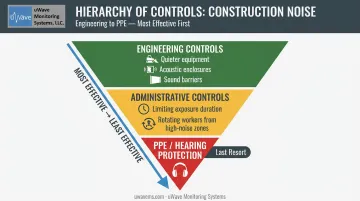
The hierarchy of controls applies to noise just as it does to other hazards — and hearing protection sits at the bottom:
- Engineering controls: quieter equipment, acoustic enclosures, sound barriers
- Administrative controls: limiting exposure duration, rotating workers away from high-noise zones
- PPE (hearing protection): last resort, not a substitute for the controls above
Frequently Asked Questions
What are OSHA's noise exposure limits for construction sites?
OSHA's PEL under 29 CFR 1926.52 is 90 dBA over an 8-hour shift, with permitted exposure time halving as levels rise: 4 hours at 95 dBA, 30 minutes at 110 dBA, and a hard ceiling at 115 dBA. A hearing conservation program is required when levels exceed Table D-2 thresholds.
What is the rule of 5 for noise?
OSHA's construction standard uses a 5 dB exchange rate: every 5 dB increase above 90 dBA cuts maximum permitted exposure time in half. NIOSH applies a stricter 3 dB exchange rate from an 85 dBA baseline, which more accurately reflects how noise dose causes cochlear damage.
What decibel level is a jackhammer on a construction site?
Jackhammers typically generate 102–111 dBA as a construction equipment benchmark. That's well above both OSHA's 90 dBA PEL and NIOSH's 85 dBA REL. Unprotected exposure at this level exceeds safe limits within minutes of sustained operation.
How far does construction site noise travel?
Noise decreases by approximately 6 dB for every doubling of distance from the source. Equipment reading 100 dBA at 1 meter may register around 76 dBA at 16 meters in open-field conditions. Reflective surfaces, enclosed spaces, and wind can push actual readings significantly higher than this baseline estimate.
What is the difference between dB and dBA in construction noise?
Unweighted dB measures raw sound pressure across all frequencies equally. dBA applies an A-weighting filter that matches the frequency sensitivity of human hearing—emphasizing the 2,000–4,000 Hz range where hearing damage is most likely. dBA is the standard unit in all occupational noise regulations because it better predicts injury risk.
Can construction noise cause permanent hearing loss?
Yes. Prolonged exposure above 85 dBA destroys cochlear hair cells, which cannot regenerate. Hearing loss typically develops gradually, which means workers often don't recognize the extent of damage until it's already severe. One in four noise-exposed tested construction workers already has material hearing impairment.