
The challenge is that rotor vibration rarely announces itself dramatically. It starts small — a slight amplitude increase in a vibration reading, a new harmonic in a frequency spectrum — and builds toward failure while production continues. By the time operators notice something is wrong, secondary damage is already underway.
This guide breaks down the mechanical root causes of rotor vibration, what happens when it goes unaddressed, and how precision maintenance combined with continuous monitoring prevents the failure cascade before it starts.
Key Takeaways
- Four root causes drive rotor vibration: imbalance, shaft misalignment, bearing defects, and resonance — each with a distinct frequency signature
- Early warning signs include rising vibration amplitude, abnormal sounds, and elevated bearing temperatures
- Effective prevention relies on regular balancing, laser alignment, structured lubrication, and real-time monitoring
- Unplanned downtime costs manufacturers an average of $125,000 per hour, according to an ABB survey across 3,215 maintenance decision-makers
- Continuous vibration monitoring catches developing faults before they reach failure thresholds
Common Causes of Rotor Vibration
Most rotor vibration problems share one trait: they don't stay contained. One problem compounds another — imbalance stresses bearings, worn bearings allow micro-movement, and that looseness amplifies whatever vibration is already present. Understanding each cause on its own is the first step to diagnosing what's actually happening in the field.
Rotor Imbalance
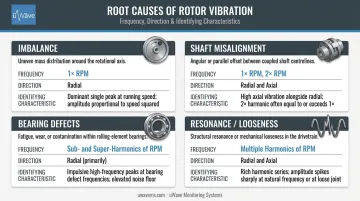
Imbalance occurs when mass is unevenly distributed around a rotor's circumference. During rotation, that asymmetry generates centrifugal force — producing vibration at exactly 1x RPM in the radial direction. The force relationship follows F = m × e × ω², meaning excitation force scales with the square of rotational speed. What's minor at low RPM becomes significant at operating speed.
Common real-world triggers include:
- Material buildup on fan blades or impeller surfaces
- Erosion that removes mass unevenly over time
- Improper repair welds that add asymmetric mass
- Missing balance weights from prior maintenance
Shaft Misalignment
Misalignment between coupled shafts creates alternating bending loads on both the rotor and its bearings. Angular misalignment — where shaft centerlines meet at an angle — typically generates strong axial vibration at 1x RPM. Parallel (offset) misalignment tends to produce elevated radial vibration at 1x and 2x RPM, often with a 180-degree phase change across the coupling.
Conditions that trigger misalignment include:
- Thermal expansion shifting machine position after startup
- Soft foot — uneven contact between machine feet and baseplate
- Improper installation or grouting
- Pipe strain transmitted into the machine casing
Vibration spectrum alone doesn't confirm misalignment. Research from SpectraQuest found that the dominant harmonic peak can shift with operating conditions. Phase data and direct alignment measurements must confirm what spectrum analysis suggests.
Bearing Wear and Defects
Healthy bearings maintain consistent rotor position. When they wear or sustain damage, micro-movements introduce high-frequency vibration with characteristic frequency patterns — BPFO (Ball Pass Frequency Outer Race), BPFI (Ball Pass Frequency Inner Race), BSF (Ball Spin Frequency), and FTF (Fundamental Train Frequency) — that are identifiable through spectrum analysis and acceleration enveloping techniques.
According to SKF's bearing failure analysis, approximately one-third of bearing failures trace back to lubrication problems — wrong lubricant type, incorrect quantity, or missed relubrication intervals. Contamination accounts for another third.
Scenarios where bearing defects develop:
- Over- or under-lubrication generating heat and accelerated wear
- Contaminated lubricant introducing abrasive particles into the contact zone
- Fatigue spalling from sustained overloading
- Misaligned bearing housing installation
Resonance
Resonance occurs when rotor operating speed coincides with a natural frequency of the machine or structure. At that point, even small excitation forces produce disproportionately large vibration amplitudes. The signature: a sharp amplitude peak confined to a specific speed band during run-up or coast-down — stronger evidence than a high steady-state reading alone.
Mechanical Looseness
Loose base bolts, worn clearances, and cracked foundations generate sub-harmonic and multiple harmonic frequencies at 2x, 3x, and 4x running speed. This complicates diagnosis: looseness can mask or mimic other faults while simultaneously amplifying imbalance or misalignment that's already present.
What Happens If Rotor Vibration Is Ignored
Initial imbalance or misalignment loads bearings beyond their design limits. As bearings degrade, loads transfer to seals and shafts — seals fail, lubricant is lost, contamination enters, and shaft fatigue accumulates. Eventually one component reaches its limit, and the failure typically takes adjacent equipment with it.
An ABB survey of 3,215 maintenance professionals found unplanned downtime costs an average of $125,000 per hour — an 8-hour shift outage represents roughly $1 million in lost output. In oil and gas, Siemens modeled downtime costs approaching $500,000 per hour.
Beyond downtime costs, vibration-related failures create secondary damage across connected systems:
- Gearboxes and couplings absorb misalignment loads until they fail
- Piping connections experience fatigue at flanges and welds
- Seals and mechanical faces wear prematurely, introducing contamination
- Component ejection and structural collapse risk rises directly with vibration severity
Warning Signs You're Approaching Failure
Each symptom maps to a specific underlying cause — catching them early is the difference between a planned correction and an emergency repair:
- Increasing vibration amplitude felt through the machine housing, foundation, or connected piping — the first and most direct indicator, typically worsening as the cause develops
- Abnormal sounds — grinding, humming, rhythmic knocking, or changes in pitch that track with machine speed — indicating bearing distress or imbalance
- Elevated bearing temperature, accelerated seal wear, or fastener loosening around the machine base — signs that persistent vibration forces are stressing the structure
How to Prevent Rotor Vibration
No single corrective action addresses all vibration causes. Effective prevention combines several engineering practices, each targeting a specific root cause.
Regular Rotor Balancing
Dynamic balancing measures residual imbalance using a balancing machine or in-situ vibration analyzer, then adds or removes mass at calculated positions to achieve even distribution. The current standard governing rigid-rotor balancing procedures and tolerances is ISO 21940-11:2016 (which replaced the withdrawn ISO 1940-1:2003).
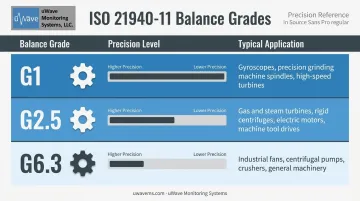
Balance grades are not universal — allowable residual unbalance depends on the grade selected (G1, G2.5, G6.3, etc.), rotor mass, and maximum service speed. Common applications:
| Grade | Typical Application |
|---|---|
| G1 | Grinding machine drives, precision armatures |
| G2.5 | Gas/steam turbines, compressors, motors above 950 RPM |
| G6.3 | Fans, pumps, general process machinery |
Implement balancing after any rotor repair, component replacement, material buildup event, or evidence of erosion — and on a scheduled interval for high-speed machinery.
Precision Shaft Alignment
Laser alignment is the current standard practice for ensuring coupled shaft centerlines fall within manufacturer tolerance. It eliminates the alternating bending loads that drive misalignment-related vibration and bearing wear.
The applicable methodology standard is ANSI/ASA S2.75-2017/Part 1 (reaffirmed 2020) for horizontally mounted, flexibly coupled machines. Part 3:2021 covers vertically oriented machinery.
Conduct alignment at:
- Initial installation
- After any baseplate modification or grouting work
- Following significant thermal events or process changes
- Whenever vibration analysis shows elevated 2x RPM frequency components
Bearing Inspection and Lubrication Management
Structured bearing maintenance requires more than a lubrication schedule. Key elements:
- Lubricant analysis to detect contamination or oxidation degradation before it reaches the bearing contact surface
- Adherence to manufacturer relubrication intervals — SKF bases intervals on bearing type, size, speed, load, and temperature, using 70°C as a reference baseline and shortening the interval for every 15°C increase above it
- Physical inspection for early signs of pitting, spalling, or housing wear
- Correct lubricant quantity — both over- and under-lubrication generate heat and accelerate failure. Timken confirms overfilling raises operating temperature and degrades grease, while underfilling causes starvation and premature wear
Record grease identity, quantity applied, bearing temperature, and contamination observations at every service event. Avoid mixing incompatible grease types.
Continuous Vibration Monitoring
Deploying vibration sensors on critical rotating equipment allows real-time detection of developing faults before they cross failure thresholds. The process starts at commissioning: establish a baseline vibration signature under known-good conditions at consistent sensor locations, speed, and load.
Subsequent readings are trended against that baseline, with alarms set from both ISO severity criteria (per ISO 20816-1:2016 and ISO 20816-3:2022) and statistically meaningful deviation from baseline.
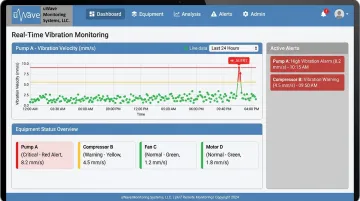
Field-to-cloud monitoring solutions — such as those offered by uWave Monitoring Systems — enable 24/7 remote access to equipment vibration data through a cloud-based web portal. When a threshold is exceeded, the system automatically dispatches email and SMS alerts to designated stakeholders and logs the event for trend analysis. That continuous coverage is what makes it practical to catch imbalance, misalignment, or bearing defect signatures between scheduled inspections — well before a fault reaches the failure threshold.
Tips for Long-Term Rotor Vibration Prevention and Control
Preventing rotor vibration failures comes down to consistent habits built into daily and scheduled operations. These four practices form the backbone of a long-term control program:
- Document baseline vibration readings at commissioning for each critical rotating asset. Schedule periodic trend comparisons — gradual amplitude increases are far easier to catch against a documented reference than from memory alone.
- Train operators to recognize early warning signs such as changes in machine sound, temperature, or vibration feel. Operators act as the first detection layer, catching changes before sensors flag them.
- Maintain detailed maintenance logs covering balancing records, alignment measurements, bearing replacement history, and vibration readings. This documentation supports root cause analysis and backs warranty claims and replacement decisions.
- Use remote monitoring with automated alerts so threshold exceedances reach maintenance teams via email and SMS immediately, regardless of shift or location. Teams at uWave Monitoring Systems, for example, configure alert systems that notify personnel the moment a reading crosses a set limit.
Conclusion
Rotor vibration has identifiable mechanical causes — imbalance, misalignment, bearing defects, and resonance — and each one is correctable before it reaches catastrophic failure. Both the failure progression and the path to preventing it follow predictable patterns.
Good maintenance habits (balancing, alignment, structured lubrication) address the root causes. Continuous monitoring closes the gap between scheduled inspections. Together, they convert what would be unplanned emergency repairs into planned, lower-cost interventions.
The math is straightforward: scheduled maintenance and continuous monitoring cost a fraction of what unplanned downtime costs per hour. The case for proactive vibration control comes down to one question: whether you address the problem on your schedule or wait for the machine to force the issue.
Frequently Asked Questions
What causes rotors to vibrate?
Rotor vibration is most commonly caused by mass imbalance, shaft misalignment, bearing defects, or resonance conditions. Each produces identifiable vibration signatures — specific frequencies, directions, and phase relationships — that allow technicians to distinguish between causes through spectrum analysis.
What are the signs of rotor vibration problems?
Key indicators include increasing vibration amplitude, abnormal noise (grinding, knocking, or humming that changes with speed), elevated bearing temperatures, and accelerated wear on seals or connected components. Any combination of these signs warrants immediate investigation.
Does rotor vibration occur at all operating speeds?
Yes. Imbalance and misalignment forces act continuously at operating speed, so rotor-related vibration is present whenever the machine runs — not only under load or specific conditions. Speed changes the amplitude, but the underlying fault is always active.
How much does it cost to fix rotor vibration?
Costs vary by cause and severity. Balancing and laser alignment corrections are relatively low-cost interventions. Bearing replacement or rotor refurbishment carries higher costs, but both are far less expensive than emergency repairs and lost production from a catastrophic failure.
How do you measure rotor vibration?
Technicians mount piezoelectric accelerometers or velocity sensors on bearing housings in radial and axial directions, then connect them to data acquisition systems. The data is analyzed in both the time domain and frequency domain (FFT), separating vibration into frequency components that identify specific fault types.
What is the difference between rotor imbalance and misalignment?
Imbalance produces dominant radial vibration at 1x RPM due to uneven mass distribution. Misalignment typically produces vibration at 1x and 2x RPM — often with strong axial components — due to bending loads from coupled shaft centerline offset. Both require different corrective actions: balancing for imbalance, laser alignment correction for misalignment.