Municipal noise ordinances have tightened in recent years, and regulators are watching construction near residential zones more closely than ever. A 2022 survey by the Chartered Institute of Environmental Health recorded 356,367 noise complaints across 144 UK local authorities in a single year, along with 11,211 formal actions and 88 prosecutions (CIEH, 2022).
Despite this scrutiny, many project teams still confuse a one-time decibel reading with continuous compliance monitoring. That mix-up leads to missed exceedances and reactive complaint handling instead of proactive management. This guide breaks down what noise monitoring actually is, and exactly how it works, stage by stage, from sensor to cloud alert.
Key Takeaways
- Noise monitoring uses calibrated instruments to track sound levels continuously, not just at a single moment
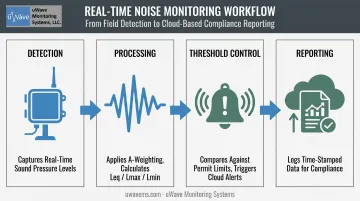
- The process follows four stages: detection, weighted processing, threshold control, and data logging
- Occupational monitoring tracks worker exposure; environmental monitoring tracks perimeter/community sound
- Cloud-connected stations now pair field sensors with real-time alerts for faster compliance response
- Construction, mining, transit, and infrastructure teams rely on it to manage permits and community relations
What Is Noise Monitoring?
Noise monitoring is the systematic measurement and recording of sound pressure levels in an environment or workplace using calibrated instruments. The goal is to evaluate exposure or compliance against defined limits, not to gather a casual impression of "how loud" a site sounds.
It exists because subjective noise complaints alone don't hold up in a dispute. A neighbor saying "it's too loud" isn't evidence. Regulators need objective, measurable, time-stamped data before they take enforcement or corrective action. That's the gap noise monitoring fills.
What it is not:
- A recording of speech or conversations
- A single spot decibel reading taken once and filed away
- A subjective judgment call by an inspector
It's a structured, calibrated, time-based measurement process. That also settles a common job-site concern: monitoring sound levels is not surveillance of speech or conversations.
Why Documented Monitoring Matters
Regulatory frameworks and municipal noise ordinances require documented monitoring. When a construction noise complaint lands, a defensible data trail is how a project proves it stayed within permit limits.
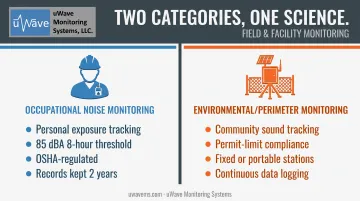
Two Categories, One Underlying Science
- Occupational noise monitoring uses personal dosimeters worn by workers to calculate daily noise dose
- Environmental/perimeter noise monitoring uses fixed or portable stations at project boundaries to track community and permit compliance
For occupational programs, OSHA requires monitoring once exposure may reach an 85 dBA 8-hour time-weighted average, with calibrated instruments and exposure records kept for two years (OSHA, 29 CFR 1910.95).
Placement, duration, and reporting cadence differ between the two categories, but the acoustic principles are the same.
How Does Noise Monitoring Work?
Regardless of whether it's occupational or environmental, noise monitoring follows the same defined sequence: detection, processing, threshold control, and reporting.
Initiation
The process can start three ways: a scheduled walk-through survey, a continuous automated station running 24/7, or a condition triggered by a project permit requirement.
Manual and automated activation look very different in practice:
- Handheld sound level meters need a technician physically on-site to take readings
- Remote monitoring units power on, self-calibrate, and run continuously, streaming data to the cloud without staff presence
The most common bottleneck at this stage is incorrect microphone placement. Distance from the noise source, mounting height, and wind shielding all affect reliability, and a poorly placed sensor produces bad data no matter how good the instrument is.
Core Operation
Once positioned correctly, the physics is simple. A microphone converts sound pressure variations into an electrical signal. Circuitry then converts that signal into decibels using a weighting filter, commonly A-weighting, which approximates how the human ear perceives loudness across frequencies (OSHA Technical Manual).
The instrument samples continuously and calculates metrics over set intervals, usually 1-minute, 15-minute, or hourly windows:
- Leq – equivalent continuous sound level (an energy average over the period)
- Lmax – the highest level recorded during that window
- Lmin – the lowest level recorded during that window
Instrument accuracy class, sampling rate, and calibration frequency all directly affect whether this data holds up as regulatory-grade evidence later.
Regulation and Control
Sites don't sit still. Background noise shifts throughout the day, so systems apply background-noise correction alongside pre- and post-deployment calibration checks. Threshold settings get tied directly to permit limits.
Here's where cloud connectivity earns its keep. Cloud-connected systems can trigger automated email and text alerts the instant a threshold is breached, so crews can adjust operations before a violation escalates.
Field-to-cloud sound and vibration units used on construction and infrastructure projects, including systems from uWave Monitoring Systems, are built around that real-time layer rather than end-of-week reports.
Without that real-time layer, exceedances often go unnoticed until a complaint or inspection occurs. By then, you're looking at a stop-work order or a fine instead of a quick operational fix.
Output and Result
The end product is time-stamped noise level data, exceedance logs, and summary reports showing compliance against applicable limits. This output feeds into project compliance documentation and community relations reporting, and it can be cross-referenced with vibration data for a fuller environmental impact picture.
Documented monitoring helps resolve disputes. An HS2 monthly report from Birmingham (July 2025) covered a resident complaint about compacting rollers. The project team checked its monitors, confirmed no trigger-level exceedance, and responded with data in hand (HS2/GOV.UK, 2025). Without data, you're left with an open-ended argument.
Noise Monitoring Tools and Technologies
Different tools solve different problems. Matching the right instrument to the right purpose is half the job.
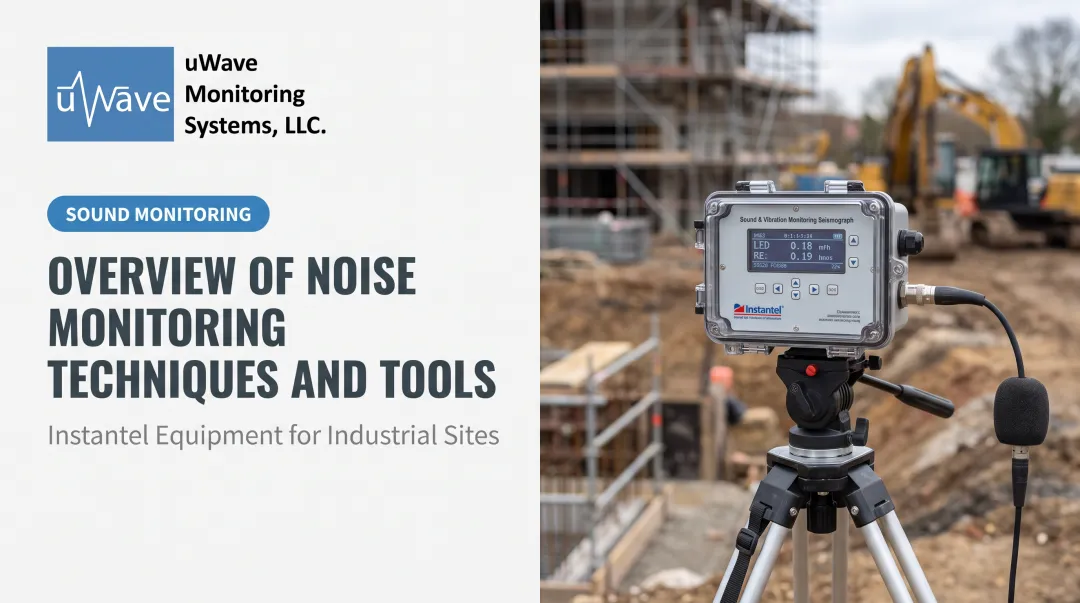
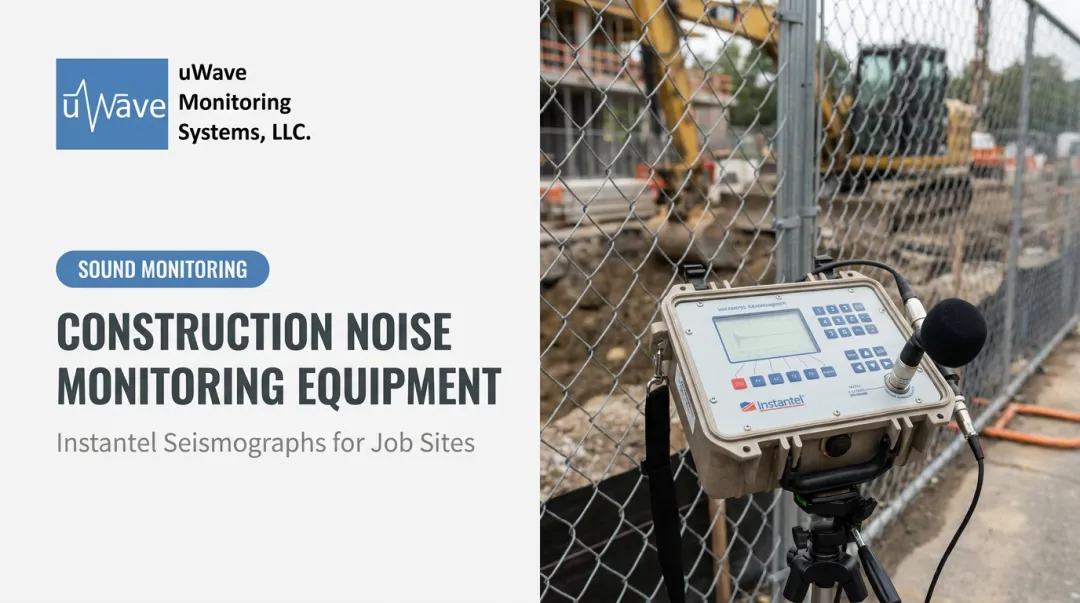
- Sound level meters (SLMs): Handheld instruments for spot checks that identify which equipment or process is generating elevated noise.
- Noise dosimeters: Worn by individual workers to calculate personal daily noise dose for occupational hearing conservation programs. Suited to mobile workers whose exposure varies throughout a shift.
- Integrating sound level meters (ISLMs): Fixed-location instruments that produce equivalent sound levels over time without being worn. Useful for area or perimeter monitoring where no single person needs to carry a device.
- Remote, cloud-connected monitoring stations: Sensors, dataloggers, and cellular or Wi-Fi connectivity stream sound (and often vibration) data to a web dashboard—the standard for long-duration, unattended perimeter monitoring on construction, mining, water, and transit projects.
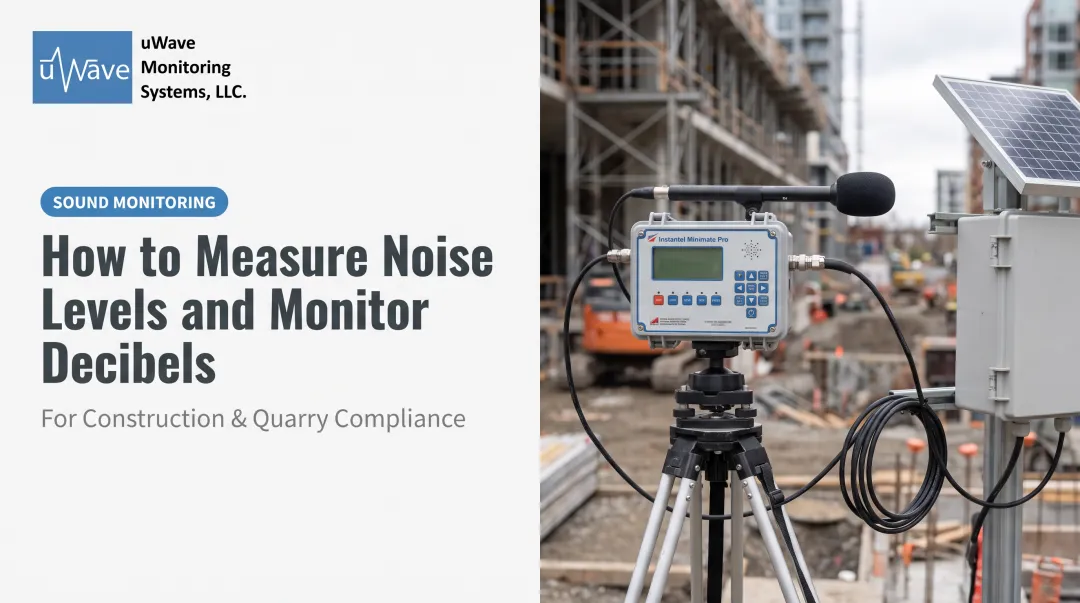
uWave's field-to-cloud stations show how this works on real projects. The Micromate records vibration and sound in one unit: three channels feed a triaxial geophone, and a fourth accepts an air-overpressure or sound-level microphone.
Larger V5 remote stations add a dedicated microphone port, a 4G LTE modem, and a 30-watt solar module. That setup runs unattended for the full project instead of needing daily technician visits.
Selection comes down to purpose:
- Need a quick compliance survey? An SLM works.
- Tracking one worker's personal exposure? Use a dosimeter.
- Monitoring a site perimeter for weeks or months without staff on-site? A remote cloud-connected station is the only practical option.
Where Is Noise Monitoring Used?
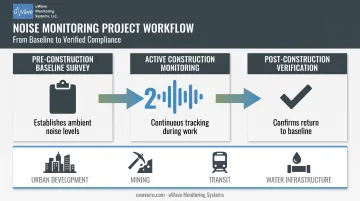
Noise monitoring typically fits into three workflow stages on any given project:
- Pre-construction baseline survey – establishes what ambient noise already exists before work begins
- Active construction/operations monitoring – tracks levels continuously while work is underway
- Post-construction verification – confirms the site returned to baseline conditions
It fits these environments best:
- Urban and suburban development near residences and schools
- Mining and quarrying perimeters
- Transit and rail corridors
- Water infrastructure upgrade sites
Use cases also split by industry. Manufacturing and industrial plants focus on indoor worker exposure through dosimeters and hearing conservation programs. Heavy construction and infrastructure projects focus on perimeter and community sound levels tied to permit conditions—same science, different application.
Conclusion
Noise monitoring is a structured pipeline, not a single instantaneous reading. A sensor detects the sound, the system weights it into a measurable metric, checks it against a threshold, and logs it as a reportable record. That's the whole loop, repeated continuously.
Understanding this flow changes how project teams operate. It helps them choose the right tool for the job, respond faster when an exceedance happens, and keep audit-ready compliance records on hand instead of scrambling to explain a complaint after the fact.
Frequently Asked Questions
What does sound monitoring mean?
Sound monitoring is the continuous or periodic measurement of noise levels in an environment using calibrated instruments. It tracks exposure or compliance over time rather than capturing a single moment.
Do noise monitors record conversations?
No. Noise monitors measure sound pressure levels in decibels—they do not capture intelligible speech or record audio.
What's the difference between a sound level meter and a noise dosimeter?
A sound level meter measures noise at a fixed location or source. A dosimeter is worn by a person and calculates their total personal noise exposure over a shift.
How often should construction sites monitor noise levels?
It depends on permit conditions and project phase. Some sites need only periodic spot checks, while others near sensitive receptors require continuous 24/7 remote monitoring for the project's duration.
What is considered an acceptable noise level for construction projects?
Limits vary significantly by municipality and time of day. Always check local noise ordinances or your specific permit conditions for exact decibel thresholds rather than relying on a general figure.
Can noise monitoring data be accessed remotely in real time?
Yes. Modern cloud-hosted systems, including the uWave Project Manager platform, allow 24/7 remote access to live data and automated alerts from any internet-connected device.