Between OSHA hearing conservation mandates and municipal noise ordinances tightening around construction, mining, quarrying, and infrastructure work, "we'll deal with it if someone complains" isn't a strategy anymore.
The problem? Many teams can't tell a sound level meter from a dosimeter, or a dosimeter from a continuous monitoring station. That confusion leads to compliance gaps, wasted equipment budgets, and data that won't hold up if a regulator or angry neighbor comes asking.
This guide breaks down the core noise monitoring techniques, the instruments behind each one, how to pick the right approach for your project, and why remote, cloud-connected monitoring is becoming standard for long-duration jobs.
Key Takeaways
- Noise monitoring serves two distinct purposes: protecting worker hearing and managing community noise impact
- Hazardous noise remains widespread—37% of construction workers reported exposure in the past year
- Technique selection depends on worker mobility, project duration, and the regulatory driver behind your monitoring
- Remote, cloud-hosted stations let teams track compliance without repeated site visits
- Layer techniques on active sites: spot survey first, then continuous monitoring
What Is Noise Monitoring?
Noise monitoring is the systematic measurement and recording of sound levels on and around a job site. It exists to do three things: keep workers safe, keep projects compliant, and keep community relations intact.
Who actually needs it:
- Employers running hearing conservation programs under OSHA and NIOSH guidelines
- Contractors working under municipal noise ordinances, which govern construction hours and permitted decibel levels in dense urban areas
- Mining, quarrying, and transit projects operating under environmental permits that require ongoing perimeter noise documentation
According to the CDC's NIOSH construction noise data, 37% of construction workers reported hazardous noise exposure in the prior year, with 13% reporting hearing difficulty and 7% reporting tinnitus.
Two Purposes, Two Different Jobs
These two goals call for different equipment and techniques:
- Occupational exposure monitoring — protecting individual worker hearing over a shift or workweek
- Perimeter/community noise monitoring — tracking sound levels at the property line to stay within ordinance limits and manage nearby complaints
A heavy construction site near residential development often needs both running simultaneously. One protects your crew. The other protects your permit.
Key Noise Monitoring Techniques
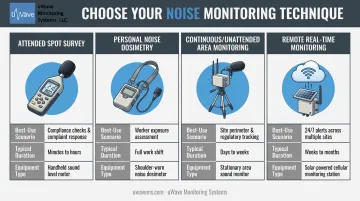
The right technique depends on what question you're trying to answer: personal worker exposure, source identification, or perimeter compliance. Most active projects end up using more than one.
Attended Spot Noise Surveys
This is usually step one. A technician walks the site with a handheld meter, mapping noisy zones and flagging problem equipment. It's fast, diagnostic, and doesn't require leaving anything unattended.
Spot surveys are ideal for:
- Identifying which piece of equipment is driving a noise complaint
- Scoping a site before committing to longer-term monitoring
- Verifying a dosimeter reading against a known source
Personal Noise Dosimetry
Dosimeters are worn on a worker's shoulder and log cumulative noise dose across a full shift. They're built for mobile workers whose exposure changes constantly, moving between a jackhammer, a generator, and a quiet office trailer in the same day.
OSHA identifies the personal dosimeter as the primary instrument for compliance exposure decisions, precisely because a fixed meter can't follow a worker around a site.
Continuous/Unattended Area Monitoring
An integrating sound level meter or monitoring station stays in one location for hours, days, or weeks. It calculates equivalent continuous sound levels over that period, which is exactly what most compliance records and complaint investigations require.
This technique works best when:
- Noise sources stay relatively fixed
- You need perimeter data documented over an extended window
- A complaint requires a defensible multi-day record
Remote Real-Time Monitoring
Long-duration mining, transit, and infrastructure projects increasingly skip manual site visits altogether. Telemetry-enabled stations transmit data continuously to the cloud, so project teams can check readings without driving out to the site every few days.
Automated source classification is advancing quickly on this front. A recent system tested across multiple construction environments using Wi-Fi, Bluetooth edge devices, and cloud computing reached 89.13% accuracy across 14 acoustic categories. That level of performance shows remote stations can distinguish noise sources without a technician on site.
Essential Noise Monitoring Tools & Instruments
Instrument choice should match both your technique and the accuracy you need:
- Type 2 meters (general-purpose, ±2 dBA): Cover most field surveys
- Type 1 meters (precision-grade, ±1 dBA): Better for high-frequency noise or when selecting engineering controls
Sound Level Meters (SLM)
A handheld device measuring instantaneous sound pressure, typically held near ear height. Best for identifying noisy equipment, comparing tasks, or scoping a work area before deeper monitoring begins.
Noise Dosimeters
Small, shoulder-worn devices that log a worker's exposure across a shift and calculate a percentage dose against a criterion level. OSHA's standard settings use a 90 dBA criterion and 5 dB exchange rate; NIOSH recommends a stricter 85 dBA REL with a 3 dB exchange rate.
Integrating Sound Level Meters (ISLM)
These calculate an equivalent continuous sound level (Leq) over a defined period at a fixed location. No need to attach anything to a worker, which makes ISLMs the go-to for variable perimeter noise on active sites.
Remote Monitoring Stations & Systems
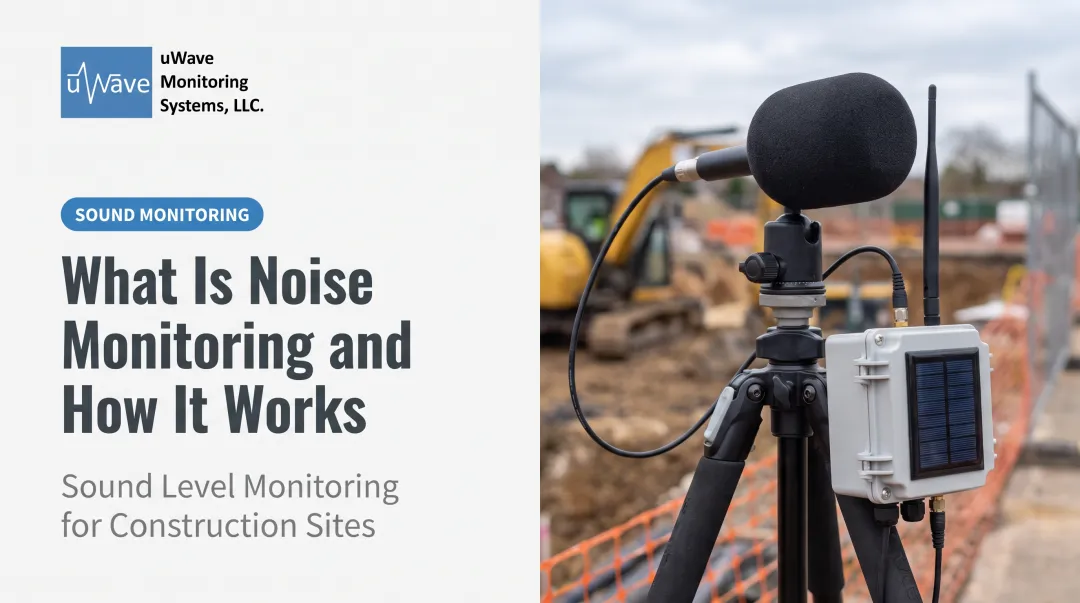
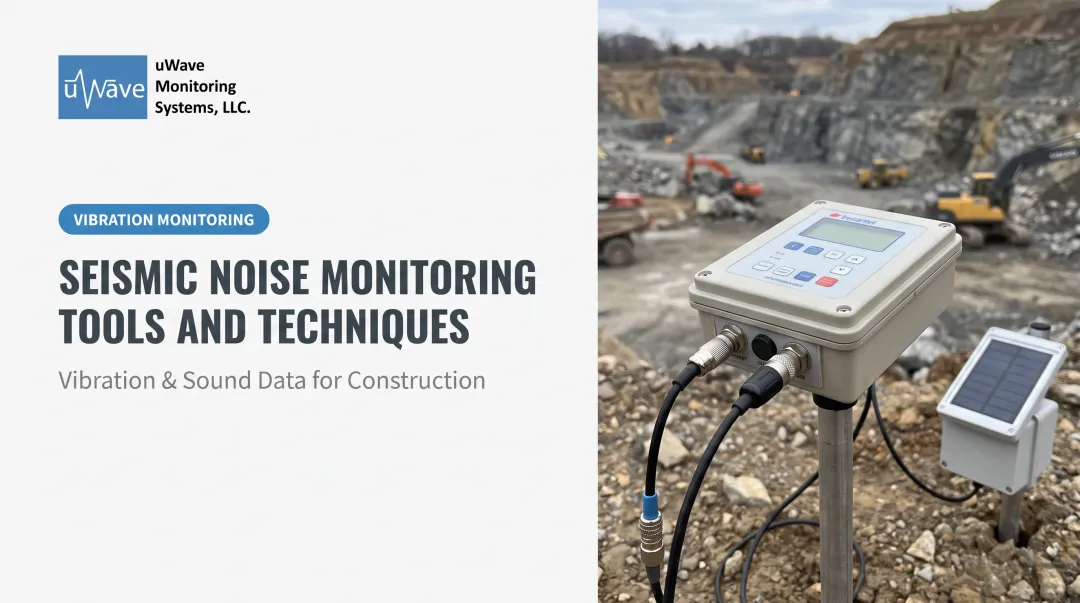
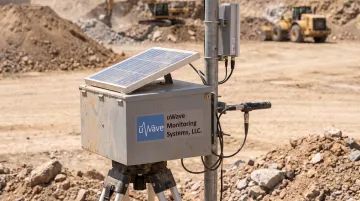
Weatherproof, field-deployed units that log and wirelessly transmit sound (and often vibration) data around the clock. uWave Monitoring Systems builds Field-to-Cloud remote monitoring systems specifically for construction, mining, quarrying, and infrastructure projects needing long-term perimeter coverage.
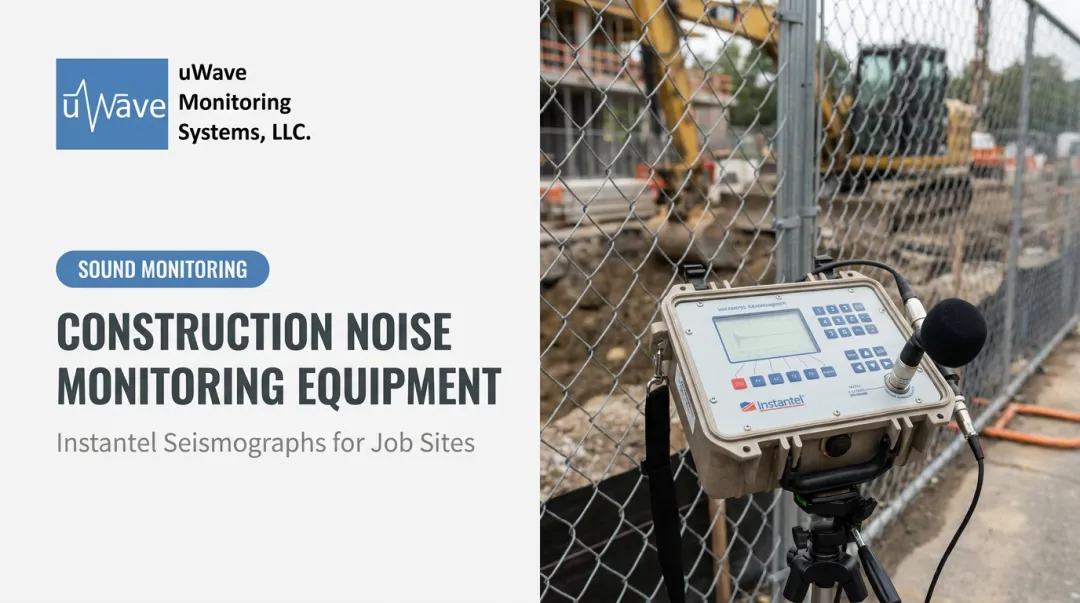
Common Instantel instruments and station setups used in these deployments include:
- Instantel Micromate: Pairs with a linear microphone (2–250 Hz, 88–148 dB range) or a Type 1 Sound Level Meter add-on for precision sound monitoring.
- MinimatePRO4: Supports simultaneous sound and vibration channels for combined monitoring.
- Blastmate III: Handles peak-only sound monitoring from 50–110 dB(A), suited to blast-focused applications.
- V3/V5 stations: Run on a 30-watt solar module with battery backup and a cellular gateway for extended unattended deployments.
Choosing the Right Monitoring Approach for Your Project
Start with the regulatory driver. An OSHA hearing conservation program calls for dosimetry. A municipal noise ordinance calls for perimeter monitoring. Some projects need both.
Ask these four questions:
- What's driving the requirement? OSHA compliance, a permit condition, or a community complaint?
- How long is the project? A single-shift survey won't cut it for a six-month tunnel bore.
- Are workers mobile or stationary? Mobile crews need dosimeters; fixed sources suit area meters.
- Do you need unattended, remote access? Multi-week or multi-site programs benefit from telemetry.
Equipment strategy usually comes down to duration and volume:
- Buying suits contractors running ongoing, multi-project programs
- Renting fits short-term or variable-duration jobs
uWave offers both paths. A complete Micromate runs $5,250 to purchase, while rental and managed monitoring services cover shorter engagements without the capital outlay.
Many contractors layer techniques together: an initial SLM survey to scope the problem, then continuous monitoring or dosimetry once the compliance record actually matters.
Why Remote & Cloud-Based Monitoring Is Transforming Construction and Infrastructure Noise Programs
Manual, periodic checks are giving way to continuous, cloud-hosted monitoring. Stricter municipal noise ordinances and rising community-complaint risk on urban development, transit, and water infrastructure projects are driving the shift.
Automated alerting is the biggest practical change. Instead of discovering a threshold violation days later during a manual review, systems like uWave's email/text alert function notify project teams the moment sound or vibration exceeds a preset limit. Teams can act before a violation escalates into a fine or a complaint.
Cloud data hosting adds concrete operational benefits:
- 24/7 remote project access for stakeholders, regulators, and community liaisons
- Secure data backup, removing reliance on a single field device
- Maintenance alerts covering power, voltage, temperature, and connectivity, so failing equipment gets flagged before it goes dark
- Customized reporting that simplifies handing documentation to agencies or clients
This model scales well for multi-site programs. Running remote stations across several project locations becomes more cost-effective with bulk-monitoring and multi-unit purchase discounts. That matters for contractors managing noise compliance across a portfolio of active sites, not just one.
Best Practices for Accurate Noise Monitoring
Good equipment doesn't guarantee good data. A few field habits make the difference between defensible records and numbers nobody trusts.
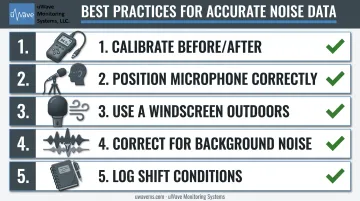
- Calibrate before and after every session — OSHA and NIOSH both require pre- and post-use checks to preserve data integrity.
- Position the microphone correctly — OSHA specifies a two-foot zone around the worker's head for SLM readings, held away from the body to avoid reflections.
- Use a windscreen outdoors — wind turbulence and dust distort readings; a windscreen protects the mic and cuts error.
- Correct for background noise — when isolating a source, subtract ambient levels so the reading reflects that source, not the surroundings.
- Log typical vs. atypical shift conditions — a day with unusual downtime or extra deliveries isn't representative; note it so the record isn't skewed.
Frequently Asked Questions
What is noise monitoring?
Noise monitoring is the measurement and recording of sound levels on or around a job site. It supports regulatory compliance, protects worker hearing, and helps manage community noise complaints near active construction and infrastructure work.
What is the difference between a sound level meter and a noise dosimeter?
A sound level meter is a handheld device used to measure noise at a specific location or source, typically during a walk-through survey. A dosimeter is worn by an individual worker to track personal cumulative exposure across a full shift.
How long should noise monitoring be conducted on a job site?
Duration depends on the regulatory requirement, project length, and how variable the noise is. It can range from a single-shift attended survey to continuous monitoring running for weeks on a long-duration project.
What are the regulatory noise exposure limits employers must follow?
OSHA sets a 90 dBA permissible exposure limit as an 8-hour time-weighted average, with a hearing conservation trigger at 85 dBA. NIOSH recommends a stricter 85 dBA limit. Local jurisdictions may impose additional, more stringent limits.
Can noise monitoring equipment be operated remotely without a technician on-site?
Yes. Cloud-connected remote stations, like uWave's Field-to-Cloud systems, log and transmit sound and vibration data unattended, sending automated email or text alerts the moment a threshold is exceeded.
Is it better to rent or buy noise monitoring equipment for a project?
Renting suits short-term or one-off projects where equipment access matters more than ownership. Buying suits long-term, multi-project programs, especially when multiple-unit purchase discounts reduce the per-unit cost.