
Many teams treat noise as an afterthought until a complaint lands on a project manager's desk or an inspector asks for exposure records that don't exist. Without accurate measurement, that gap gets expensive fast: citations, retrofits, contested claims, and schedule delays.
This guide covers the fundamentals: how decibels actually work, which instruments measure what, the regulatory limits that matter most, and how field-to-cloud remote monitoring has changed the compliance conversation for crews working near sensitive boundaries.
Key Takeaways
- Decibels are logarithmic; A-weighting (dBA) matches how the human ear hears sound, not raw pressure.
- Sound level meters, dosimeters, and integrating meters answer different compliance questions—wrong tool, data gaps.
- OSHA's 90 dBA limit and NIOSH's 85 dBA recommendation use different exchange rates for dose.
- Field-to-cloud monitoring cuts site visits and sends real-time alerts before levels hit thresholds.
Understanding Decibels and Sound Measurement Basics
The Decibel Scale Explained
Sound levels are measured in decibels (dB), and that scale is logarithmic rather than linear. You can't add two readings together the way you'd add feet or pounds: two equal 90 dB sources sitting side by side combine to roughly 93 dB, not 180 dB.
The OSHA Technical Manual defines 0 dB using a reference sound pressure of 20 micropascals at 1,000 Hz, representing the threshold of human hearing rather than silence. A 10 dB increase equals a tenfold increase in sound intensity, based on the formula dB = 10 log10(I/I0). That intensity jump does not mean the sound feels ten times louder to your ear.
Perceived loudness also depends on frequency. Measured in hertz (Hz), frequency describes pitch, and human hearing doesn't respond evenly across the spectrum. We're far more sensitive to mid-range sounds than to very low or very high pitches, which is exactly why raw dB readings can mislead on a jobsite.
A-Weighting and dBA
Because the ear isn't equally sensitive to every frequency, sound level meters apply an A-weighting filter to approximate that natural response. OSHA notes this weighting is most responsive between roughly 500 and 4,000 Hz, the range where human hearing is sharpest.
This is why regulations reference dBA instead of raw dB. NIOSH uses A-weighted levels to predict hearing risk, and OSHA's permissible exposure limit is measured on the A-scale with a slow meter response. A raw dB reading can overstate risk from low-frequency rumble the ear barely registers; dBA tracks more closely with potential hearing damage.
Putting Decibel Levels in Context
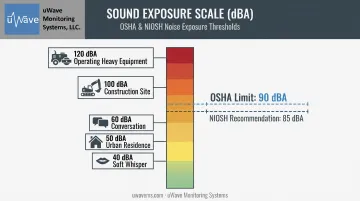
A number like "85 dBA" means little without a reference point. Here's how common sounds compare:
| Sound source | Approximate level |
|---|---|
| Soft whisper (5 ft away) | 40 dBA |
| Urban residence | 50 dBA |
| Conversation (3 ft away) | 60 dBA |
| Construction site | 100 dBA |
| Operating heavy equipment | 120 dBA |
NIOSH separately groups vacuums and power tools around 85-90 dBA, and puts bulldozers and chainsaws at an average of 95 dBA or higher.
These reference points matter onsite because they help crews distinguish normal ambient hum, like traffic on an adjacent road, from equipment noise actually pushing toward a permitted limit. Without that context, a monitoring report is just a column of numbers.
Types of Instruments Used for Noise Measurement
Sound Level Meters (SLMs)
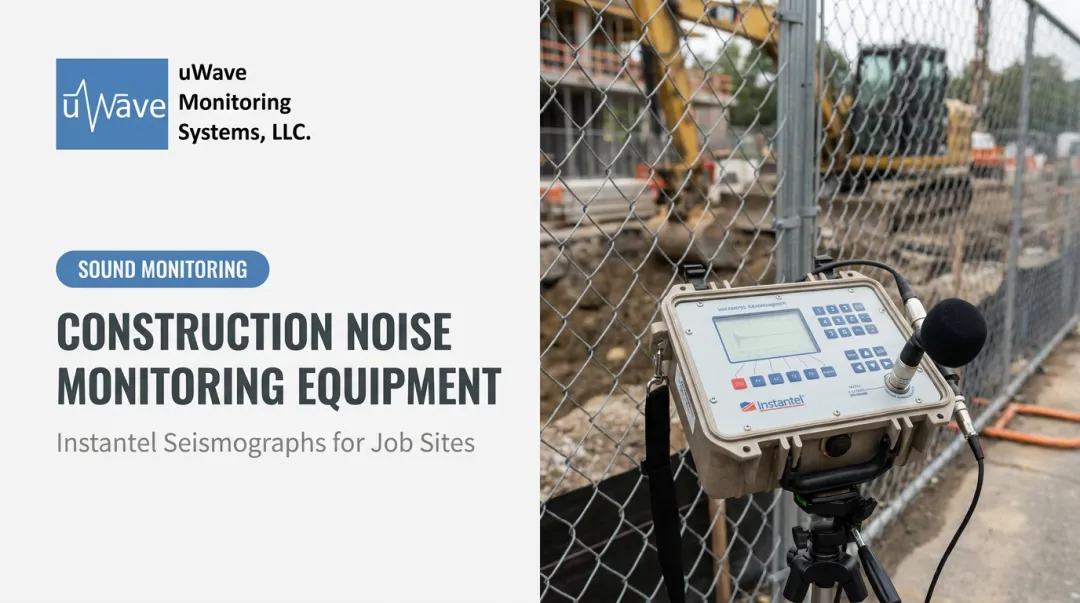
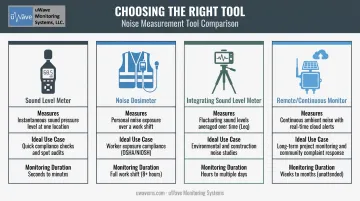
A handheld SLM captures an instantaneous reading at a single point in time, the noise equivalent of a snapshot rather than a video. Technicians use them for quick spot checks: confirming a generator isn't running hot, checking a property line before a shift starts, or documenting a complaint.
IEC 61672-1 sorts these instruments into Class 1 and Class 2 accuracy categories (older documents call these Type 1 and Type 2). Class 1 meters carry tighter acceptance limits and suit lab-grade or high-stakes work, while Class 2 units are field-grade and adequate for most construction monitoring.
Calibrate before and after every session. Environmental drift and knocks in transit can throw off a reading with no visible sign of damage.
Noise Dosimeters
A dosimeter takes a different approach. Instead of measuring a location, it measures a person. Worn near the worker's ear, it logs exposure continuously through a full shift and reports it as a time-weighted average or a percentage of allowable dose.
This makes dosimeters essential for hearing conservation programs. OSHA requires employers to assess exposure once it may reach the action level, though the regulation doesn't mandate a dosimeter specifically. In practice, it's the only tool that follows a worker between a quiet trailer and a noisy excavation pit.
Integrating Sound Level Meters (ISLMs)
An integrating-averaging SLM calculates Leq, the equivalent continuous sound level, at a fixed point over a set period. Rather than a single snapshot, it captures fluctuating noise and weights louder moments more heavily, producing one number representing acoustic energy across that whole window.
ISLMs handle variable noise sources well, such as a jobsite where equipment cycles on and off. What they don't do is track an individual's personal exposure. If hearing conservation compliance for a specific worker is the goal, pair an ISLM reading with dosimetry rather than relying on one or the other.
Remote and Continuous Environmental Noise Monitors
Handheld tools work for a snapshot. They don't work for a six-month tunneling project running noise checks at three property lines, overnight, in the rain. That's where fixed, unattended monitoring stations come in.
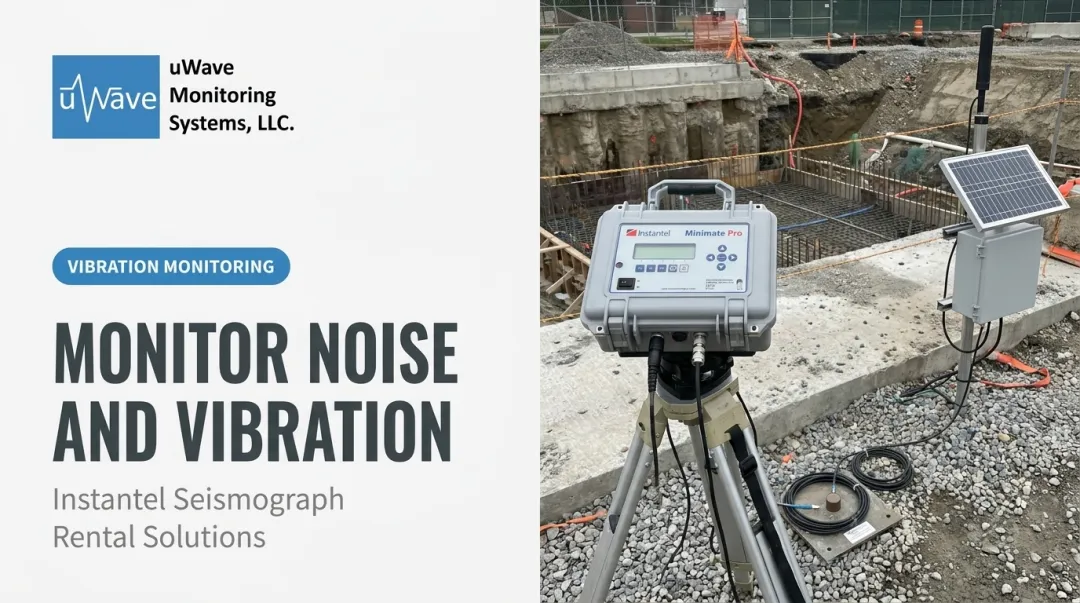
These systems stay deployed at a project boundary for weeks or months, logging data continuously and transmitting it to the cloud for review. uWave Monitoring Systems, for example, builds solar-powered enclosures around Instantel seismographs for exactly this kind of long-term outdoor deployment.
Typical station setups include:
- 30-watt solar module paired with deep-cycle batteries
- Cellular gateway connectivity instead of manual memory-card pulls
- Weather-resistant enclosures built for unattended outdoor use
- Continuous logging with cloud access for regulatory reporting
Unlike handheld tools, these stations are built for long-term boundary monitoring—not one-time spot checks.
Key Noise Metrics and Regulatory Standards
Two metrics show up in nearly every construction noise ordinance and compliance report: Leq and Lmax.
- Leq is the equivalent continuous sound level over a stated averaging period, a measure of total acoustic energy rather than a simple average.
- Lmax captures the single highest level reached during that period, useful for catching a brief spike, like a hammer strike, that an averaged number would smooth over.
Local ordinances typically specify both, tied to an averaging window. A permit might set an hourly Leq limit of 75 dBA alongside a separate Lmax cap, since a site could stay under the average while still producing peaks loud enough to draw complaints.
Worker exposure is a separate compliance track from property-line limits, with its own federal benchmarks.
Occupational Exposure Limits
| Authority | 8-hour limit | Exchange rate | Status |
|---|---|---|---|
| OSHA | 90 dBA TWA | 5 dB | Enforceable PEL |
| NIOSH | 85 dBA | 3 dB | Recommended limit |
OSHA's permissible exposure limit sits at 90 dBA as an 8-hour time-weighted average, with a 5 dB exchange rate. Exposure time must be cut in half for every 5 dB increase.
A separate 85 dBA action level triggers hearing conservation program requirements, even though it isn't the enforceable limit itself.
NIOSH recommends a stricter 85 dBA limit over an 8-hour shift, using a 3 dB exchange rate instead. That tighter rate means NIOSH's guidance treats moderate noise increases as riskier than OSHA's rule does, so a crew compliant with OSHA's PEL could still exceed NIOSH's recommendation.
Local Construction Ordinances Vary Widely
Municipalities set their own daytime and nighttime property-line limits, and they rarely match each other:
- Denver applies a general residential property-line limit of 55 dBA from 7 a.m. to 10 p.m., dropping to 50 dBA overnight.
- Portland caps commercial construction noise at 85 dBA measured 50 feet from the source, with stricter limits during evening and weekend hours.
Research your jurisdiction's specific ordinance before mobilizing. A limit that works on a project three miles away may not apply to yours.
How Remote & Continuous Noise Monitoring Works for Construction and Infrastructure Projects
Why Continuous Monitoring Matters for Compliance
Blasting, pile driving, and demolition don't produce steady noise. They produce spikes, and spikes are exactly what a once-a-week spot check misses. A technician who happens to measure between blasts walks away with a compliant-looking reading that tells you nothing about the event a neighbor called to complain about.
Continuous monitoring closes that gap. It creates a timestamped, defensible record covering every hour of activity, which matters if a complaint turns into a dispute, a fine, or litigation months later.
Components of a Field-to-Cloud Monitoring System
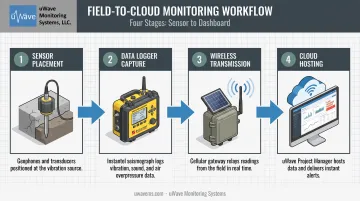
A typical setup follows four steps:
- Sensor placement - A microphone and, where vibration is also required, a geophone are positioned at the monitoring location, secured with ground spikes or anchor screws and pointed toward the source.
- Data logger capture - An Instantel seismograph, like the Micromate, records the event. These units support four channels (three for vibration, one for sound or air overpressure) and store thousands of events before needing to be cleared.
- Wireless transmission - A cellular gateway, such as the Sierra Wireless AirLink RV55 that uWave recommends for Instantel equipment, sends captured data to the cloud, typically once or twice daily.
- Cloud hosting - The data lands in a web-based platform, such as uWave's Project Manager, for review anytime from any device.
Automated Alerts and Reporting
The real value shows up between measurements. Threshold-based email and text alerts notify a project manager the moment noise approaches or crosses a set limit, so the team can act before a violation—not after—by rescheduling a noisy task, repositioning equipment, or notifying a neighbor.
Those alerts and reports ship with field-to-cloud rental and purchase packages from uWave Monitoring Systems. Built on Instantel seismographs, the packages combine cloud-hosted data, automated alerts, and compliance reports tailored for heavy construction, mining, quarrying, and infrastructure work.
For blasting or pile driving, combined vibration-and-sound units—Micromate, Minimate Pro4/Pro6, and Blastmate III—capture both metrics in one instrument. That cuts equipment needs and yields one compliance record instead of two disconnected data sets.
Best Practices for Accurate Noise Monitoring
Good equipment doesn't guarantee good data. A few habits separate defensible compliance records from readings nobody trusts.
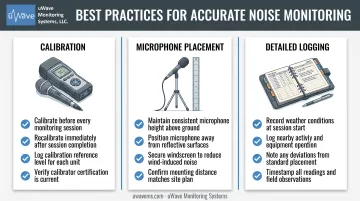
Calibrate before and after every session. Use an acoustic calibrator for field checks at the start and end of each monitoring period. A meter off by even a couple of decibels can turn a compliant reading into a violation, so document both checks. Schedule annual lab calibration as well. Instantel recommends yearly service for its seismographs and sensors.
Get microphone placement right:
- Position the microphone at the height specified for your application, typically ear height for occupational readings.
- Keep consistent distance from the noise source between readings so results stay comparable over time.
- Use a windscreen for outdoor measurements; wind noise alone can add several decibels of error.
- Apply a background noise correction when isolating equipment-specific sound from ambient site noise.
Keep detailed logs. A reading without context is hard to defend. Note these details alongside every measurement:
- Weather conditions
- Activity underway
- Nearby equipment running
- Shift or operating conditions
If a complaint surfaces later, that log turns a number into evidence.
Frequently Asked Questions
What is 70 dB equivalent to in sound?
About 70 dB is similar to steady road traffic or a nearby vacuum cleaner. It sits well below OSHA's 90 dBA occupational limit, but it can still disrupt conversation or sleep.
What's the difference between a sound level meter and a noise dosimeter?
A sound level meter measures noise at a specific location or source, useful for spot checks and boundary readings. A dosimeter is worn by an individual worker to track personal exposure over an entire shift.
How often should noise monitoring equipment be calibrated?
Most instruments need calibration before and after each use, following manufacturer guidance. Instantel, for example, recommends annual calibration for its seismographs and sound sensors in addition to session-level checks.
What decibel level is considered hazardous to hearing?
NIOSH considers noise above 85 dBA hazardous over an 8-hour shift, while OSHA's enforceable limit sits at 90 dBA TWA. The two use different exchange rates, so NIOSH's guidance is the more conservative standard.
Do construction sites need continuous noise monitoring or periodic checks?
Continuous monitoring works better for variable or high-risk activities like blasting or pile driving, where spot checks can miss spikes entirely. Steady, predictable noise sources may be adequately covered with periodic checks.
Can one system monitor both vibration and noise simultaneously?
Yes. Combined units, such as the Instantel Micromate or Minimate Pro4 paired with a sound level microphone, capture vibration and sound data together. This is especially useful for blasting, demolition, and pile-driving projects where both metrics matter.