That proximity creates a recurring problem: is a shaking floor or rattling window a genuine structural risk, or just an annoying but harmless vibration? Nobody can tell just by feeling it. That uncertainty fuels damage claims, triggers stop-work orders, and sours relationships between contractors and the communities around them.
This guide breaks down what causes building vibration, how it's classified, the standards used to judge risk, and how a proper monitoring program protects both the structure and the project schedule.
Key Takeaways
- Human perception of vibration occurs at levels far below any structural damage threshold, which is why complaints often outpace actual risk.
- Peak Particle Velocity (PPV), measured in inches per second, is the industry-standard metric for judging structural risk.
- Continuous vibration sources like vibratory compaction carry higher resonance-driven damage potential than short transient events.
- Safe vibration limits shift based on structure age, construction type, and soil conditions — there's no single universal number.
- A pre-construction baseline survey combined with real-time remote monitoring is the strongest defense against disputed damage claims.
What Causes Building Vibrations?
Building vibration comes from two broad directions: outside the structure and inside it.
External sources dominate on active job sites. Caltrans identifies these primary construction-related contributors:
- Excavation
- Static and vibratory compaction
- Tracked vehicle movement
- Pile driving (impact and vibratory)
- Blasting, drop balls, and pavement breakers
Highway and rail traffic add to the mix, though heavy trucks generate roughly five to ten times the vibration of a passing car.
Internal sources originate from within the building itself:
- Rooftop or floor-mounted HVAC units
- Elevator machinery
- Reciprocating or rotating mechanical equipment
These are less about ground motion and more about floor response. The concern grows when equipment sits on lightweight, long-span floor systems that lack the mass older concrete-and-masonry buildings used to dampen movement.
Continuous vs. Transient: Why It Matters
Not all vibration behaves the same way over time.
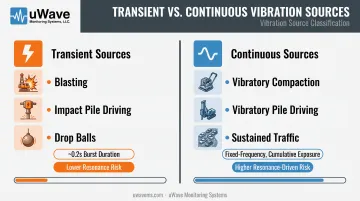
- Transient sources (blasting, impact pile driving, drop balls) deliver a single jolt or short burst. An impact pile strike typically lasts about 0.2 seconds, giving the structure time to settle before the next hit lands.
- Continuous sources (vibratory compaction, vibratory pile driving, sustained traffic) operate at a nearly fixed frequency for extended periods.
That sustained, fixed-frequency energy is what makes continuous sources riskier. If the frequency matches a building component's natural resonant frequency, motion amplifies instead of dissipating. Cumulative exposure, not any single event, drives the risk, so continuous-source limits are often set more conservatively than transient limits.
Types of Building Vibration and Their Effects
Causes matter, but so does the path vibration takes through a structure. Each path produces different consequences.
Ground-Borne vs. Structure-Borne Vibration
Ground-borne vibration starts at an external source and travels through soil as a combination of compression, shear, and Rayleigh waves before reaching a building's foundation. Rayleigh waves usually dominate at greater distances from the source.
Structure-borne vibration originates inside the building from sources such as elevator motors or rooftop mechanical units and travels through columns, floors, and walls as internal building response.
The measurement approach differs accordingly. Foundation-level PPV captures incoming ground motion, while floor acceleration or RMS velocity readings capture how that energy amplifies (or dampens) once it's inside the structure.
Effects on the Structure
Repeated vibration exposure can produce:
- Fatigue cracking in plaster, stucco, or masonry joints
- Cracks radiating from window and door corners
- Loosened mortar joints
- Differential settlement, in severe cases, from soil densification beneath foundations
Caltrans has documented minor mortar-joint damage next to a parking structure during sustained pile driving at roughly 0.30–0.35 in/sec PPV. That case is a useful reminder that damage thresholds aren't abstract numbers.
Effects on Occupants and Sensitive Operations
Here's the gap that drives most disputes: people feel vibration at levels nowhere near structural damage territory. Caltrans places continuous-vibration perception around 0.006–0.019 in/sec, with annoyance beginning near 0.10 in/sec, well below the roughly 0.20 in/sec architectural-damage-risk threshold for a typical plastered home.
Sensitive facilities complicate this further. Hospitals, laboratories, and precision manufacturing sites can experience operational disruption such as blurred MRI scans or distorted microscope readings at vibration levels the building itself would shrug off entirely.
Industry practice generally sorts consequences into three categories:
- Cosmetic damage: hairline drywall or mortar-joint cracks
- Structural damage: cracked structural elements, loosened joints, damaged columns
- Functional damage: disrupted equipment or process interference, independent of any physical damage to the building
How Building Vibration Is Measured
Judging whether vibration crosses a safety line starts with the right instrument and the right metric.
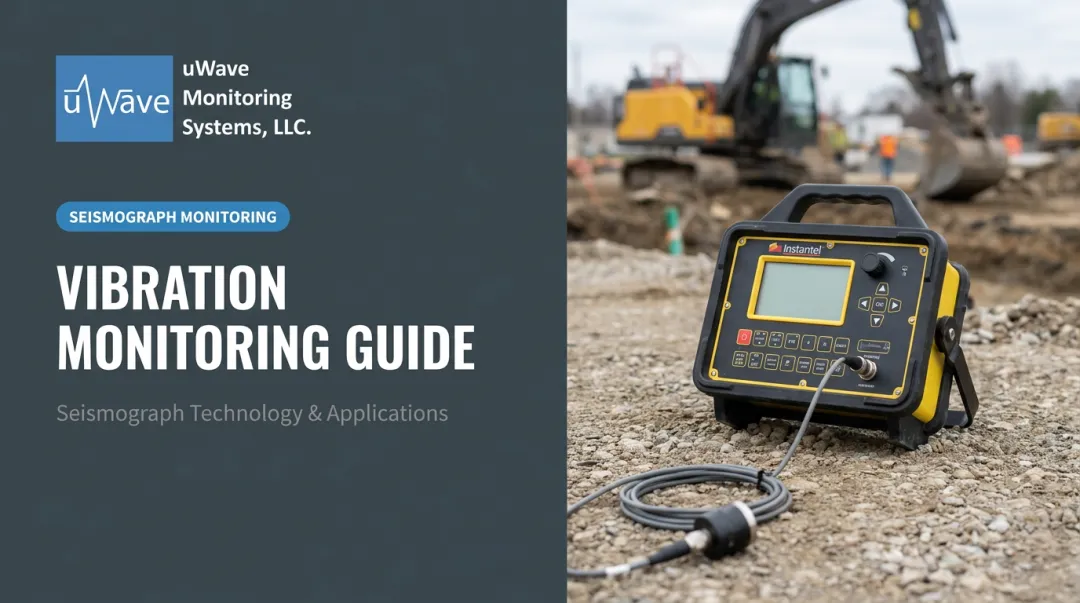
Seismographs (also called vibration monitors) record three key values simultaneously: Peak Particle Velocity (PPV), frequency, and event duration. Together, these determine whether a given vibration event exceeds an applicable limit. A single number rarely tells the whole story.
Sensors: Geophones, Accelerometers, and Vibrometers
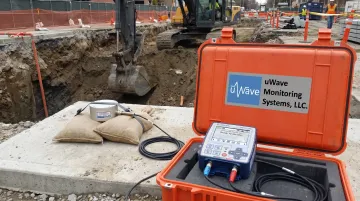
Triaxial geophones measure velocity along three axes — vertical, transverse, and longitudinal — giving a full picture of ground or structure motion. Standard installation methods include:
- Ground spike mounting in soil
- Slab or concrete anchor mounting using 3/8-inch anchors on rock or concrete
- Borehole mounting for below-grade structures
Accelerometers measure acceleration rather than velocity and cover higher frequency ranges, making them better suited to structural response and resonance analysis than geophones alone.
A vibrometer typically refers to the complete recording and analysis instrument rather than a distinct sensor type. It's the box that processes what the geophone or accelerometer picks up.
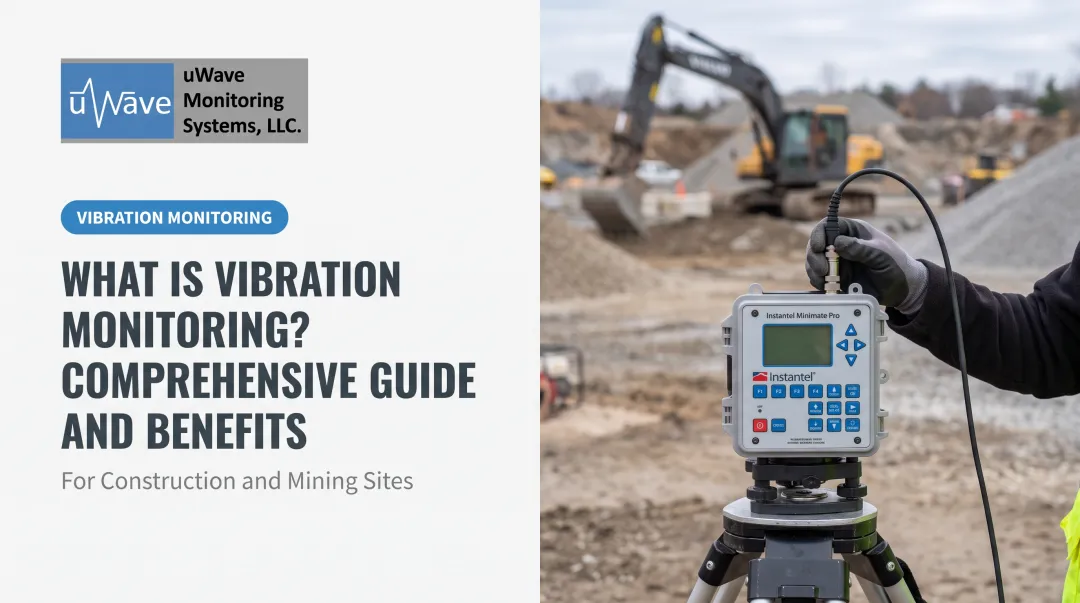
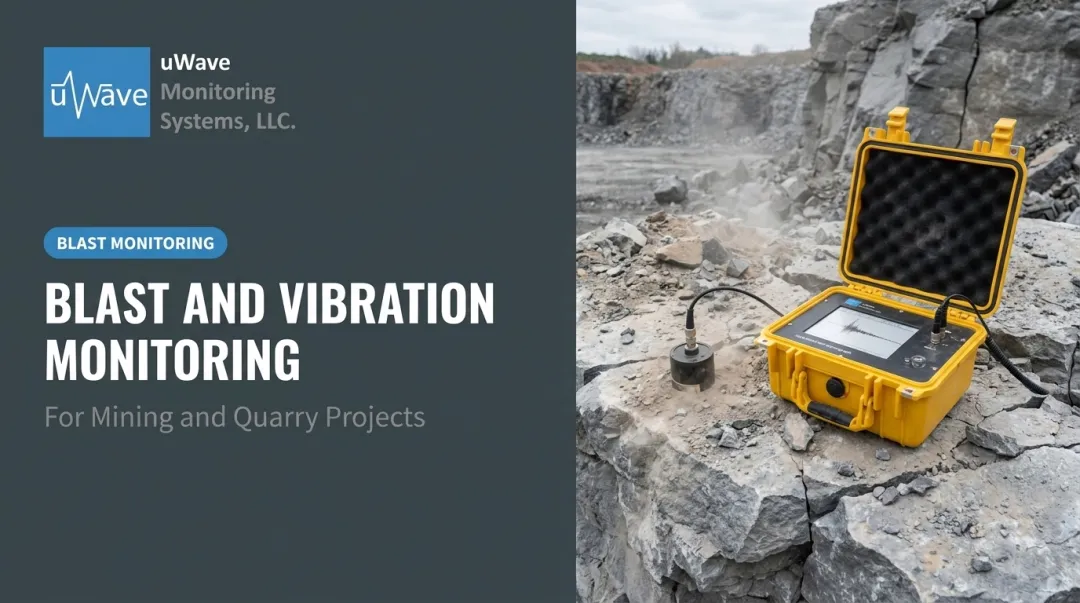
Project teams usually get these instruments from specialized dealers. uWave Monitoring Systems, an Instantel authorized dealer, handles rental, sales, and service of seismographs such as the Micromate, Minimate Pro4/Pro6, Minimate Plus, and Blastmate III. That support covers field-to-cloud data collection for heavy construction, mining, quarrying, and transit work across the US.
Turning Raw Data Into Compliance Documentation
Monitoring only matters if the data becomes usable. Two report types typically come out of a monitoring program:
- Histogram reports track long-term vibration trends across the life of a project
- Waveform event reports document threshold exceedances, with PPV, frequency, and duration for each event
Together, these give a project team both the big-picture trend and the granular evidence needed if a specific event gets questioned.
Vibration Standards and Damage Thresholds
No single number defines "safe" vibration. A handful of references still anchor most industry decisions.
The most widely cited is USBM RI 8507, a 1980 study of 76 homes and 219 production blasts. It established a frequency-dependent limit line:
- Below 40 Hz, the limit follows a peak-displacement curve up to 0.50 in/sec for plaster-on-lath and 0.75 in/sec for drywall construction
- Above 40 Hz, the recommended maximum rises to 2.0 in/sec PPV
That frequency dependence matters. The USBM RI 8507 blast vibration damage study shows lower frequencies require tighter limits because displacement, not just velocity, drives cracking risk at those ranges.
Other governing references fill in gaps RI 8507 doesn't cover:
| Reference | Primary Use | Notable Value |
|---|---|---|
| AISC Design Guide 11 | Floor vibration from human activity (offices, residences) | 0.5%g walking-vibration acceptability limit |
| FTA Report 0123 | Transit construction vibration screening | 0.50 in/sec (reinforced concrete) down to 0.12 in/sec (fragile buildings) |
| Local ordinances | Municipal vibration bylaws | Varies by jurisdiction |
The AISC Engineering Journal guidance on floor vibration applies specifically to serviceability comfort, not construction-damage risk (an important distinction that's easy to blur when reading standards side by side).
In practice, thresholds shift with structure age, construction type, soil conditions, and how sensitive the building's function is. A century-old brick building near a subway extension needs a tighter limit than a modern steel-frame office.
Building an Effective Vibration Monitoring Program
A defensible monitoring program follows a predict-protect-manage framework rather than reacting after complaints start rolling in.
Predict:
Conduct a pre-construction vibration study to define the Zone of Influence, the area where vibration is likely to be perceptible or potentially damaging. Identify sensitive receptors within that zone, including historic structures and vibration-sensitive facilities.
Protect:
Complete a pre-construction condition survey documenting existing cracks with photos, video, and written notes. Establish background (ambient) vibration levels before work begins.
That last point gets overlooked constantly. If a trigger threshold is set below normal ambient conditions (say, from nearby traffic), the system generates false alarms and unnecessary stop-work interruptions before construction even starts.
Manage:
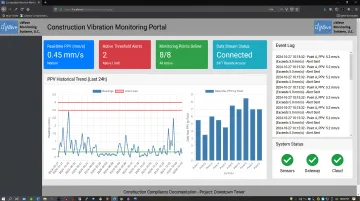
Active monitoring throughout construction is where remote, automated systems earn their value. Rather than someone walking a site to manually pull data off a unit, cloud-connected monitoring flags threshold exceedances the moment they happen.
This is the core of what uWave's field-to-cloud rental systems are built for:
- Custom enclosure design adapted to site conditions, including solar-powered stations for locations without grid power
- 24/7 project access through the Project Manager web portal
- Email and text alerts the moment a vibration or sound threshold is crossed
- Secure, backed-up data storage that keeps historical records accessible long after the project ends
Without that kind of accessible record, disputing a claim becomes a matter of memory and guesswork instead of documented fact.
Mitigation Strategies to Minimize Vibration Impact
Once a monitoring program flags risk, the next question is how to actually reduce vibration output at the source.
Structural and engineering controls:
- Dampers and base isolators for sensitive receiving structures
- Flexible connections between vibration-generating equipment and building frames
- Sequencing high-vibration work for lower-impact hours near sensitive facilities
Equipment and method substitutions often deliver bigger wins than structural fixes:
- Continuous flight auger (CFA) piles instead of impact-driven piles (drilled and cast in place, not hammered)
- Hand tools instead of machine-driven equipment near sensitive sites
- Fresh resilient pile cushions, which can cut vibration by as much as half compared to worn cushions
Communication matters as much as engineering. Many disputes come from uncertainty, not confirmed structural damage. Useful steps include:
- Community notices before high-vibration phases
- Transparent pre-construction surveys
- Post-construction follow-ups
Frequently Asked Questions
Why is my building vibrating?
Vibration typically comes from nearby construction activity, passing traffic, or a building's own mechanical systems like HVAC units or elevators. People usually feel vibration well before it poses any real structural risk.
What are the types of building vibration?
Vibration is classified as ground-borne (traveling through soil from an outside source) or structure-borne (originating inside the building). Timing splits further into continuous sources like compaction and transient sources like blasting.
How much vibration is safe for a building?
Safe limits are typically measured in Peak Particle Velocity, with USBM RI 8507 guidance commonly cited around 0.5–0.75 in/sec for plaster and drywall construction. The exact safe limit varies by structure age, construction type, and soil conditions.
What is peak particle velocity (PPV)?
PPV is the standard metric used to measure vibration intensity, expressed in inches per second in the US. It's compared against frequency-dependent damage thresholds to determine whether a specific vibration event poses structural risk.
How long should vibration monitoring continue during a project?
Monitoring typically runs from pre-demolition or excavation through compaction and finishing work, especially near sensitive structures. Continuous coverage through every high-vibration phase provides the strongest documentation if disputes arise later.
Do I need a professional to monitor construction vibration?
Basic monitors can be self-managed for low-risk work, but professional-grade seismographs and remote monitoring services provide far more reliable compliance documentation. That record is critical legal protection if a damage claim is ever filed.