As projects push closer to urban centers and residential neighborhoods, noise compliance has become as critical as vibration compliance. Community complaints can trigger stop-work orders just as fast as a missed vibration threshold. Many contractors still rely on periodic spot-checks, an approach that's quickly becoming outdated.
This article covers five major trends shaping acoustic monitoring in 2026, the forces driving them, their real-world impact, and what to watch for next.
Key Takeaways
- Continuous cloud-based monitoring now replaces manual spot-checks as the compliance standard
- AI-driven analytics and automated alerts cut response time to noise exceedances
- Acoustic and vibration data now merge into single compliance reports
- Wireless, portable sensor networks scale coverage across multi-phase projects
- Tighter local ordinances raise the baseline requirement for every project type
Key Trends Shaping Acoustic Noise Monitoring in 2026
Five shifts are defining how project teams measure and manage sound in 2026. Each one connects to a broader push for real-time data, automation, and regulatory transparency.
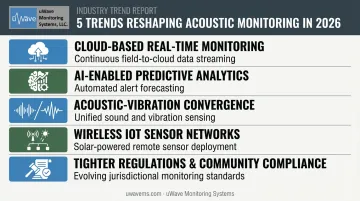
Cloud-Based, Real-Time Remote Monitoring Goes Mainstream
Manual, periodic sound level meter readings are giving way to continuous field-to-cloud systems. These setups stream data around the clock to web-based dashboards, no site visit required.
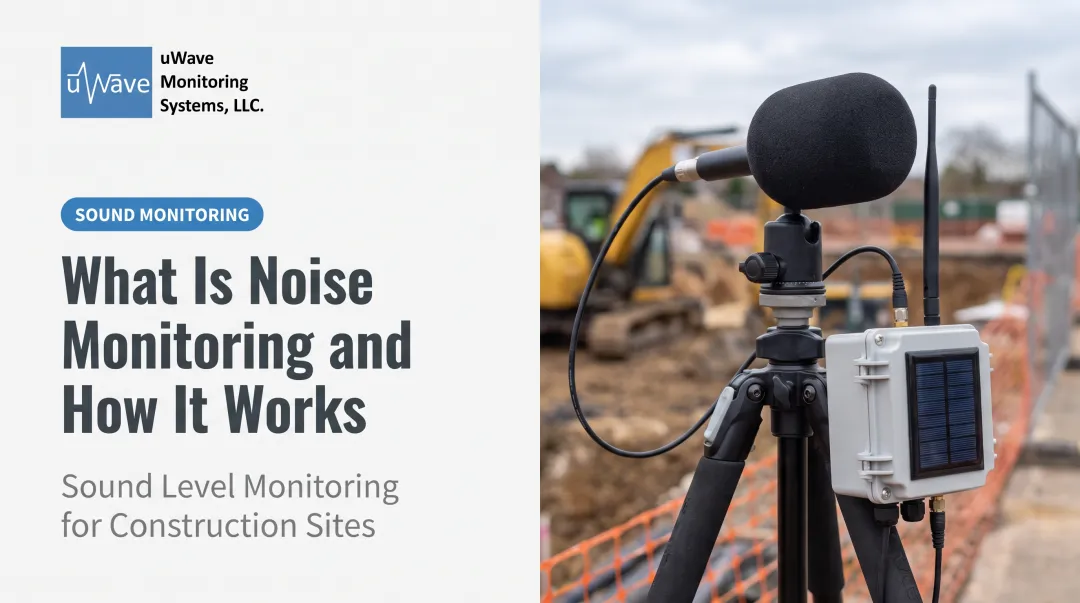
A typical deployment looks like this: unattended acoustic monitors sit at a construction perimeter or quarry boundary, automatically uploading readings so both project teams and regulators can access reports remotely. uWave's Field-to-Cloud systems work exactly this way, pairing solar-powered V3 and V5 monitoring stations with the uWave Project Manager portal for 24/7 remote project access.
New York City's construction noise rule, effective April 21, 2026, illustrates why this shift matters. Projects with at least 200,000 sq ft of gross floor area within 50 feet of a residential receptor, running after-hours work for 30 days or more, must deploy outdoor monitors facing the nearest sensitive receptor.
These projects must also collect data continuously throughout construction (NYC DEP, 2026). Rules like this turn cloud connectivity into a practical compliance requirement.
Urban infill projects near sensitive receptors are pushing this shift industry-wide. Contractors that already have remote systems in place simply meet the requirement; those still using clipboards and handheld meters are scrambling to catch up.
AI-Enabled Predictive Analytics and Automated Alerting
Manual review of continuous data streams doesn't scale. A single monitor generating readings every minute produces more data in a week than most field teams can reasonably review by eye.
That's why AI and machine learning are being layered onto acoustic data streams to detect abnormal patterns, filter background noise like wind gusts, and flag genuine exceedances. Instead of waiting for a weekly report, site managers get notified the moment a threshold is crossed.
uWave's Email and Text Alert System delivers this in practice. When a monitoring threshold is exceeded, the system sends real-time notifications directly to site managers and compliance officers, without anyone needing to be physically present. Maintenance Alerts round out the picture, flagging equipment servicing needs before a monitoring gap occurs.
The broader industrial market backs this trajectory: predictive maintenance is projected to grow from $13.89 billion in 2026 to $23.79 billion by 2031, an 11.4% CAGR, with AI and machine learning posting the highest growth rate in that market at 14.0% (MarketsandMarkets, 2026).
Acoustic monitoring is following that same push toward automated, sensor-driven operations.
Convergence of Acoustic and Vibration Monitoring
Projects increasingly deploy combined seismograph-acoustic units to capture ground vibration and airborne noise from the same event, whether that's blasting, pile driving, or demolition. One unit, one report, two compliance metrics.
Consider a blast monitoring setup: a single instrument records peak particle velocity alongside decibel levels, giving regulators and communities a complete compliance record instead of two disconnected data sets. This matters because most jurisdictions and blasting standards expect both metrics together.
- The International Society of Explosive Engineers (ISEE) recommends placing the vibration sensor blast-facing and the microphone nearest the blast, with annual calibration (ISEE, 2020 field practice guidelines)
- WMATA's Northern Bus Garage project ran five perimeter noise and five vibration monitors together, checking noise against an 85 dBA limit and vibration against 0.2 to 2.0 in/sec
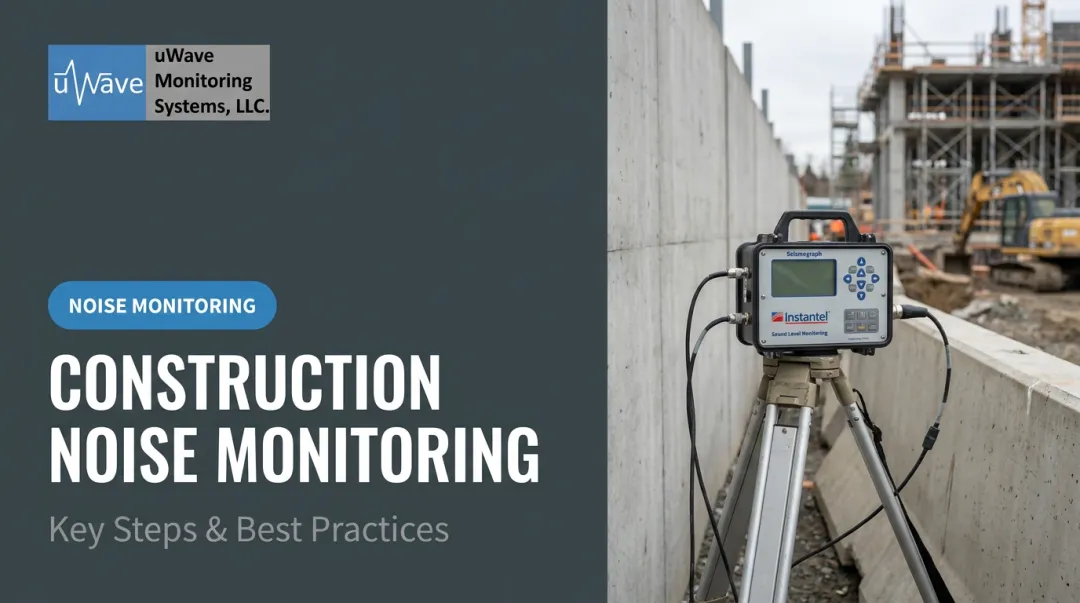
uWave supports this convergence directly. Instruments like the Instantel Micromate, Minimate Pro, and Blastmate III capture vibration, air overpressure, and sound through a single unit with up to four channels, three for a triaxial geophone and one for a microphone. That eliminates the need to deploy, calibrate, and reconcile two separate systems.
Wireless IoT Sensor Networks and Portable/Modular Stations
Battery-powered, weatherproof, wireless sensor units are replacing fixed wired installations. As a project moves through phases, the monitoring equipment moves with it.
Picture a transit corridor project: portable noise stations shift along the alignment as tunneling or utility work advances through different zones, rather than staying bolted to one spot for the entire project duration. Multi-phase infrastructure and quarry operations need exactly this kind of flexible, scalable coverage.
uWave's V3 and V5 monitoring stations are built for this. Each includes a 30-watt solar module, cellular and GNSS antennas, and a lockable enclosure, letting crews relocate a station from one zone to the next without rebuilding wired infrastructure.
Redeployment typically involves disconnecting cables, repacking in the original shipping materials, and reprogramming remotely once the unit is reinstalled.
The broader wireless sensing market supports this momentum. The global industrial wireless sensor network market was valued at $5.19 billion in 2023, with a projected 12.1% CAGR through 2030 (Grand View Research, 2024). Environmental and acoustic sensing is a growing slice of that broader industrial trend.
Tighter Regulations and Community-Driven Compliance Demands
Municipalities are tightening permissible noise limits and reporting frequency for construction near residential and urban zones, largely driven by community complaints.
The NYC rule mentioned earlier is a clear example: it requires wind- and rain-protected microphones meeting IEC 61672-1 Class 2, mounted 8 to 10 feet above ground, with continuous data collection until only minimal-noise work remains.
- Non-compliant projects must postpone covered construction activities until their mitigation plan is approved by regulators
- Existing plans become subject to the new rule upon renewal after April 21, 2026
- Affordable housing projects and emergency work carry specific exemptions
Other jurisdictions show similar patterns. Washington, DC caps weekday construction noise at 80 dB(A) Leq measured 25 feet from the site boundary during daytime hours, with nighttime residential limits dropping to just 55 dB(A). Regulators now track both noise levels and how quickly contractors respond to violations.
What's Driving These Acoustic Monitoring Trends
Four forces are pushing these five trends forward simultaneously.
- Technology advances: Sensor miniaturization, IoT connectivity, and affordable AI analytics now make continuous, cloud-hosted monitoring accessible for smaller contractors.
- Market and regulatory demand: Rapid urban and suburban development, combined with stricter noise ordinances, raises compliance requirements across nearly every project type.
- Cost and efficiency pressures: Rental and lease models, plus bulk package discounts, lower upfront costs while enabling flexible short- or long-term deployment.
- Competitive dynamics: Contractors and monitoring providers differentiate through faster reporting, automated alerts, and greater data transparency for regulators and communities.
Together, these pressures explain why cloud connectivity and AI-driven alerts moved from optional extras to expected features within just a few years. For example, uWave's rental program covers everything from single instruments to full V3/V5 station packages with discounted multi-unit pricing.
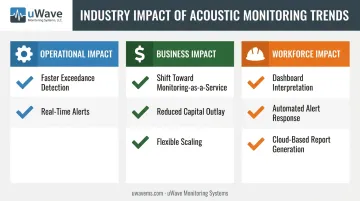
How These Trends Are Impacting the Industry
These shifts aren't abstract. They're changing how field teams operate, how companies budget, and what skills project staff need on a daily basis.
Operational impact: Continuous cloud-based data is shrinking the window between a noise exceedance and corrective action. The Crossrail C501 Moorgate Shaft project offers a working example: three real-time monitors fed a system that sent email and SMS warnings to shift teams the moment a threshold was crossed.
The system also recorded audio during high-level events and produced daily alert reports for investigating complaints. Faster detection means fewer surprises during a regulator's site visit.
Business impact: Companies are shifting spend toward monitoring-as-a-service and rental/bulk package models instead of buying and maintaining fleets of standalone meters. This lets a contractor scale coverage across multiple job sites without a large capital outlay upfront, and then scale back down once a project phase wraps.
Workforce impact: Field teams need fewer manual readings, but they need more training in a different skill set:
- Interpreting real-time dashboards instead of logging numbers by hand
- Responding correctly to automated alerts within compliance windows
- Generating and submitting compliance reports pulled from cloud platforms
- Understanding equipment maintenance flags before they become monitoring gaps
Future Signals for Acoustic Noise Monitoring Beyond 2026
Monitoring practices will keep evolving past 2026. A few early indicators are worth watching:
- ESG integration: Noise data is increasingly feeding into broader ESG and community-relations reporting platforms used by developers and municipalities, not just standalone compliance files.
- Larger shared datasets: AI models trained on bigger, industry-wide datasets should get better at distinguishing construction noise from ambient or natural sources, cutting down false alerts.
- Public dashboards as permit conditions: Standardized, real-time public noise dashboards could become a permit requirement for major infrastructure and transit projects within the next one to three years.
None of these are guaranteed, but each builds directly on the cloud, AI, and regulatory momentum already visible in 2026.
Conclusion
Cloud connectivity, AI-driven alerts, and tightening regulations are reshaping how noise is measured and managed on construction and infrastructure projects. What used to be a periodic checklist item is now a continuous, data-driven compliance function.
Early adopters of remote, integrated monitoring systems gain a measurable edge: fewer disputes and faster compliance turnaround, plus stronger relationships with the communities surrounding their sites. As these trends accelerate, partnering with an experienced remote monitoring provider like uWave Monitoring Systems will help you turn compliance data into a competitive advantage rather than just a regulatory box to check.
Frequently Asked Questions
How does acoustic monitoring work?
Microphones or acoustic sensors capture sound pressure waves and convert them into digital data. That data is then compared against baseline signatures or regulatory thresholds to flag anomalies or exceedances.
What's the difference between acoustic monitoring and vibration monitoring?
Acoustic monitoring measures airborne sound in decibels, while vibration monitoring measures ground-borne motion using peak particle velocity. Many modern systems, including Instantel seismographs, now combine both in one unit.
What equipment is used for acoustic noise monitoring on construction sites?
Common tools include sound level meters, noise dosimeters, integrating sound level meters, and remote field-to-cloud monitoring stations. Combined units like the Minimate Pro capture sound alongside vibration and air overpressure.
What noise level typically triggers regulatory action on a construction site?
Thresholds vary widely by jurisdiction and time of day. Washington, DC, for example, caps daytime construction noise at 80 dB(A) and drops residential nighttime limits to 55 dB(A), so always check local ordinances.
Can acoustic monitoring be combined with vibration monitoring on the same project?
Yes, this is increasingly common, especially for blasting and demolition work. Combined units record both metrics from a single event, simplifying compliance reporting for regulators and communities alike.
Is cloud-based remote noise monitoring reliable enough for regulatory compliance reporting?
Cloud-hosted systems with secure data backup and automated alerts meet most regulatory documentation requirements. Reliability depends on proper sensor calibration and ongoing maintenance of the monitoring equipment.