Introduction
Construction crews rarely get to choose their neighbors. A pile-driving rig might sit fifty feet from a century-old brick facade, and a quarry blast might rattle windows in a subdivision that didn't exist when the quarry first opened. Getting the vibration and sound numbers wrong here isn't just inconvenient. It invites fines, damage claims, and stop-work orders.
New York City alone logged 37,806 construction-noise complaints in 2015, up from 14,259 just five years earlier, according to the New York State Comptroller's office. That same pressure shows up in every metro area with an active building boom.
Poor measurement practices turn manageable projects into liability nightmares: sensors in the wrong spot, uncalibrated equipment, or no one watching the data in real time.
This guide breaks down the instruments, units, and field process that keep sound and vibration monitoring accurate, defensible, and useful.
Key Takeaways
- Measure ground motion and airborne noise with seismographs, accelerometers, and sound level meters
- Accuracy hinges on correct units (PPV, Hz, dB, g-force), sensor placement, and calibration
- A six-step field process turns raw readings into compliance-ready, defensible data
- Cloud-connected monitoring adds 24/7 alerts and reduces manual site visits
What Is Sound and Vibration Measurement?
Sound and vibration measurement is the process of detecting, recording, and quantifying mechanical energy moving through the ground or air, using calibrated sensors and a data acquisition system. Instead of guessing whether a blast or a piling rig is causing damage or a noise nuisance, you get a number you can defend in a compliance meeting.
Four units show up constantly in the field:
| Unit | What It Measures | Typical Format |
|---|---|---|
| Frequency | Oscillations per second | Hertz (Hz) |
| Peak Particle Velocity (PPV) | Ground vibration amplitude | in/s or mm/s |
| Acceleration | Rate of velocity change | g or m/s² |
| Sound level | Acoustic pressure, A-weighted for human hearing | dB or dBA |
Two decisions shape every monitoring plan: how long you monitor, and how you collect the data.
- Continuous or remote monitoring tracks compliance across multi-week blasting or piling programs
- Spot-check measurement delivers quick diagnostic readings for one-off complaints or troubleshooting
- Manual handheld tools stay portable and low-cost, but require someone on-site for every reading
- Automated data-logging systems run unattended, build a continuous record, and often pair with cloud access
Why Accurate Measurement Matters for Construction, Mining, and Infrastructure Projects
Skip the monitoring step, or get it wrong, and the fallout lands squarely on the contractor. A single unrecorded blast near a building with pre-existing cracks can turn into a costly damage claim with no data to refute it. Regulators don't accept "we think it was fine" as evidence.
OSHA sets an 8-hour occupational noise limit of 90 dBA under 29 CFR 1926.52. Blasting near protected structures typically falls under PPV limits set by state or federal regulators.
The federal surface-coal-mining rule caps PPV at protected dwellings between 0.75 in/s and 1.25 in/s depending on distance. Miss those numbers, even briefly, and the paperwork trail starts.
Accurate, documented measurement pays off in five ways:
- Protects nearby structures and utilities from blast- or equipment-induced damage before cracks appear
- Provides legal documentation and timestamped evidence when damage claims surface months later
- Supports safety compliance with OSHA, EPA, and local noise and vibration ordinances
- Reduces community complaints by sharing real-time data with residents and regulators
- Enables proactive adjustments to equipment, blast design, or work hours before limits are exceeded
Core Techniques and Instruments for Measuring Sound and Vibration
Field teams rely on a short list of instrument types—from handheld seismographs and sound meters to remote, cloud-connected systems—to capture vibration, noise, and air overpressure on active sites.
Vibration Seismographs and Accelerometers
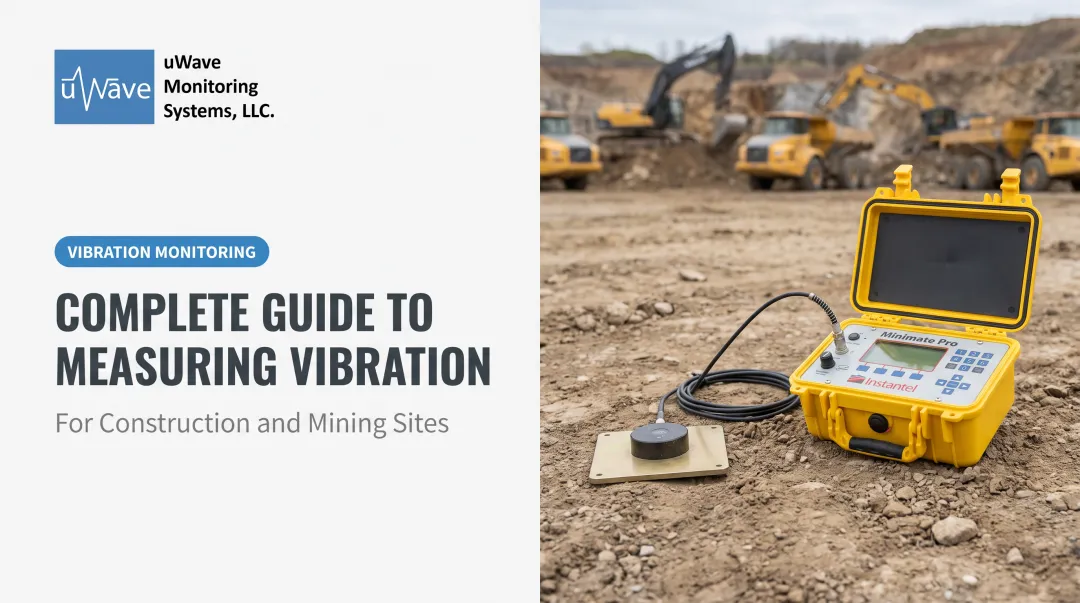
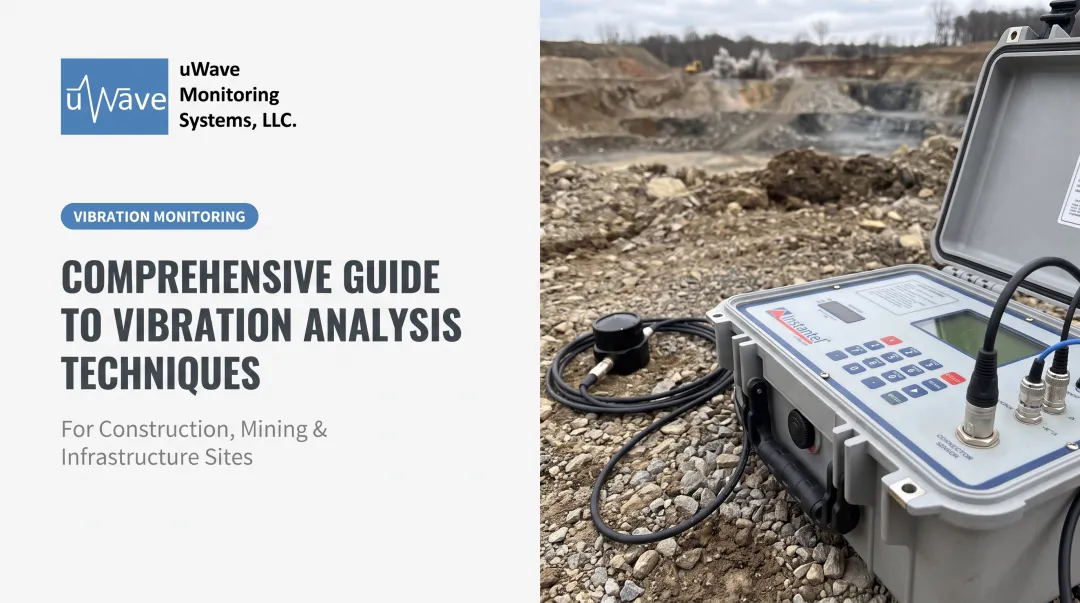
Triaxial seismographs sit at the center of most blast and construction monitoring programs. Three geophone channels capture ground motion along the longitudinal, transverse, and vertical axes simultaneously, while a fourth channel often handles air overpressure or sound.
uWave's rental and sales catalog includes the Instantel Micromate, Minimate Pro4/Pro6, and Blastmate III:
- Micromate: Four channels (triaxial geophone + microphone); ISEE geophone rated 2-250 Hz, up to 10 in/s
- Minimate Pro4/Pro6: Four or six channels; supports accelerometers, high-frequency geophones, and hydrophones (512–65,536 samples/s)
- Blastmate III: Series III blast monitor, typically paired with an ISEE geophone and linear microphone for vibration plus peak sound
Sound Level Meters
Airborne noise is measured separately from ground vibration, usually with an A-weighted microphone that filters frequencies the way human ears do. Linear field microphones commonly cover 2-250 Hz and 88-148 dB; high-pressure mics extend up to 184 dB(L) for close-range blast work.
On Micromate and Minimate Pro units, the sound channel runs with the vibration channels, so one instrument captures both streams from a single event.
Spectrum Analyzers and FFT-Based Analysis
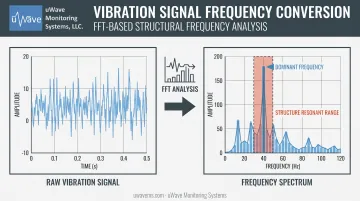
Raw waveforms show how strong a vibration was, not which frequencies drove it. Fast Fourier Transform (FFT) analysis converts the time-domain signal into a frequency spectrum so you can see what dominates.
That breakdown matters because structures respond differently by frequency. A building's resonant range can amplify motion even when overall PPV looks modest. Narrowband spectra help pinpoint the offending frequency and guide mitigation—adjusting blast timing or equipment standoff distance, for example.
Remote and Cloud-Based Continuous Monitoring Systems
Field-to-cloud systems eliminate the need to drive out and manually download data after every event. A cellular gateway, commonly a Sierra Wireless AirLink unit, sends recorded data to cloud hosting where teams review readings, pull reports, and get email or text alerts without a site visit.
Common mistakes to avoid:
- Setting sample rates too low for the expected frequency content, which clips or distorts fast events
- Skipping calibration schedules, leaving readings that won't hold up if challenged later
- Mismatching instrument range to the job, such as using a low-range geophone near a heavy blast
How Sound and Vibration Measurement Works – Step by Step
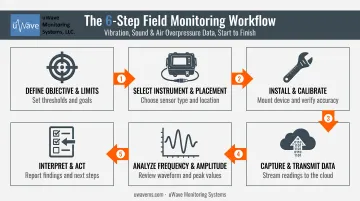
This is the practical field process, and it's where most teams cut corners.
Define the monitoring objective and compliance limits. Identify the PPV or dB threshold from the permit, regulator, or contract, and name the exact structure or receptor being protected. Without this, nothing else has a target to measure against.
Select the right instrument and sensor placement. Match sensor type (geophone, microphone, or both), range, and sample rate to the expected vibration or air-overpressure source. ISEE field practice guidelines recommend placing blast sensors within 10 feet of the structure, or less than 10% of the blast distance, whichever is less.
Install, mount, and calibrate equipment. Couple the geophone firmly to the ground or structure by spiking, burying, or bolting as conditions require. Confirm the calibration certificate is current, ideally within the past year.
Capture and transmit data. Log continuously through the event and, where cellular coverage allows, transmit via field-to-cloud connectivity so the team can see readings without waiting for a site visit.
Analyze frequency and amplitude. Run fast Fourier transform (FFT) and amplitude analysis to pull PPV, dB, and dominant frequency from the raw waveform. The peak number alone won't tell you whether a structure is at risk; the frequency content will.
Interpret results against thresholds and act. Compare readings to the compliance limit set in step one. If an alert fires, adjust blast design, equipment distance, or work hours before the next event.
Real-World Example: Monitoring a Construction Site Near a Sensitive Structure
Picture a mixed-use development going up next to a masonry building constructed in 1925. The permit sets a PPV limit of 0.5 in/s at the building's foundation, reflecting the lower thresholds typically recommended for older, plaster-on-lath construction.
Step 1: The team documented the compliance limit before work started: 0.5 in/s, measured at the foundation wall closest to the excavation.
Step 2: They specified a triaxial seismograph for continuous monitoring through the piling phase, with a sample rate high enough to capture short-duration impact events.
Step 3: Here's where the crew almost got it wrong. The first instinct was to mount the sensor on a nearby concrete pad, roughly 30 feet from the building, simply because it was easier to access. That placement would have measured vibration at the pad, not at the structure regulators actually cared about.
The fix: they moved the geophone to the building's foundation itself, coupled directly to concrete with anchors.
Step 4: Once repositioned, the sensor logged continuous data through a pile-driving event.
Step 5: FFT analysis of the waveform showed a peak PPV of 0.44 in/s at 22 Hz, close to the limit but compliant.
Step 6: The project team used that margin to set an operating distance for the pile rig going forward, rather than waiting for a violation to force a redesign. Because the data came from the foundation itself, the timestamped readings held up when a resident later called in a damage complaint. Vibration had stayed under threshold throughout the disputed period.
How uWave Monitoring Systems Can Help
Consistent measurement means having the right hardware, a reliable data pipeline, and someone to call when a sensor throws an error. That's the gap uWave Monitoring Systems fills for construction, mining, quarrying, water infrastructure, and transit projects across North America.
As an authorized Instantel dealer, uWave rents and sells the Micromate, Minimate Pro4/Pro6, and Blastmate III, complete with sensors, cables, and calibration certificates.
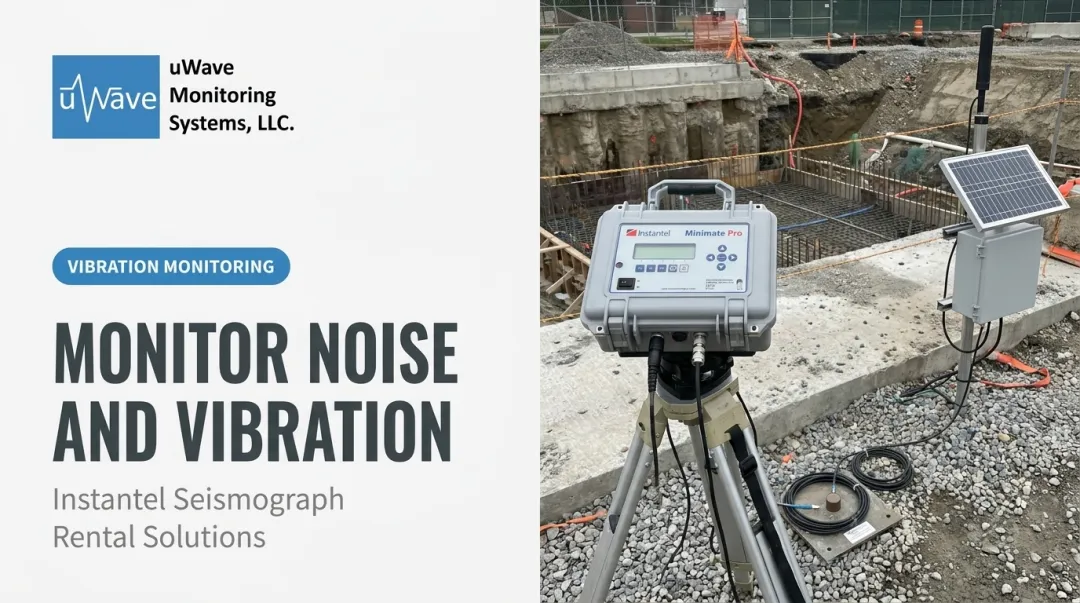
Projects that need more than a standalone seismograph can add a remote monitoring station: solar-powered enclosure, battery backup, cellular gateway, and a mount built for the site's power and connectivity constraints.
What that looks like in practice:
- Field-to-cloud systems for lease or purchase—scale from one sensor to a multi-unit network on the same platform
- Custom enclosures and remote communications consulting matched to site cellular coverage, antenna, and power needs
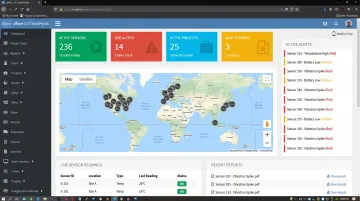
- Automated email and text alerts for vibration, sound, and maintenance issues, with 24/7 access via the uWave Project Manager portal
- Customized reporting and secure cloud backup so compliance docs are ready before a regulator or resident asks
- Bulk monitoring package discounts for multi-unit, long-duration projects
Reliable sound and vibration measurement takes the right instrument, sensor placement matched to real risk, calibration that holds up months later, and a process for reviewing data before small issues become disputes.
Frequently Asked Questions
How do you measure sound and vibration on a job site?
Seismographs with geophones, microphones, and air overpressure sensors capture PPV, sound level, frequency, and acceleration. Options range from handheld meters to continuous, cloud-connected remote monitoring systems.
How much is 1g of vibration?
One g equals the acceleration due to gravity, roughly 9.81 m/s² or 386 in/s². It is the standard reference when reporting vibration acceleration in g-force units.
What is the unit of measurement for vibration?
Ground vibration is typically measured in Peak Particle Velocity (PPV), expressed in in/s or mm/s. Acceleration uses g-force, and frequency is reported in Hertz (Hz).
How can I tell what frequency I am vibrating at?
Spectrum analysis using Fast Fourier Transform (FFT) converts the raw time-based signal into a frequency spectrum. The resulting spectrum shows which frequencies dominate the event.
How often should vibration monitoring equipment be calibrated?
Follow the manufacturer’s schedule—Instantel and ISEE both recommend annual calibration—so readings stay accurate and defensible.
What vibration level is considered safe for nearby structures?
Safe limits vary by regulation, structure age, and vibration frequency. Many jurisdictions reference PPV thresholds around 0.5-1.25 in/s, but site-specific compliance limits should always take priority.