Monitoring matters for a few concrete reasons: protecting aging structural elements from cumulative stress, satisfying regulatory thresholds before permits are even issued, keeping stakeholders informed, and avoiding disputes that can shut down a job site overnight. This article breaks down what vibration monitoring actually involves, why pier projects need it, the main techniques contractors use, and how to pick the right one for your site.
TL;DR
- Vibration monitoring tracks ground-borne vibration to protect piers and adjacent structures—and reduce dispute risk for project stakeholders.
- Undetected vibration near aging materials and public infrastructure can trigger structural harm or costly disputes.
- Three core techniques: PPV threshold monitoring, continuous remote/cloud monitoring, and frequency-domain (spectral) analysis.
- The right fit depends on structure sensitivity, project duration, and how fast stakeholders need alerts.
- Picking the wrong technique risks missed damage, false alarms, or paying for complexity you don't need.
Understanding Vibration Monitoring for Pier Construction
What Is Vibration Monitoring?
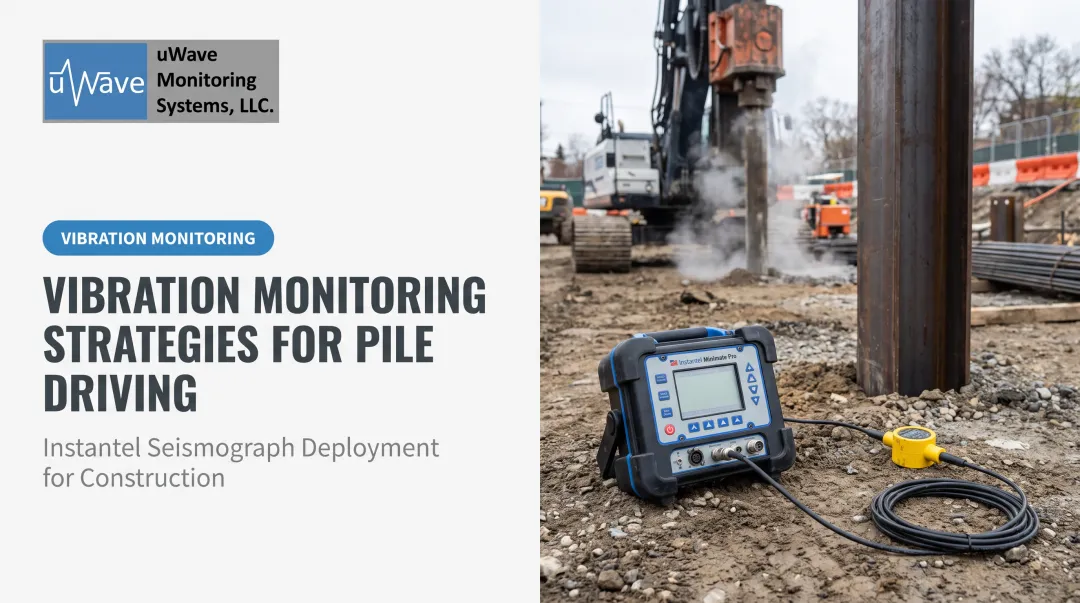
Vibration monitoring uses seismographs or accelerometers to record the velocity, frequency, and duration of ground-borne vibration produced by construction activity. On pier jobs, that typically means placing sensors near piling operations, demolition, compaction, and heavy equipment working close to marine or waterfront structures.
Triaxial sensors measure motion in three directions at once, then calculate a combined peak particle velocity (PPV) value. Contractors working near piers commonly deploy Instantel units such as the Micromate, Minimate Pro, and Blastmate III.
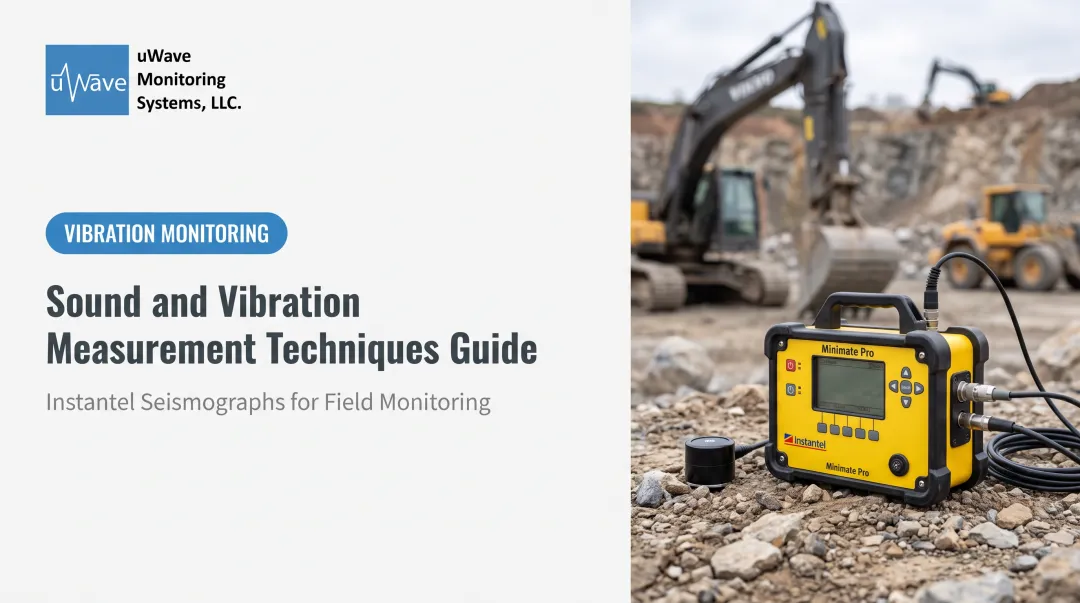
The Micromate pairs a triaxial geophone with a microphone channel for air overpressure or sound. The Minimate Pro (available in 4- and 6-channel configurations) supports sample rates from 512 to 65,536 samples per second, which is useful when a project needs both compliance data and advanced diagnostics.
Why It Matters for Pier Projects
Timber, concrete, and steel pier elements don't fail from a single vibration spike most of the time. They deteriorate through cumulative fatigue: repeated stress that weakens connections, widens cracks, or loosens fasteners over weeks of piling and compaction work.
Without monitoring, projects run into predictable problems:
- Undocumented structural stress that surfaces months later as a disputed damage claim
- Public complaints that go unresolved because there's no data to confirm or rule out construction as the cause
- Regulatory non-compliance discovered mid-project, forcing a stop-work order
- Costly delays while parties argue over what actually happened
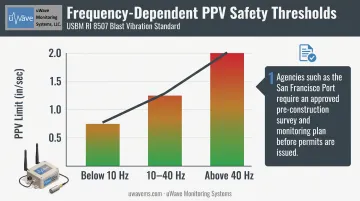
Regulatory bodies don't leave this to guesswork. The U.S. Bureau of Mines Report RI 8507 established frequency-dependent safe vibration levels, ranging from 0.5 in/sec at frequencies below 10 Hz up to 2.0 in/sec above 40 Hz, as a benchmark for structural response to blast-induced vibration.
Waterfront agencies build on standards like this. San Francisco's Port Waterfront Plan, for example, requires an approved pre-construction survey and vibration monitoring plan before a demolition or building permit can even be issued. Work must halt if monitored levels exceed the approved limit.
Types of Vibration Monitoring Techniques for Pier Construction
There's no single correct way to monitor a pier project. The right technique depends on structural sensitivity, project scale, and site conditions.
Larger jobs often combine two or three methods by risk zone. A bridge abutment might need spectral analysis while the rest of the site runs standard PPV compliance checks.
Peak Particle Velocity (PPV) Threshold Monitoring
This is the industry default. Seismographs with triaxial geophones measure peak particle velocity across three axes and compare the result against a fixed threshold, such as 0.5 in/sec.
Unlike frequency-based methods, PPV monitoring uses one overall amplitude value. It fits standard compliance work on bridges, seawalls, and piers when a regulator or permit sets a PPV limit. The FTA's Transit Noise and Vibration Impact Assessment Manual lays out damage-risk criteria by building category:
| Structure Category | PPV Limit |
|---|---|
| Reinforced concrete, steel, or timber (no plaster) | 0.5 in/sec |
| Engineered concrete and masonry (no plaster) | 0.3 in/sec |
| Non-engineered timber and masonry | 0.2 in/sec |
| Extremely vibration-susceptible structures | 0.12 in/sec |
Source: FTA Report 0123
PPV checks are widely accepted, cost-effective, and simple to deploy across multiple points on a job site. Instruments like the Micromate Plus, paired with a standard ISEE triaxial geophone (2–250 Hz range), cover most compliance scenarios without extra complexity.
The tradeoff: a single PPV number won't flag frequency-specific sensitivity. Historic timber piers or nearby sensitive equipment can respond poorly to frequencies a basic PPV check would pass right over.
Continuous Remote (Field-to-Cloud) Monitoring
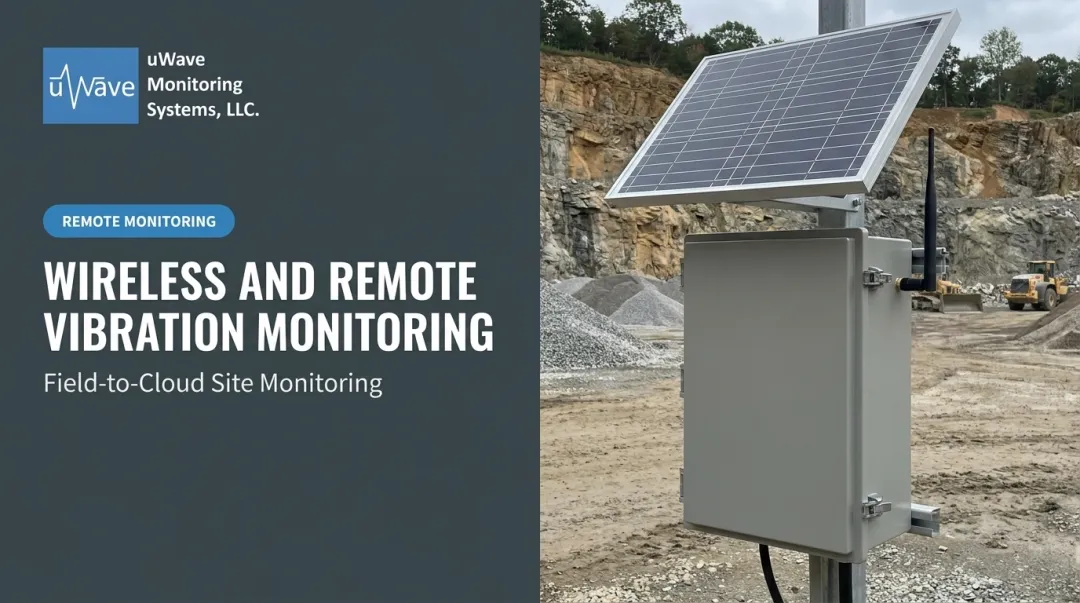
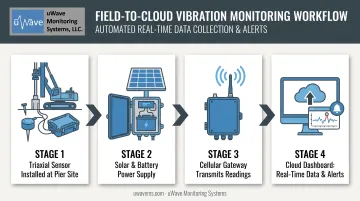
Sensors connect via cellular telemetry to a cloud platform that logs data continuously and sends automated alerts when thresholds are exceeded. uWave Monitoring Systems builds field-to-cloud rental packages for this use case: solar-powered enclosures, cellular modems, and a cloud dashboard.
What changes versus spot checks is automation and round-the-clock remote access. Nobody has to visit the site to pull a reading. That makes continuous monitoring a strong fit for long-duration, high-visibility pier or bridge projects where rapid response and stakeholder transparency matter.
Typical capabilities include:
- Real-time email and text alerts when vibration, sound, or maintenance thresholds trip
- Multi-user remote access so contractors, engineers, and agencies see the same data
- Secure cloud data backup through platforms such as uWave Project Manager, which pairs maintenance alerts with vibration and sound notifications
- Customizable reporting for regulatory submissions
Coastal and remote sites still need dependable power and connectivity: usually a solar panel, deep-cycle battery, and cellular gateway (uWave’s current recommendation is the Sierra Wireless AirLink RV55). Budget for an ongoing rental or subscription cost as well.
Frequency-Domain (Spectral) Analysis Monitoring
Instead of one peak value, spectral analysis breaks vibration into frequency bands (often one-third octave) with sensitive accelerometers. The goal is frequency content and duration, so you can identify the vibration source, not only its intensity.
Use it on piers near vibration-sensitive equipment, laboratories, or fragile historic elements that need micro-vibration analysis. Spectral plots can separate construction-generated vibration from ambient sources such as wave action, boat traffic, and pedestrian loads. The FTA specifically recommends one-third-octave charts for tracking propagation and narrowband spectra for discrete-frequency issues.
The cost of that detail is complexity. You need specialized equipment, trained interpretation, and far denser data than a basic PPV report. For simple compliance sign-off, it’s usually overkill.
How to Choose the Right Vibration Monitoring Technique
The most advanced option isn't automatically the right one. Choosing well means weighing structure sensitivity, project goals, and site constraints together.
Factors to consider:
- Regulatory and compliance goals — Basic PPV threshold vs. frequency-level detail for sensitive structural or mechanical elements
- Age, material, and condition — Timber responds differently than concrete or steel; historic elements warrant tighter scrutiny
- Project duration and scale — A two-week job doesn't need the same setup as multi-year continuous monitoring
- Site environment and accessibility — Marine and coastal sites need corrosion-aware enclosures plus stable power and connectivity
- Real-time alerts and remote access — Public-facing pier projects benefit when stakeholders can check data without waiting on a report
- Budget — Renting for a defined window is often more practical than buying, especially with Micromate or Minimate Pro available either way
A short piling job on a modern concrete pier might only need a rented Blastmate III checking PPV against a 0.3 in/sec limit. A multi-year waterfront redevelopment next to a historic timber structure is a different animal entirely. That project likely needs continuous cloud monitoring with spectral analysis at the most sensitive points.
What to Check Before Finalizing Your Vibration Monitoring Approach
A few checks before locking in your monitoring plan can save weeks of rework later.
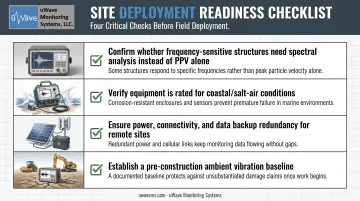
- Don't default to PPV alone if the pier or nearby structures have known frequency-specific sensitivities. A single amplitude number can miss what a spectral analysis would catch.
- Confirm equipment is rated for coastal conditions. Salt air and moisture degrade standard enclosures faster than most people expect. Discuss custom enclosure design with your provider instead of relying on a basic weather-resistant case.
- Verify power, connectivity, and data backup redundancy, especially on continuously monitored remote sites. Size solar arrays, deep-cycle batteries, and cellular gateways for the full deployment length, not best-case conditions.
- Establish a pre-construction baseline. Record ambient vibration from traffic, waves, and pedestrian activity before work begins. That baseline is the only way to separate construction readings from background noise.
Conclusion
Vibration monitoring protects a pier's structural integrity, the project timeline, regulatory standing, and relationships with the public and stakeholders watching the work.
PPV monitoring, continuous remote systems, and frequency-domain analysis each solve a different problem. Matching the right method to your structure's sensitivity and project scale is what keeps a job on track.
Pair that decision with reliable equipment, dependable connectivity, and solid reporting, and you end up with a project that's safer, better documented, and easier to defend if a dispute ever comes up.
Frequently Asked Questions
How do you measure construction vibration?
Vibration is measured using a seismograph or accelerometer placed near the source or the sensitive structure. It records peak particle velocity (PPV) and frequency data continuously during active construction.
What are some vibration monitoring devices used in construction?
Common devices include seismographs, triaxial accelerometers, and geophones. Many modern systems, like the Instantel Micromate or Minimate Pro, now include cloud connectivity for remote, real-time monitoring.
What is an acceptable vibration level for pier construction projects?
Acceptable levels vary by jurisdiction and structure type. Many projects reference USBM RI 8507 or FTA criteria, with common limits roughly 0.5–2.0 in/s PPV depending on frequency and how sensitive the structure is.
How often should vibration monitoring occur during pier construction?
Monitoring usually runs continuously during active piling, demolition, or compaction phases. Baseline monitoring should happen before work starts to establish ambient conditions for comparison.
Can continuous remote monitoring prevent damage to historic piers?
Monitoring itself doesn't stop vibration from happening. Real-time alerts do let crews pause or adjust work quickly enough to avoid cumulative or acute damage.
Do I need a permit before starting vibration monitoring near a pier?
Monitoring itself is rarely permitted separately. However, many municipal or coastal projects require documented vibration thresholds and a monitoring plan as a condition of the construction permit itself.