This scenario plays out constantly on blasting, demolition, and heavy construction sites near occupied structures. Contractors and project managers need documented, time-stamped evidence that their work stayed within safe limits, not just a good-faith assurance.
A 2021 OSMRE-commissioned conflict resolution study reviewed two residential damage complaints tied to nearby blasting. In both cases, seismograph records, blast logs, and preblast surveys showed vibration levels stayed well under state limits, resolving the disputes with data instead of guesswork.
This guide covers what vibration monitoring is, how the systems work, and why it's become standard practice for heavy construction, mining, and infrastructure projects.
Key Takeaways
- Seismographs capture ground vibration and air overpressure from blasting, pile driving, and heavy equipment
- Monitoring keeps projects within regulatory peak particle velocity (PPV) limits and creates a legal record if damage claims arise
- Cloud-connected sensors now send real-time alerts, replacing manual site visits and delayed downloads
- Documented compliance lowers liability, builds community trust, and helps avoid costly project delays
What Is Vibration Monitoring?
Vibration monitoring is the process of measuring and recording ground vibration, and often airborne overpressure, generated by blasting, pile driving, demolition, or heavy machinery working near sensitive structures. The goal is confirmation that a project stays within regulatory or contractual limits designed to protect nearby buildings, utilities, and infrastructure.
The Key Metrics: PPV, Frequency, and Air Overpressure
The industry-standard measurement is Peak Particle Velocity (PPV), expressed in inches per second. PPV captures the maximum speed at which ground particles move as a vibration wave passes through.
Two other readings complete the picture:
- Frequency (Hz) — how many times per second the ground oscillates; lower frequencies at the same PPV tend to be more damaging to structures
- Air overpressure (decibels) — the pressure wave traveling through air after a blast, capable of rattling windows even with minimal ground vibration
Federal regulation shows why all three matter together. Under 30 CFR 816.67, surface coal mining operations must keep PPV at protected structures under 1.25 in/s within 300 feet, 1.00 in/s between 301 and 5,000 feet, and 0.75 in/s beyond that, or use an approved frequency-dependent alternative.
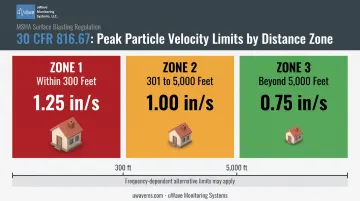
A PPV reading without frequency and distance context tells an incomplete story.
Not to Be Confused With Machine Condition Monitoring
Those metrics define construction and blasting work—but the same phrase shows up in another field entirely. In industrial settings, "vibration monitoring" means tracking vibration signatures in motors, pumps, and bearings to predict mechanical failure. That's a maintenance discipline. Construction and infrastructure vibration monitoring protects structures and people near an external vibration source.
Who relies on it:
- Heavy construction and demolition contractors working near occupied buildings
- Mining and quarrying operations running regular blast schedules
- Water infrastructure and transit agencies tunneling through dense urban corridors
- Urban and suburban developers building near existing homes and utilities
How Does a Vibration Monitoring System Work?
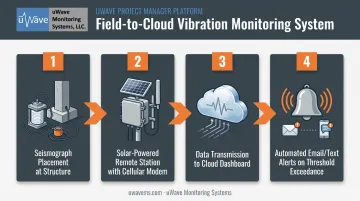
Modern vibration monitoring combines ground-based sensors, remote power and communications, and cloud software, an approach often called field-to-cloud monitoring.
Sensor Placement and Baseline Thresholds
A seismograph pairs a geophone (ground motion sensor) with a microphone (for air overpressure). Units sit at or near the structure being protected, not at the vibration source itself.
ISEE field practice guidelines call for the geophone on the blast-facing side of the structure, within 10 feet or 10% of the blast distance, whichever is less.
Before monitoring starts, teams set baseline thresholds using:
- Applicable regulations (OSMRE limits, state blasting codes, local ordinances)
- Structure sensitivity, such as historic masonry versus reinforced concrete
- Ambient background vibration recorded before work begins
From Field Sensors to Cloud Dashboard
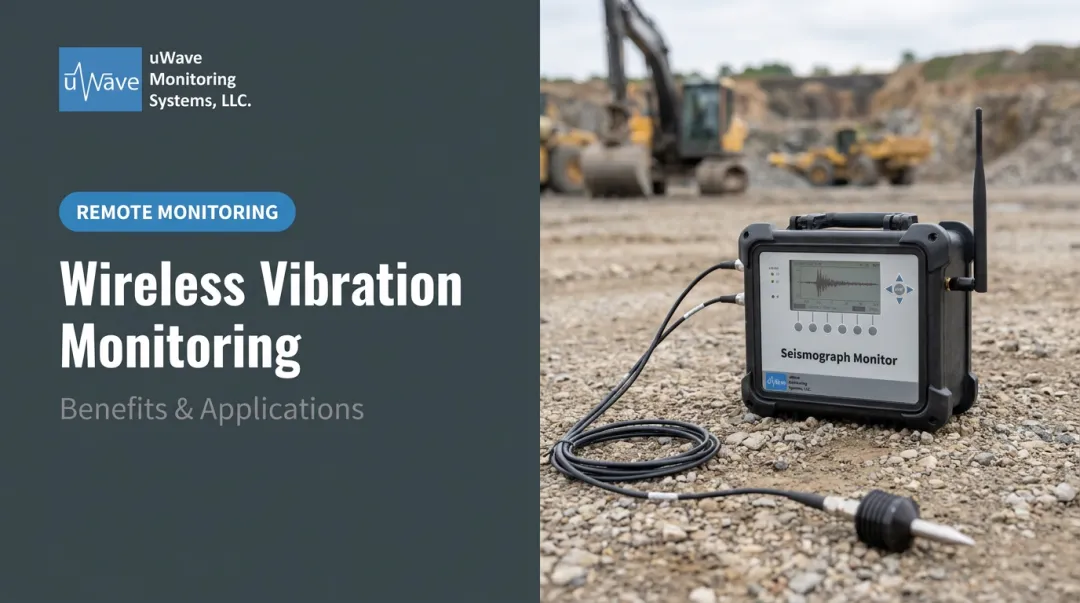
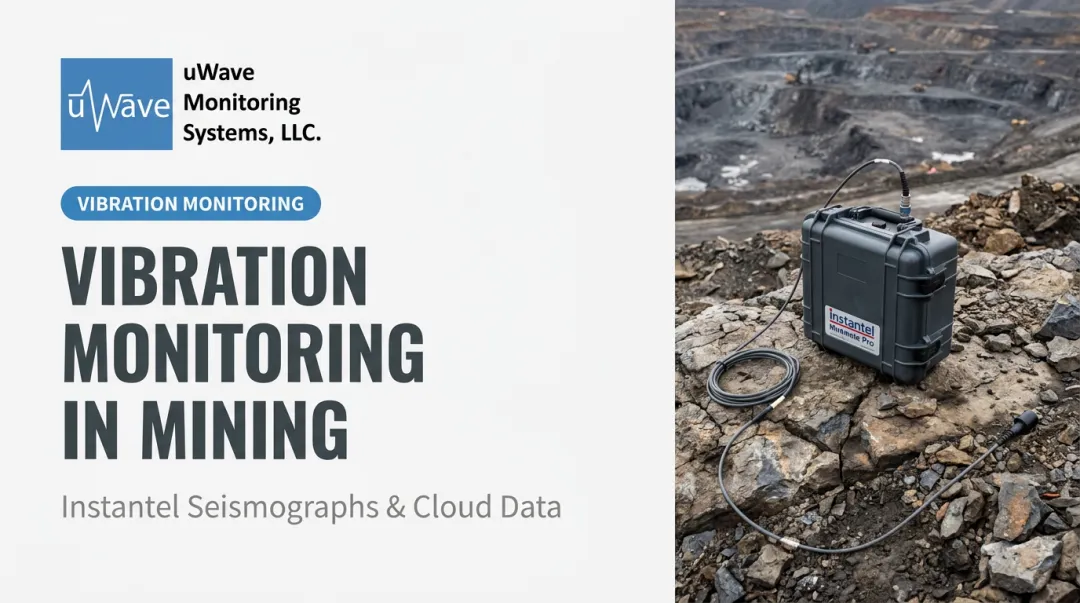
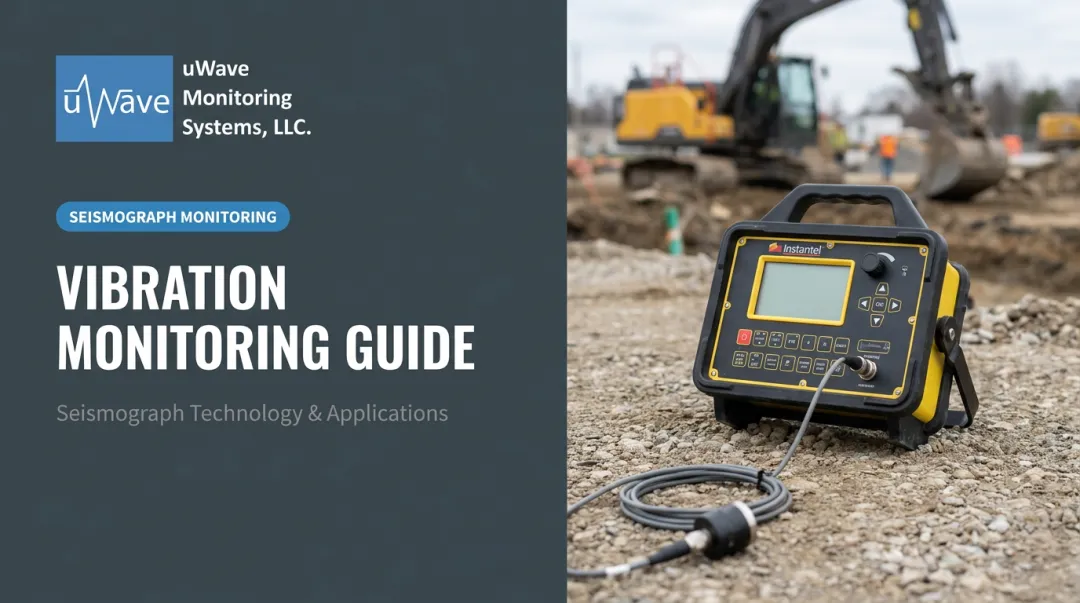
Instantel seismographs handle the actual measurement. uWave Monitoring Systems rents and sells the Micromate, Micromate Plus, Minimate Pro, Minimate Plus, and Blastmate III, matched to the job:
- Micromate / Micromate Plus — portable option for pile driving and tunnel boring
- Minimate Pro / Minimate Plus — compliance-grade, multi-sensor, long-term deployments
- Blastmate III — full-featured unit for demanding blast and construction monitoring
For unattended locations, uWave builds solar-powered remote stations. A 30-watt solar module, charge controller, deep-cycle battery, and a cellular modem transmit data straight to the cloud. Nobody has to drive out and manually pull a memory card.
That data lands in the uWave Project Manager dashboard, giving teams 24/7 remote access to:
- Live monitoring locations on a project map
- Unit and modem status
- Alert history and event logs
Automated Alerts for Fast Response
When a reading crosses a preset threshold, the system fires off an email or text alert right away. Teams do not wait for someone to spot it in a report days later. uWave's platform also issues maintenance alerts separate from vibration and sound alerts, flagging equipment issues before they create a data gap.
Event data feeds customized reports with event number, timestamp, operator, location, GPS coordinates, and waveform data. Teams can export them for compliance filings, client updates, or a damage-claim dispute.
Why Vibration Monitoring Matters: Key Benefits
Vibration monitoring earns its place in a project budget by paying for itself many times over.
- Protects structures and infrastructure. Continuous monitoring flags an exceedance the moment it happens, before a cracked foundation, damaged utility line, or stress on a historic building next door.
- Ensures regulatory compliance. Many jurisdictions require documented vibration limits for blasting, demolition, or work near occupied structures. Some cities require measurement at every detonation, and skipping it can halt a project outright.
- Reduces legal and financial liability. Time-stamped records give contractors objective proof against damage claims. In the residential complaints referenced earlier, seismograph data, preblast surveys, and inspection records settled disputes without years of litigation.
- Strengthens community relations. Nobody likes feeling like a guinea pig next to a construction site. Transparent, real-time reporting shows residents and stakeholders that someone is watching the numbers.
- Improves cost efficiency. A maintenance alert or threshold warning costs far less than a stalled project, rework, or drawn-out legal fight.
- Supports data-driven planning. Historical data helps refine blasting patterns, equipment choices, and scheduling so teams reuse what they learn project after project.
Where Vibration Monitoring Is Used
Vibration monitoring is used wherever heavy work runs close to sensitive structures, utilities, or occupied buildings.
- Heavy construction and demolition — pile driving, blasting, and heavy equipment near buildings or utilities, where excess vibration can crack foundations or damage lines
- Mining and quarrying — blast schedules that need consistent tracking of vibration and air overpressure on nearby land and structures
- Water infrastructure upgrades — tunneling and shaft construction projects that require monitoring at nearby structures during all blasting activity
- Transit projects — subway and rail tunneling in dense urban corridors, where agencies often require monitoring along the full alignment
- Urban and suburban development — housing and land work within feet of existing homes, where documented compliance builds community trust
Each sector shares a common thread: work close enough to sensitive structures that "we think it's fine" isn't an acceptable answer to a resident, a regulator, or a judge.
Choosing the Right Vibration Monitoring System
Not every project needs the same setup. A two-week demolition job has different needs than a multi-year tunnel expansion, so the right system depends on scope, budget, and how many locations need coverage.
Rental vs. Purchase
Short projects usually favor renting a Micromate or Minimate Pro for the job's duration. Long-running or repeat work often makes purchasing the better investment.
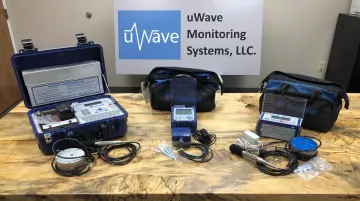
uWave offers both paths, plus discounts for bulk or multi-unit monitoring packages. New-unit pricing is available on request.
Cloud Access and Data Security
Look for a system offering:
- Web-based data hosting with 24/7 remote project access
- Automated alerts for vibration, sound, and equipment maintenance
- Secure data backup, so a damaged or stolen field unit doesn't mean losing months of records
Custom Deployment Support
Remote sites rarely fit a standard kit. uWave designs custom enclosures for different ground conditions and access constraints.
The team also provides remote communications consulting so clients can pick the right cellular hardware and configure modem-to-seismograph connections before equipment reaches the field.
A vendor who only sells equipment and leaves setup to guesswork puts more risk back on the project team. Pairing the right instrument with reliable data infrastructure matters just as much as the sensor itself.
Frequently Asked Questions
What is a vibration monitoring system?
A vibration monitoring system uses a seismograph with a geophone and microphone to measure ground vibration and air overpressure near a structure or project site. It tracks whether activity like blasting or pile driving stays within compliance limits.
How do you monitor vibration?
Technicians place sensors at key locations near the protected structure, set baseline thresholds based on regulations or structure sensitivity, and collect data continuously or periodically. Cloud-connected remote systems now handle most of this without manual site visits.
What is considered a safe level of vibration on a construction site?
Safe levels vary by regulation, structure type, and distance from the source, typically measured in Peak Particle Velocity. Federal surface-mining rules set limits between 0.75 and 1.25 in/s depending on distance, but always check local codes for exact figures.
How often should construction vibration monitoring take place?
Continuous remote monitoring is standard near occupied structures or active blasting, since it catches every event as it happens. Lower-risk projects farther from sensitive structures may use periodic monitoring instead.
What happens if vibration levels exceed the allowed limit?
Automated alerts notify the project team by email or text right away, so crews can pause or adjust activity before further exceedances occur. The documented data also supports any regulatory reporting the incident requires.
Is vibration monitoring required by law?
Many state and local regulations require vibration monitoring for blasting, demolition, or construction near occupied structures. Requirements vary by project type and jurisdiction, so checking local codes early avoids surprises.