The risks go beyond fines. Unmonitored blast vibrations can crack foundations, generate legal claims from neighboring property owners, erode community trust, and — if your documentation doesn't hold up — leave your operation legally exposed even when the actual ground motion was within limits.
That's the core problem this guide addresses. Good vibration monitoring isn't just about placing a seismograph in the field. It's about the right equipment, correct sensor setup, verified calibration, and a response protocol that's ready before the first shot fires.
Key Takeaways
- Peak Particle Velocity (PPV), measured in inches per second, is the standard metric for assessing blast vibration risk to structures
- Geophones must be oriented toward the blast source and firmly coupled to the ground — loose placement produces invalid data
- OSMRE sets enforceable distance-based PPV limits under 30 CFR 816/817; many states impose stricter thresholds
- Automated email and SMS alerts are essential for unattended quarry operations near occupied structures
- Missing air overpressure data, skipped calibration, and poor sensor placement are the costliest monitoring failures
What Is Quarry Vibration Monitoring and Why It Matters
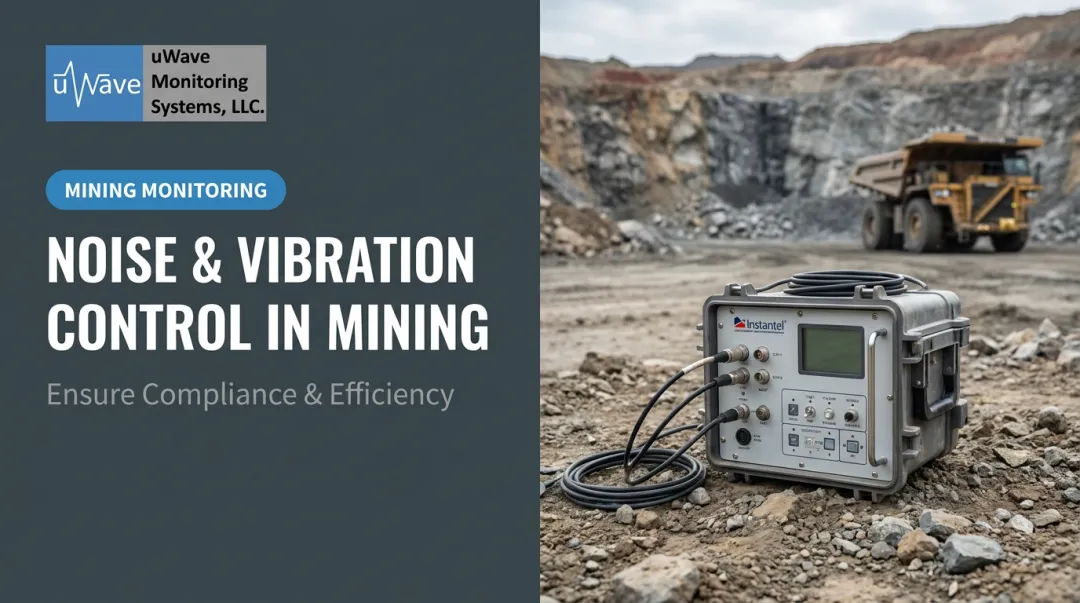
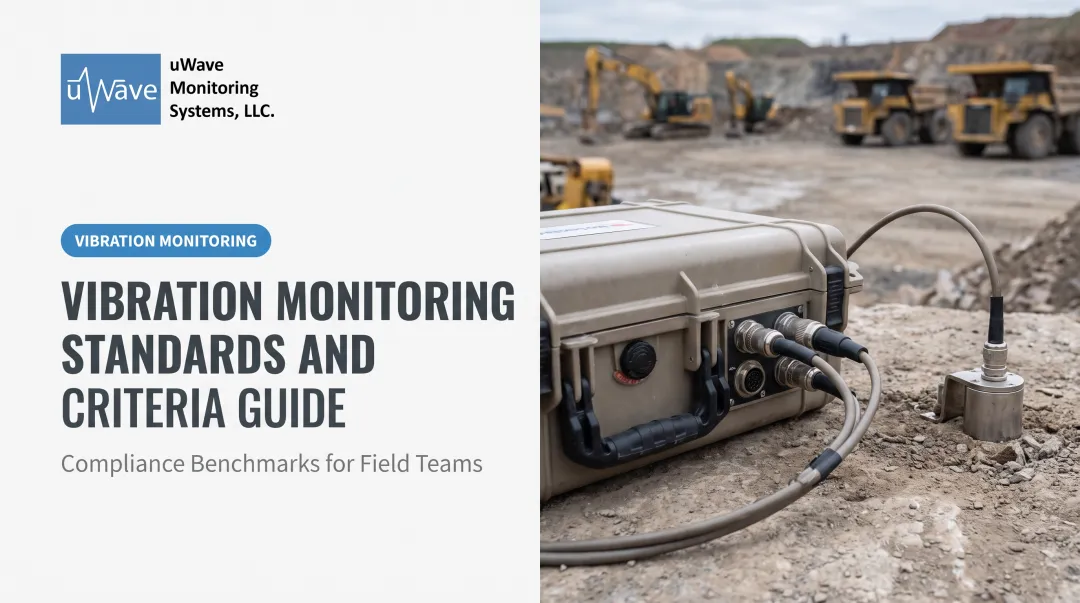
Quarry vibration monitoring is the practice of measuring ground motion and air overpressure generated by blasting, drilling, and heavy equipment using portable seismographs. Its two purposes are closely linked: demonstrating regulatory compliance and protecting nearby structures and communities from damage.
Peak Particle Velocity: The Primary Damage Metric
PPV measures the maximum speed at which a ground particle moves in response to a traveling seismic wave, expressed in inches per second (in/s). It's the standard damage-risk metric because it correlates more reliably with building response than displacement or acceleration alone. Federal OSMRE rules, state regulations, and ISEE field practice guidelines all frame blast compliance around PPV.
Why Three-Axis Measurement Matters
A seismograph with a triaxial geophone captures ground motion across three simultaneous planes:
- Transverse — side-to-side movement
- Vertical — up-and-down movement
- Longitudinal (radial) — front-to-back, toward and away from the blast source
Measuring all three axes together gives the most complete picture of vibration energy reaching a structure. A single-axis reading can miss the dominant motion direction entirely, producing data that underestimates ground motion.
Beyond Structural Damage
Even when individual blasts stay within PPV limits, repeated vibration events can drive complaints and erode community trust. OSMRE training materials specifically identify low-frequency airblast as a complaint driver even when ground vibration is fully compliant. Common sources of friction include:
- Noise complaints from residents near the blast zone
- Window-rattling reports tied to low-frequency airblast
- Cumulative loss of community goodwill after repeated events
- Legal exposure from incomplete or inconsistent documentation
Consistently documenting both PPV and air overpressure readings is what separates a defensible monitoring program from one that creates liability.
Quarry Vibration Monitoring Best Practices
An effective monitoring program operates across three stages: pre-blast planning, active monitoring, and post-blast review. Running it as a continuous program, rather than a one-time equipment deployment, is what determines whether your data holds up under regulatory review.
Pre-Blast Planning and Site Assessment
Start with a pre-blast survey. Federal OSMRE rules under 30 CFR 816.62 allow residents within one-half mile of a permit area to request a preblast survey documenting existing structure conditions. Conducting these surveys proactively — before operations begin — creates defensible "before" evidence for any future damage claim. Without that baseline, any crack or settlement found in a neighbor's foundation becomes a potential claim against your operation.
Determine monitoring locations based on these criteria:
- Nearest occupied structure in the direction of each blast
- Property boundary if required by permit conditions
- Historically sensitive structures: older masonry buildings, unreinforced concrete, buried pipelines
Account for site geology. Seismic energy attenuates differently depending on rock and soil type. Denser, harder rock transmits vibration energy farther than soft soils. OSMRE's scaled-distance framework accounts for this, and modified scaled-distance factors can be approved from seismographic records — but only when enough data exists to calculate with 95% confidence that limits won't be exceeded.
Setting Up Monitoring Equipment Correctly
With your site conditions mapped and monitoring locations identified, equipment selection and setup become the next critical step.
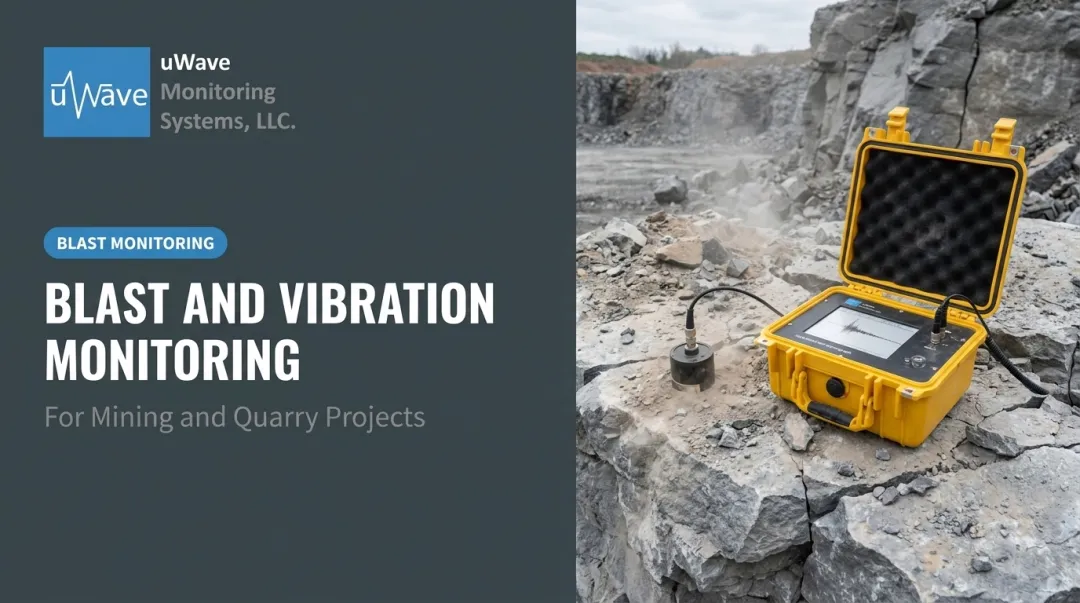
Choose the right instrument. For quarry blast monitoring, standard equipment includes a seismograph with a triaxial geophone, an air overpressure microphone, and on-board data storage. uWave Monitoring Systems rents and leases the full Instantel lineup — Micromate Plus, Micromate, Minimate Pro, Minimate Plus, and Blastmate III — all of which include triaxial geophones and support air overpressure monitoring.
For quarries with multiple simultaneous blast zones, renting several units rather than purchasing outright keeps equipment costs manageable while maintaining full coverage.
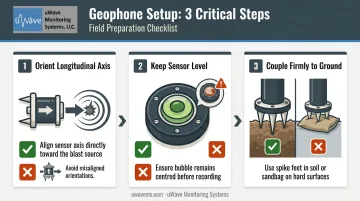
Geophone orientation and coupling — get this right:
- Orient the longitudinal axis toward the blast source — the geophone's arrow must point at the blast
- Keep the sensor level — tilt introduces cross-axis error
- Couple firmly to the ground — spike feet should be fully driven into soil until the base is flush; on hard surfaces, secure the geophone under a sandbag
An OSMRE geophone coupling study found that sandbagging alone produced a combined relative standard error of over 10%, compared to roughly 3.3% for burial. The same study found decoupling indications in 36% of blasts when non-burial methods were used. These numbers matter when your data faces regulatory review.
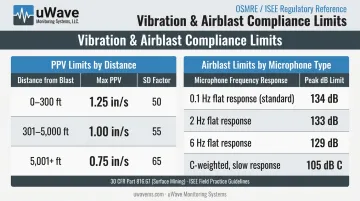
Connect the linear air overpressure microphone before every blast event. This measures airblast in peak dB — a separate compliance parameter with its own regulatory limits. Federal OSMRE limits vary by microphone frequency response (for example, 134 dB for systems with 0.1 Hz or lower flat response). Check your permit for the applicable limit and ensure the microphone is properly positioned and connected before the shot.
Monitoring During Operations and Managing Real-Time Response
Configure the seismograph before each blast:
- Set the trigger threshold below the regulatory limit so the unit captures the full event before any limit is approached
- Select the correct recording mode (Single Shot for individual blast events)
- Verify battery charge, internal clock accuracy, and calibration status
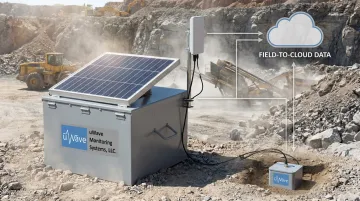
For unattended or near-residential operations, waiting until a technician retrieves data manually is a compliance risk. uWave's field-to-cloud monitoring architecture uses solar-powered V3 or V5 enclosure stations with integrated Sierra Wireless cellular modems to transmit waveform data after each recorded event via the AutoCall Home feature. The uWave Project Manager platform delivers automated email and SMS alerts to project managers and compliance personnel when PPV or air overpressure thresholds are approached or exceeded — so you get notified before a limit becomes a violation.
When a recorded event exceeds the regulatory limit:
- Stop blasting — do not fire again until a review is complete
- Examine the waveform for anomalies; check whether the exceedance is genuine or a sensor coupling artifact
- Notify the regulatory authority as required by your permit
- Document the review outcome in your project monitoring log
Regulatory Standards and Compliance for Quarry Vibration
OSMRE Federal PPV Limits
Under 30 CFR 816.67 and 817.67, OSMRE sets enforceable PPV limits for protected structures — dwellings, public buildings, schools, churches, and community buildings outside the permit area:
| Distance from Blast | Maximum PPV | Scaled-Distance Factor |
|---|---|---|
| 0 to 300 ft | 1.25 in/s | 50 |
| 301 to 5,000 ft | 1.00 in/s | 55 |
| 5,001 ft and beyond | 0.75 in/s | 65 |
A frequency-based alternative chart (Figure 1 in 30 CFR 816.67) allows higher PPV limits at higher frequencies — but requires seismograph records that capture waveform frequency, not just peak amplitude.
Federal airblast limits by microphone type:
| Microphone Lower Frequency Limit | Maximum Airblast |
|---|---|
| 0.1 Hz or lower flat response | 134 peak dB |
| 2 Hz or lower flat response | 133 peak dB |
| 6 Hz or lower flat response | 129 peak dB |
| C-weighted, slow response | 105 peak dBC |
State-Specific Requirements
Several states impose stricter or more detailed requirements than federal minimums:
- Ohio: Lower plateau of 0.50 in/s for dwellings unless technical evidence supports 0.75 in/s; seismographs must meet ISEE specifications
- Florida: Within two miles of urban development, PPV limit is 0.5 in/s; every blast must be monitored at the nearest non-mine building within one mile
- Kentucky: Records must be retained for five years and include annual calibration certification
- Pennsylvania: State authority may impose more restrictive limits and require seismograph records beyond the standard scaled-distance approach
If a state rule is stricter than the federal minimum, the state rule governs — operating to the lower standard is a compliance failure. Solid documentation is your first line of defense when that gets challenged.
Documentation: The Foundation of Compliance
A recorded event within limits is only legally defensible if the supporting record exists. Every blast event record should include:
- Waveform file with timestamp
- Monitoring location and distance from blast
- Geophone placement description and orientation
- Calibration status and most recent calibration date
Federal OSMRE requires retention for at least 3 years (30 CFR 816.68/817.68); Kentucky requires five years. Store records in a cloud-based system with secure backup. Paper records in a site trailer won't hold up in a dispute.
Common Quarry Vibration Monitoring Mistakes to Avoid
Poor Geophone Placement and Coupling
Placing the geophone on loose rubble, behind a structure rather than at its foundation, or without the orientation arrow pointing toward the blast source are all common errors. Each produces readings that may significantly under- or over-represent actual ground motion. The OSMRE coupling study showed measurable performance differences across all common field methods — burial outperforms sandbagging alone consistently.
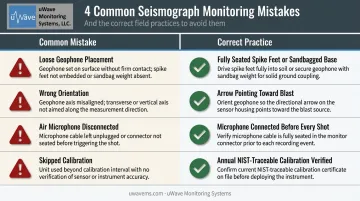
What to check before every deployment:
- Spike feet fully seated in soil, or geophone properly sandbagged on hard surfaces
- Arrow pointing toward the blast source
- Unit level (use the built-in bubble level)
- Sensor positioned at the structure's foundation, not in the middle of a field
Omitting Air Overpressure Measurement
Many operators monitor PPV but skip the air microphone — leaving an incomplete compliance record and missing the data most relevant to noise complaints and window-rattling calls.
Low-frequency airblast travels farther than ground vibration and can trigger community complaints even when PPV readings are well within limits. Most permits require both parameters. Submitting records with only one is a documentation gap that regulators will notice.
Common air overpressure oversights:
- Air microphone left disconnected at the instrument
- Microphone placed indoors or obstructed, distorting readings
- Records submitted without airblast data, even when the permit requires it
Skipping Calibration Checks
ISEE performance specifications require annual calibration, calibration before initial use, and recalibration after any repair that could affect sensor response. Calibration equipment must be traceable to NIST or equivalent. Ohio requires the most recent calibration date to appear in every blast record. Kentucky requires a calibration certification.
Using an uncalibrated unit puts every reading from that instrument at risk of challenge — in the field or in court. uWave Monitoring Systems includes calibration documentation with all rental units, but check the certificate date before deployment and flag any unit approaching its annual renewal deadline.
Conclusion
Done right, quarry vibration monitoring protects your operation across regulatory compliance, legal defensibility, and community relations. None of those protections hold without calibrated equipment, proper sensor placement, air overpressure data alongside PPV readings, and complete records for every blast event.
Treat your monitoring program as an engineering asset. Consistent, accurate data improves blast design over time, gives you the technical evidence to defend any claim, and builds a documented track record that regulators and neighbors both respond to.
The infrastructure to support this includes:
- Remote monitoring stations with solar power and cellular connectivity
- Automated alerts triggered by threshold exceedances
- Cloud-hosted data access for centralized recordkeeping and reporting
uWave Monitoring Systems provides field-to-cloud monitoring solutions — from Instantel seismograph rentals to fully managed remote stations — sized for quarry operations that need reliable data without full-time on-site staff.
Frequently Asked Questions
What is the standard for vibration monitoring in quarries?
The primary US federal standard is OSMRE's 30 CFR Part 816/817, which sets enforceable PPV limits based on distance from the blast to the nearest protected structure; ISEE field practice guidelines govern equipment requirements. Many states impose stricter limits — always check your site-specific permit conditions alongside federal minimums.
What are the methods of vibration monitoring?
Quarry vibration monitoring uses triaxial geophones to measure ground particle velocity on three axes, paired with a linear air microphone to capture air overpressure — both feeding a seismograph that records waveform data for each event. Modern systems add cellular connectivity for real-time cloud transmission and automated threshold alerts.
What is vibration monitoring in mining?
In mining and quarrying, vibration monitoring measures the ground motion and air pressure generated by blasting, drilling, and heavy equipment — primarily to protect nearby structures and demonstrate compliance with OSMRE and MSHA regulations. It produces timestamped waveform records that serve as the primary documentation for regulatory review.
What are the 4 types of vibration measured in quarry monitoring?
A triaxial geophone captures three ground motion components: transverse (side-to-side), vertical (up-and-down), and longitudinal (toward and away from the blast source). Air overpressure — measured simultaneously by a linear microphone in peak dB — is the fourth parameter and is required alongside PPV for a complete compliance record.
Where should the geophone be placed during quarry blast monitoring?
Place the geophone at or near the foundation of the nearest occupied structure in the direction of the blast, with the orientation arrow pointing toward the blast source. Drive spike feet fully into soil — on hard surfaces, secure the sensor under a sandbag — and avoid loose fill or positions behind a structure.
How do I know if a quarry blast exceeded a safe vibration limit?
The seismograph records peak PPV and air overpressure for each event; if either value exceeds the applicable OSMRE limit or your site-specific permit threshold, the event is an exceedance. Stop blasting, review the waveform data, document your findings, and notify your regulatory authority as required.