New York City's Department of Environmental Protection recently adopted a construction-noise rule, effective April 21, 2026, that requires mandatory noise-monitoring devices on qualifying job sites operating under Alternative Noise Mitigation Plans. That's the direction the entire industry is heading.
Manual spot-checks and aging equipment leave project teams exposed. A single missed exceedance, an unreadable data gap, or a broken sensor at the wrong moment can turn into a compliance violation, a legal dispute, or weeks of delay.
This guide breaks down what environmental monitoring equipment actually is, the main types available, how modern remote systems work, and how to choose the right setup for your next project.
Key Takeaways
- Regulatory pressure is rising nationwide, not just in major cities
- Vibration/seismic, sound/noise, and air overpressure monitoring cover most compliance needs
- Cloud-connected systems replace manual checks with 24/7 automated alerts and defensible records
- Rental vs. purchase decisions hinge on project length, phases, and budget
What Is Environmental Monitoring Equipment?
Environmental monitoring equipment refers to the sensors, data loggers, and software systems used to measure, record, and report environmental parameters, such as vibration, sound, and air quality, on or near an active project site. These systems capture raw physical data and turn it into timestamped records that regulators, insurers, and legal teams can rely on.
Demand for this equipment has grown right alongside stricter local and state environmental ordinances and rising community pushback near active job sites.
The global environmental monitoring market was valued at $14.4 billion in 2024 and is projected to reach $20.1 billion by 2030, growing at a 5.7% compound annual rate, according to Grand View Research. That growth reflects a broader shift: compliance documentation is now a core project requirement.
Core Components of a Modern Monitoring System
Every functional system, whether rented or purchased, breaks down into three parts:
- The sensor or transducer — Captures raw data, such as ground vibration (geophone) or sound and air overpressure (microphone). The Instantel Micromate ships with a triaxial geophone standard, plus an optional microphone add-on.
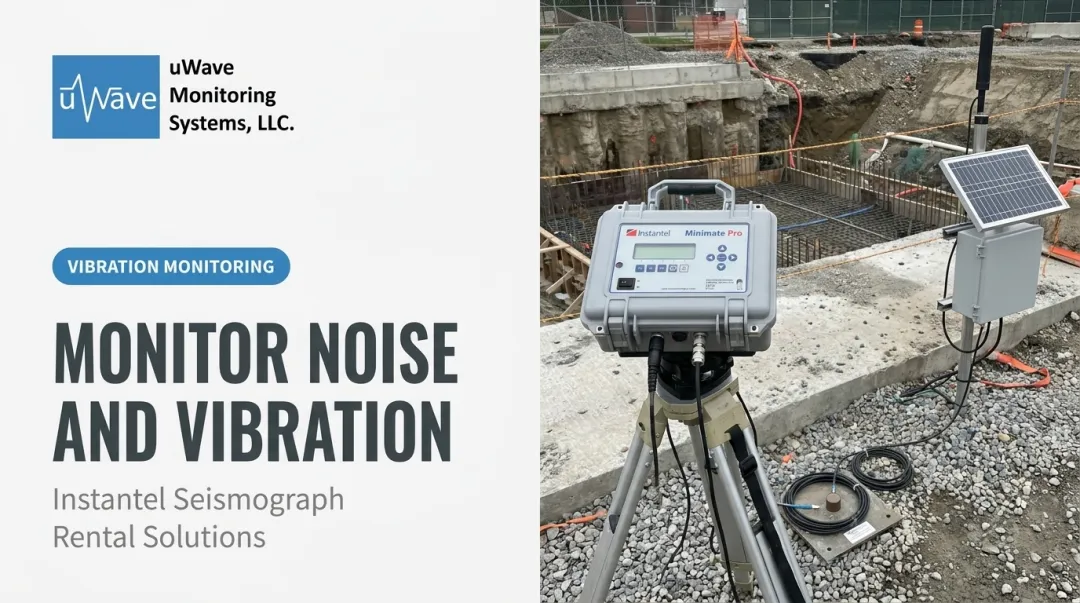
- The data logger/seismograph unit — Records and timestamps every reading on-site. Instantel's Micromate, Minimate Pro, and Blastmate III vary in channel count and sample rate, but each logs and timestamps every event.
- The communication and software layer — A cellular gateway (uWave uses Sierra Wireless AirLink hardware) sends readings to the cloud, giving teams real-time, 24/7 remote access instead of a hard drive to retrieve.
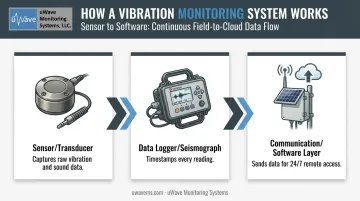
Together, these three layers turn a single vibration reading into a defensible, timestamped compliance record.
Types of Environmental Monitoring Equipment
Most environmental monitoring equipment on construction and mining sites falls into three main categories: vibration/seismic monitoring, sound/noise monitoring, and air-water-weather monitoring. Each addresses a different compliance risk, and many projects need more than one running simultaneously.
Vibration and Seismic Monitoring Equipment
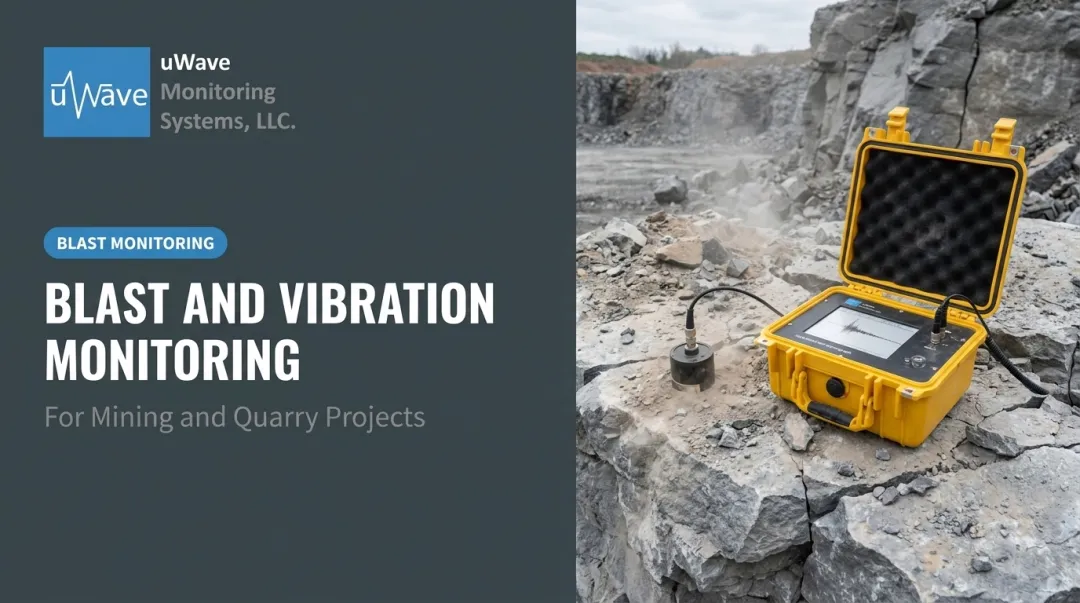
Seismographs measure ground vibration caused by blasting, pile driving, or heavy equipment operation. This matters because vibration is a leading cause of structural damage claims near active job sites, particularly in residential neighborhoods where foundations weren't built to handle repeated shock loads.
The industry commonly references benchmarks from the Federal Transit Administration's construction vibration criteria, which set peak particle velocity (PPV) limits based on building type:
| Building/Structure Category | Construction Damage Criterion (PPV) |
|---|---|
| Reinforced concrete, steel, or timber (no plaster) | 0.50 in/sec |
| Engineered concrete and masonry (no plaster) | 0.30 in/sec |
| Historic buildings, non-engineered timber or masonry | 0.20 in/sec |
| Buildings extremely susceptible to vibration damage | 0.12 in/sec |
Source: FTA Transit Noise and Vibration Impact Assessment Manual
Older projects also reference the U.S. Bureau of Mines' RI 8507 report, which established frequency-dependent PPV thresholds for residential structures. Both frameworks share the same goal: giving project teams a documented, defensible ceiling they can monitor against in real time.
Sound and Noise Monitoring Equipment
Decibel and noise monitors track construction or mining noise levels to keep projects compliant with local noise ordinances, especially near residential zones. Municipal limits vary widely. Some cities cap daytime construction noise around 75 dBA at the property line; others set equipment-specific limits at a fixed distance.
Instantel units like the Micromate and Minimate Pro4 pair a Type 1 sound level meter with the same instrument used for vibration monitoring, so teams get sound and vibration data from a single deployment instead of running two separate systems.
Air, Water, and Weather Monitoring Equipment
Dust and particulate monitors track fugitive dust from grading, excavation, and crushing operations, which is a common compliance requirement on land development and quarry sites. Water quality sensors track turbidity and discharge on projects involving dewatering, stormwater runoff, or water system upgrades.
Air overpressure monitoring, unlike water and weather sensing, is a standard capability on vibration seismographs. Every major Instantel model supports an overpressure microphone channel alongside its geophone, which is why most blasting and pile driving projects monitor vibration and air overpressure together rather than as separate systems.
How Remote Vibration and Sound Monitoring Systems Work
Modern systems follow a straightforward workflow, but the details matter for compliance defensibility.
- Capture — A seismograph or sound sensor placed at the monitored location, often outside the nearest residence or sensitive structure, continuously records vibration and decibel readings.
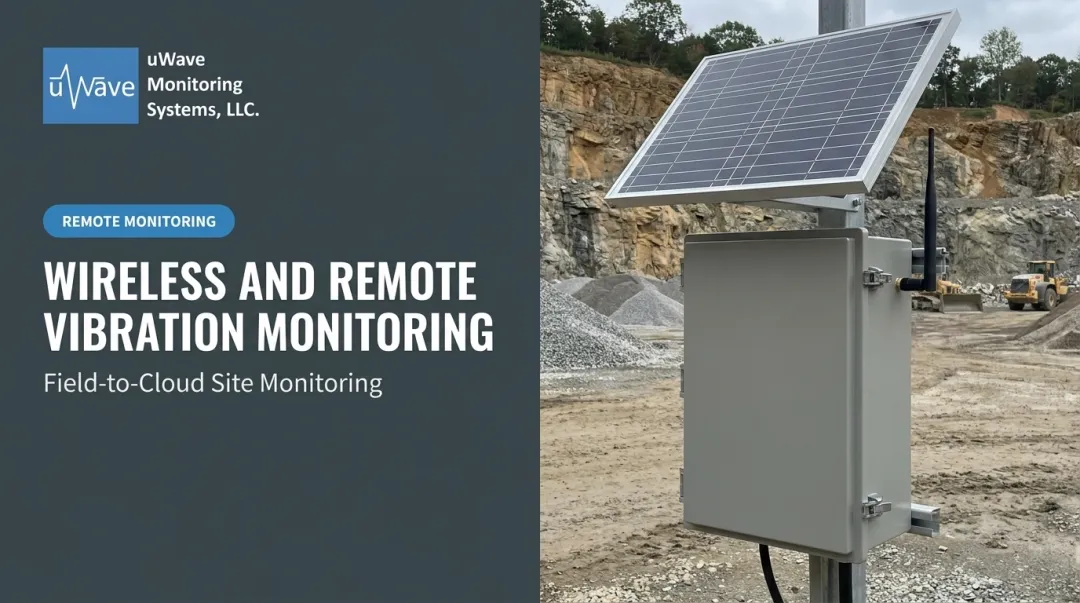
- Transmit — Readings move via cellular connection to a cloud-hosted platform. uWave's Field-to-Cloud approach uses a Sierra Wireless AirLink cellular gateway, housed in a solar-powered enclosure, to send data to the uWave Project Manager portal without anyone visiting the site.
- Alert — Automated email and text alerts notify project teams the moment readings approach or exceed set thresholds. Maintenance alerts also flag device issues, like low battery or lost cellular signal, before they create a data gap.
- Report — 24/7 web-based access lets project managers and compliance officers pull customized, timestamped reports for regulators or legal documentation from anywhere, no site visit required.
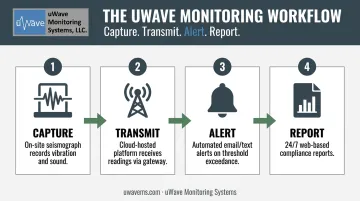
This workflow delivers real operational value. Automated remote monitoring:
- Cuts on-site labor by eliminating manual visits for readings
- Speeds up response time when readings creep toward a limit
- Builds a defensible data record for regulators or legal disputes
Instantel's own remote access documentation confirms that immediate alerts enable faster corrective action than periodic manual checks ever could.
Choosing the Right Environmental Monitoring Equipment
The right setup depends on what you're monitoring and why. A blasting operation, a pile driving job, and a quarry each carry different regulatory triggers and different parameters to track.
Start with the project type:
- Blasting near structures → vibration + air overpressure monitoring
- Pile driving in urban areas → vibration + sound monitoring
- Quarry operations → vibration, sound, and often dust monitoring
Rent or Buy?
- Rent for short-term or single-phase projects. uWave's rental fleet includes Micromate, Minimate Pro, and Blastmate III units, plus full remote monitoring stations, so you're not tying up capital.
- Buy for multi-phase or ongoing operations. A certified Micromate runs around $5,250, with extended discounts available on multi-unit purchases.
Whichever route you choose, equipment alone won't cover every scenario — site conditions dictate what kind of setup keeps instruments running reliably.
Site-Specific Planning
Remote or exposed sites need more than just an instrument. Weather exposure, limited cellular coverage, and power access all factor into enclosure design.
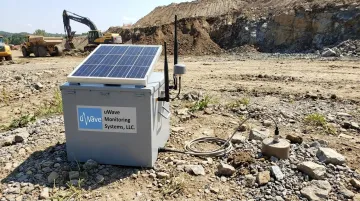
uWave's V3 and V5 monitoring stations pair a 30-watt solar module with a deep-cycle battery and cellular/GNSS antennas. They're built specifically for semi-permanent outdoor deployment where running power lines isn't practical.
Industries That Rely on Environmental Monitoring Equipment
Several industries depend on this equipment as a standard part of doing business near people and structures:
- Heavy construction — general building, demolition, and excavation near existing structures
- Mining and quarrying — blasting, crushing, and hauling operations
- Water infrastructure and system renewal — pipeline replacement, dewatering, and utility upgrades
- Urban and suburban development — housing and land development near residential zones
- Transit projects — tunnel boring and underground construction beneath active neighborhoods
Consider a typical scenario: controlled blasting for sewer or utility work near a residential subdivision. Crews conduct pre-blast inspections to document existing conditions, then run seismographs during every blast to confirm ground vibration and air overpressure stay under agreed limits.
That record protects both the contractor and the homeowners if a damage claim surfaces later.
Compliance monitoring obligations extend well beyond blasting sites, too. Construction projects disturbing significant ground area commonly face stormwater and environmental permitting requirements.
That's one reason monitoring equipment demand keeps climbing across nearly every heavy-construction sector.
Why Partner with uWave Monitoring Systems
uWave Monitoring Systems specializes in Instantel seismograph rental, sales, and service, along with fully designed remote monitoring systems for construction, mining, and infrastructure clients across North America. As a small business focused entirely on this niche, uWave builds systems around the project rather than pushing a one-size-fits-all package.
What sets uWave apart:
- Complete remote monitoring system rentals: seismograph, cellular gateway, enclosure, and cloud access as one package
- Custom enclosure design: solar-powered V3 and V5 stations built for remote, weather-exposed sites
- Web-based data hosting with automated alerts: the uWave Project Manager platform handles email/text alerts, maintenance alerts, and customized reporting
- Remote communications consulting: guidance on modem compatibility, cabling, and connectivity planning before equipment ever ships
The practical payoff: 24/7 project access, secure data backup, and bulk/multi-unit discounts that help teams stay compliant without blowing the equipment budget on a single project.
Frequently Asked Questions
What is monitoring equipment?
Monitoring equipment refers to sensors, loggers, and software that measure and record physical conditions over time. In environmental applications, this typically means tracking vibration, sound, and air overpressure on project sites.
What are the three main types of monitoring equipment?
The three main categories are vibration/seismic monitoring, sound/noise monitoring, and air overpressure monitoring. Most construction and mining projects rely on all three, often running simultaneously on the same instrument.
What is the most commonly used monitoring device?
Seismographs and sound level meters are among the most widely used devices on construction, mining, and quarry sites. Blasting and heavy equipment operation both create compliance obligations that these instruments are built to satisfy.
Do I need environmental monitoring equipment for compliance on construction projects?
Most blasting, pile driving, and demolition work near structures or residential areas falls under local vibration or noise limits. These limits typically require documented, timestamped monitoring, not just a visual inspection.
Should I rent or buy environmental monitoring equipment?
Rentals suit short-term or single-phase projects where you don't want equipment sitting idle afterward. Purchasing benefits ongoing operations, especially since multi-unit discounts make ownership more cost-effective over time.
Can environmental monitoring equipment be monitored remotely?
Yes. Modern systems use cellular-connected cloud platforms to deliver real-time data, automated alerts, and compliance-ready reports accessible 24/7 from any location, no site visit required.